
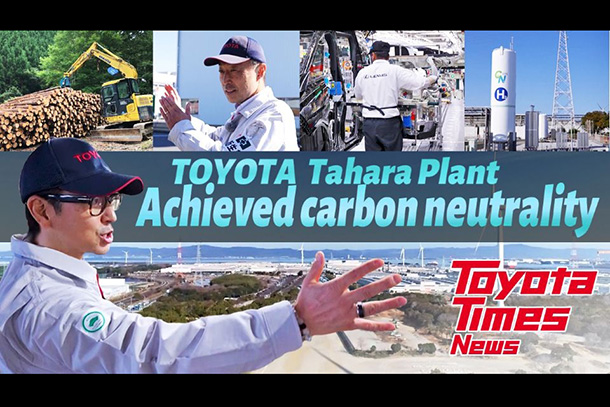


Toyota’s Tahara Plant, a 4.03-million-square-meter sprawl in Aichi Prefecture employing roughly 9,000 workers, has become the first factory in the company’s global network to claim carbon neutrality. The announcement, made for fiscal year 2026, is the kind of milestone that sounds transformative on paper. The details tell a more complicated story.
Tahara is one of Toyota’s largest production sites in Japan. Getting a facility that size to net-zero emissions is no small engineering feat, and the company deployed some impressive hardware to get there. Wind turbines standing 145 meters tall, among the biggest in the country, and approximately 1,200 solar panels lining the plant’s test course.
But the fine print matters. Toyota’s definition of carbon neutrality here covers only greenhouse gas emissions generated by vehicle production activities within the Tahara Plant premises. That’s a narrow boundary.
It excludes the upstream supply chain, the energy embedded in raw materials, the logistics of shipping parts in and vehicles out, and of course the tailpipe emissions of every car that rolls off the line. This is not unusual. Most automaker carbon-neutrality claims at the plant level draw similar boundaries.
But Toyota, the world’s largest automaker by volume and a company that has been openly skeptical of a rapid all-EV transition, invites a different kind of scrutiny.
The “unavoidable emissions” that couldn’t be eliminated through engineering were balanced through “absorption and removal efforts” like forest management. Toyota didn’t specify how much of Tahara’s neutrality comes from actual emission reductions versus offsets. That ratio is everything.
A plant that cut 90 percent of its emissions and offset the rest is a fundamentally different achievement than one that cut 40 percent and bought credits for the balance.
Toyota leaned heavily into the human element, branding the effort “One Tahara” and emphasizing that every employee played a role. “The entire plant came together as one team,” a staff member said. The kaizen philosophy — continuous, ground-level improvement — is deeply embedded in Toyota’s DNA, and there’s no reason to doubt that small-bore process changes contributed real reductions alongside the big renewable energy installations.
Still, one plant out of dozens worldwide is a starting point, not a finish line. Toyota operates major production facilities across Japan, North America, Europe, and Southeast Asia. Tahara may be the template, but replicating wind turbines and solar arrays at every site depends on local geography, grid infrastructure, and regulatory frameworks that vary wildly.
The timing is also worth watching. Toyota has faced years of criticism from environmental groups and investors who argue the company has dragged its feet on electrification while lobbying against stricter emissions regulations. A carbon-neutral factory is a tangible, photogenic counter to that narrative. It is also, by Toyota’s own framing, limited to production emissions at a single site.
For context, rivals aren’t standing still. Volvo has claimed carbon-neutral manufacturing at its Torslanda plant since 2021. BMW’s Leipzig facility has run on wind power for over a decade. The race to decarbonize factories is real, but it’s also become a PR battleground where definitions do a lot of heavy lifting.
Tahara’s achievement is genuine progress for a company that builds more than 10 million vehicles a year. The wind turbines are spinning. The solar panels are generating. Nine thousand workers pulled together under a single banner, and that deserves recognition.
But carbon neutrality scoped to one factory’s gate, with unspecified offset ratios, from a company still betting heavily on internal combustion and hydrogen, is a chapter — not the whole book. The question now is whether Tahara becomes a blueprint Toyota replicates aggressively across its global footprint, or a showcase it points to while the rest of the empire runs on business as usual.



Share this Story