
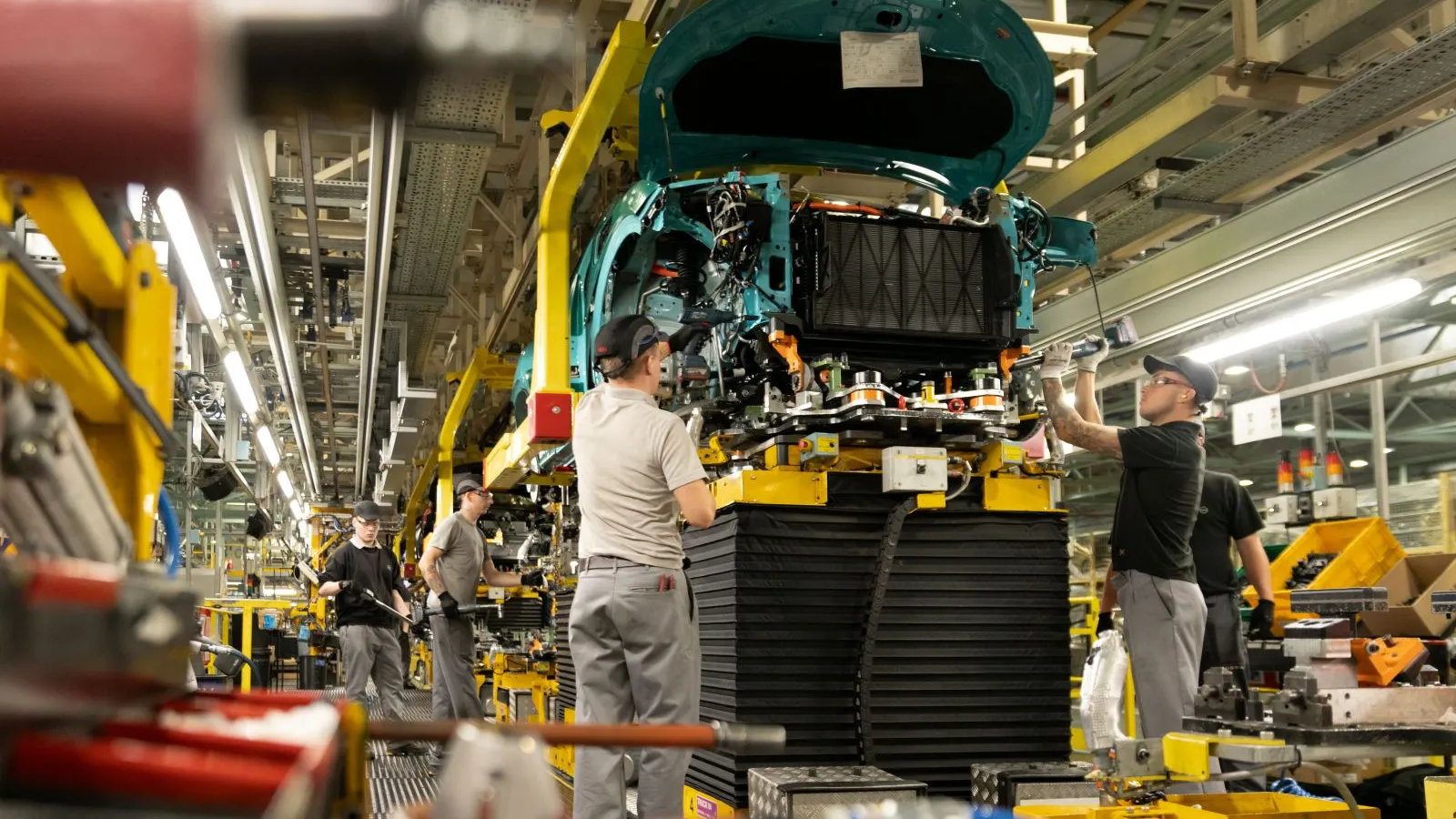


Nissan has scrapped plans to manufacture electric vehicle powertrains at its Sunderland plant in northeast England, canceling a 48.7 million euro ($65.4 million) supplier investment that was supposed to anchor the factory’s electric future.
The company’s transmission subsidiary, Jatco, had planned to build a 138,840-square-foot production facility to supply 3-in-1 EV powertrains for two new battery-electric models — the electric Qashqai and the electric Juke. Both were expected to be built at Sunderland. Both now look increasingly unlikely.
A Nissan spokesperson confirmed the cancellation to WardsAuto after Japan’s Nikkei first reported the decision, saying the move came out of the RE:Nissan global turnaround strategy. That restructuring plan calls for cutting 20,000 jobs worldwide and shuttering seven production plants by 2027. “As part of this, the decision has been taken not to localize production of 3-in-1 electric vehicle powertrain to the U.K.,” the spokesperson said.
Just five months ago, on Jan. 16, Nissan had publicly touted the Sunderland expansion as a path forward. The Jatco facility was pitched as a creator of 183 high-skilled jobs in one of England’s most economically deprived regions. That promise evaporated fast.
The cancellation doesn’t just kill a parts factory. It undercuts the entire logic of building electric Qashqais and Jukes at Sunderland. On-site powertrain production was the economic backbone of those vehicle programs, and without it, the cost case for assembling those EVs in the U.K. gets considerably harder to make.
Nissan has been in full retreat on electrification commitments across multiple markets. In May, it canceled two electric SUVs that had been planned for the U.S. market. The pattern is unmistakable: a company that once positioned itself as an EV pioneer with the Leaf is now tearing apart the infrastructure meant to carry that legacy forward.
The Sunderland plant has been Nissan’s U.K. manufacturing hub since 1986, employing thousands of workers and serving as a bellwether for British automotive confidence, particularly in the post-Brexit era. The plant survived the uncertainty of Britain’s departure from the European Union, and Nissan repeatedly reassured the U.K. government it remained committed to the site.
This latest reversal tests that commitment in a very concrete way. Without EV powertrains and without confirmed EV models, Sunderland’s long-term relevance in Nissan’s shrinking global footprint becomes an open question rather than an assumed answer.
Nissan recently named a new CFO as part of its turnaround leadership shuffle, and the company has been leaning harder into its e-Power hybrid technology for near-term models like the 2027 Rogue. Hybrids are cheaper to build, easier to sell, and don’t require the kind of dedicated powertrain infrastructure Nissan just abandoned in Sunderland.
The math is brutal but straightforward. A company hemorrhaging cash and closing factories isn’t going to invest tens of millions in localized EV production for a market where consumer demand hasn’t materialized at the pace everyone predicted three years ago.
Northeast England, once again, absorbs the hit. The 183 jobs that were coming aren’t. The electric Qashqai and Juke that were supposed to secure Sunderland’s next chapter may never arrive, and a turnaround plan built on contraction has claimed another piece of the future Nissan used to promise.


Share this Story