
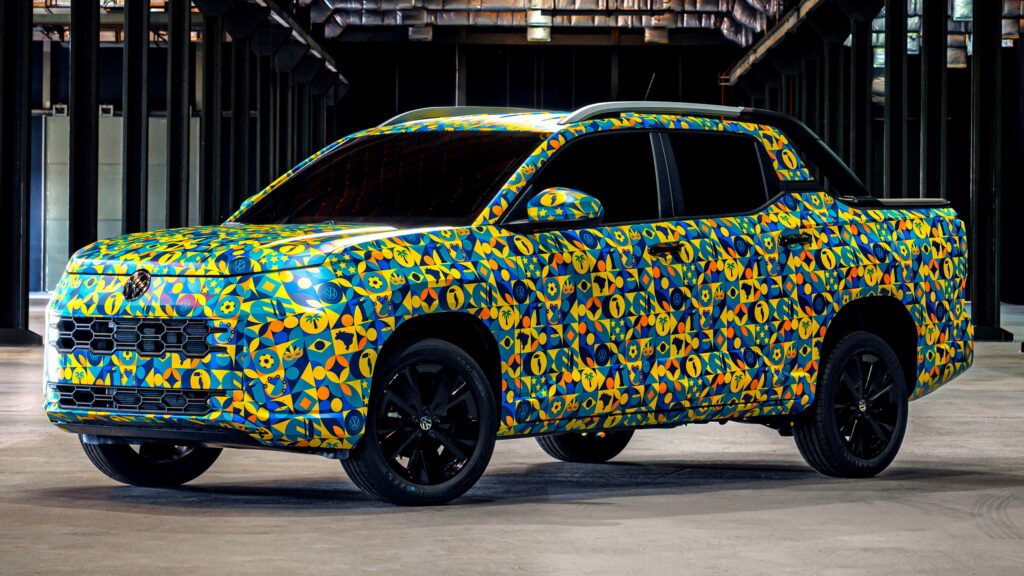


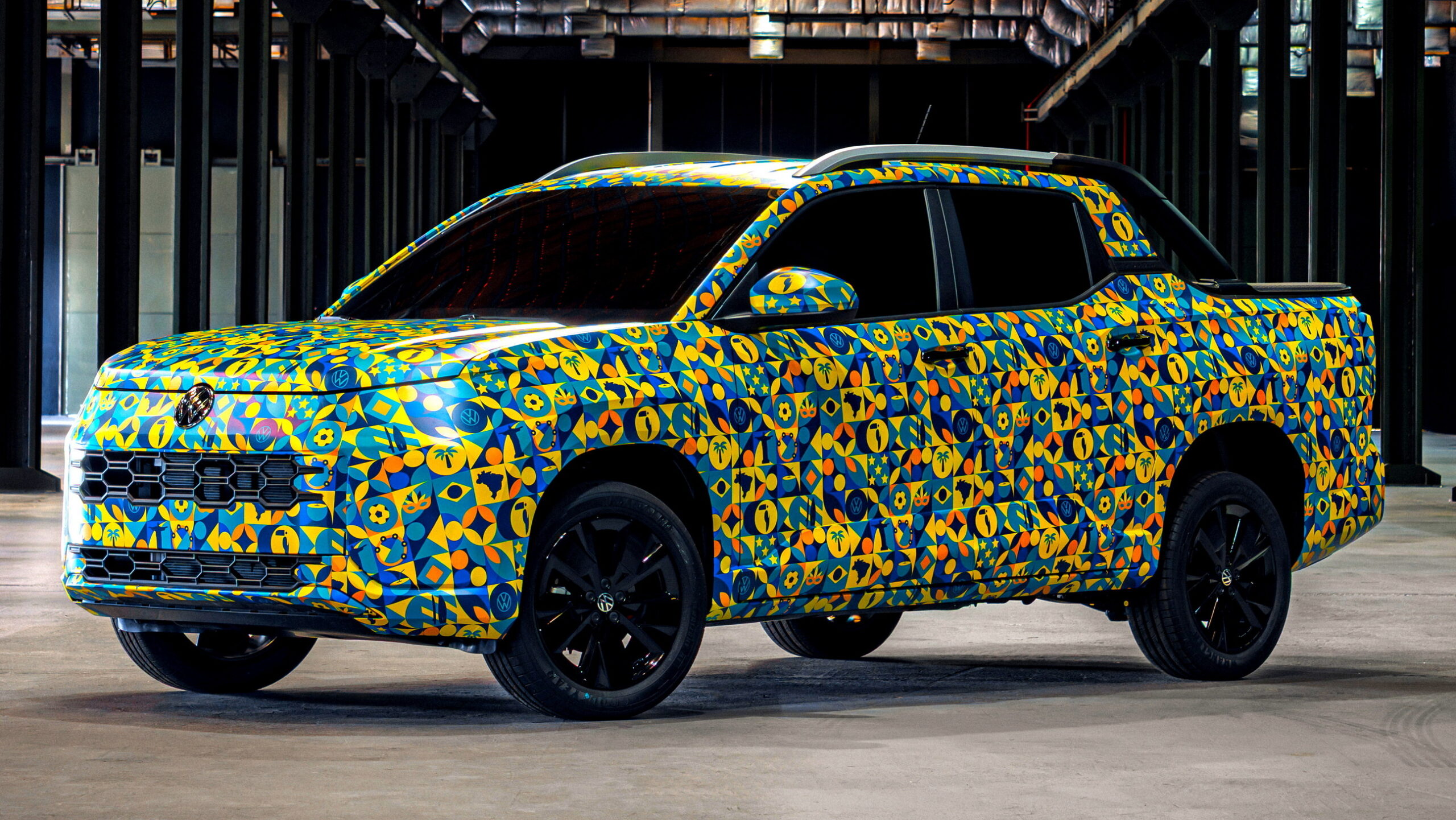
Volkswagen just parked a camouflaged pickup truck next to Carlo Ancelotti in Rio de Janeiro, timed perfectly to Brazil’s 2026 World Cup roster announcement. Subtlety has never been VW’s play in South America, and the Tukan is no exception.
The compact unibody pickup, draped in wrap featuring VW logos, the Brazilian flag, and a soccer ball, is aimed squarely at the segment Fiat has owned for years with the Strada and Toro. Its proportions tell the story immediately: short hood, dual cab, stubby bed. It looks less like a work truck and more like a T-Cross that got conscripted into hauling duty.
That impression isn’t entirely wrong. The Tukan rides on a modified version of VW’s MQB platform, sharing bones with the T-Cross crossover. But the engineering underneath the bed tells a different story.
VW ditched the torsion beam axle and coil springs from the aging Saveiro and went instead with a rigid rear axle and semi-elliptical leaf springs. That’s a deliberate choice, one that trades refinement for payload capacity. It’s the same formula Fiat uses on the Strada, and it signals VW is done pretending a crossover-based truck can get away with crossover suspension when buyers need it to actually carry things.
Up front, sharp LED headlights and a honeycomb bumper intake borrow from the European T-Roc. Sculpted fenders, generous ground clearance, and roof rails flowing into a sport bar give it enough visual aggression to hold its own on a dealer lot next to the Chevrolet Montana and the Renault Niagara, which was teased just days ago.
Powertrain details remain unconfirmed, but a mild-hybrid turbocharged 1.5-liter four-cylinder is the expected headliner. An entry-level turbo 1.0-liter three-cylinder will likely anchor the bottom of the lineup, keeping the price accessible in a market where affordability determines volume.
The Tukan is part of a broader offensive. VW has pledged 21 new models for Latin America by 2028, and this truck is one of the linchpins. It will be assembled at VW’s São José dos Pinhais plant in Paraná state with roughly 76 percent local content, a number that matters enormously for tax incentives and pricing in Brazil.
The full reveal is expected during the World Cup this summer, with sales following shortly after. VW’s sponsorship of the Brazilian national team gives it a marketing runway most competitors can only envy.
The competitive landscape is fierce. Fiat’s Strada has been the small pickup king in Brazil for years, and the Toro carved out a premium niche above it. The Chevrolet Montana arrived with GM’s global small-vehicle architecture, and now Renault is jumping in with the Niagara. Every major player wants a piece of a segment that barely registers in North America but moves serious volume south of the equator.
VW’s bet is that MQB versatility, paired with purpose-built rear suspension and hybrid efficiency, can crack a market where Fiat wrote the rules. The Saveiro, ancient and overdue for replacement, proved VW could sell small trucks in Brazil. The Tukan needs to prove VW can sell modern ones.
Wrapping the prototype in national team colors and debuting it alongside the World Cup squad is theater, not engineering. But in Brazil, where soccer and pickups both qualify as religion, it might be exactly the right kind of theater.

Share this Story