
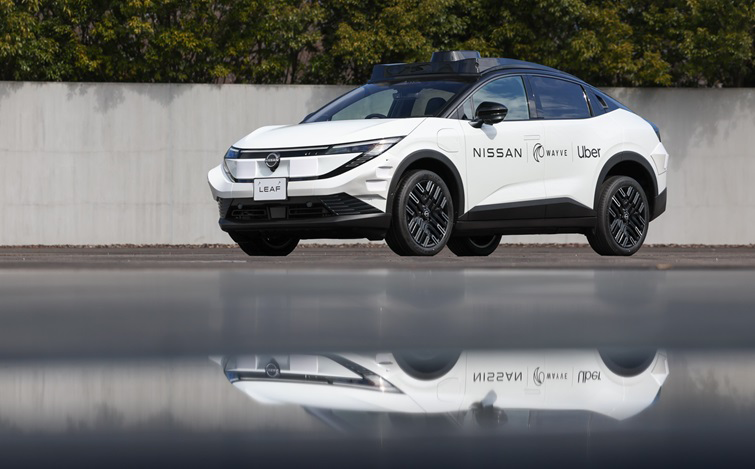


A Nissan LEAF — the aging EV that launched a thousand punchlines about range anxiety — is about to get a second life as a self-driving taxi on the streets of Tokyo. Uber, Nissan, and British AI startup Wayve announced a three-way collaboration this week to deploy robotaxis in one of the world’s most unforgiving urban driving environments, with a pilot planned for late 2026.
The deal, formalized as a memorandum of understanding, puts Wayve’s end-to-end AI driving system inside Nissan’s electric hatchback and routes passengers through Uber’s ride-hailing app. It is Uber’s first autonomous vehicle partnership in Japan, and it slots into a broader Wayve-Uber global rollout targeting more than ten cities, with London expected to go first.
A safety driver will sit behind the wheel during the initial phase. Uber plans to operate the service through a licensed local taxi partner it has yet to select. The regulatory path remains unfinished — the announcement is explicitly “subject to discussions with relevant authorities.”
That Tokyo is the chosen proving ground says a lot about ambition and very little about ease. The city’s narrow lanes, byzantine intersections, hyper-polite but assertive driving culture, and pedestrian density make it a nightmare for any autonomous system trained primarily on Western roads. Wayve CEO Alex Kendall noted the company has been testing in Japan since early 2025, building experience in what he called “the country’s unique road environments.” Unique is one word for it.
Wayve’s pitch is that its AI learns from real-world driving data and generalizes to new cities without relying on pre-built HD maps. That’s the crucial differentiator from competitors like Waymo and Cruise, which have historically leaned on painstakingly detailed mapping. If Wayve’s approach works at scale in Tokyo, it would validate a fundamentally cheaper and faster expansion model. If it doesn’t, the mess will be very public.
For Nissan, this collaboration is a lifeline dressed up as innovation. The automaker has been hemorrhaging market share and recently underwent leadership upheaval, with Ivan Espinosa stepping in as CEO. Espinosa told reporters the companies are already discussing whether to extend the partnership beyond Japan.
Nissan’s consumer vehicle work with Wayve — a next-generation ProPILOT driver-assistance system slated for financial year 2027 — laid the groundwork here. But plugging your sedan into someone else’s autonomy stack is a very different proposition from building your own.
Wayve, for its part, has deep-pocketed backers in SoftBank and Nvidia, which gives it runway. The startup partnered with Uber in August 2024 and has been aggressively positioning itself as the autonomous driving brain that any automaker can license. That platform play mirrors what Mobileye tried to do a decade ago with advanced driver assistance — except at a far higher level of autonomy and risk.
Uber CEO Dara Khosrowshahi framed Japan as “a critical market where innovation can help address driver shortages.” He’s not wrong. Japan’s taxi industry is graying fast, and the country has been more open to autonomous vehicle trials than its regulatory reputation might suggest. But openness to trials and openness to full commercial deployment are very different things in a nation that still runs much of its bureaucracy on fax machines.
The prototype LEAF-based robotaxi got its first public showing alongside the announcement. No specs on sensor suites or compute hardware were disclosed. The three companies offered vision statements and handshakes. What they did not offer was a timeline for removing the safety driver, a revenue model, or a fare structure.
Memorandums of understanding are the business world’s version of a first date. Everyone smiles for the photo. The real test comes when the LEAF has to merge into Shibuya traffic at rush hour — alone.

Share this Story