
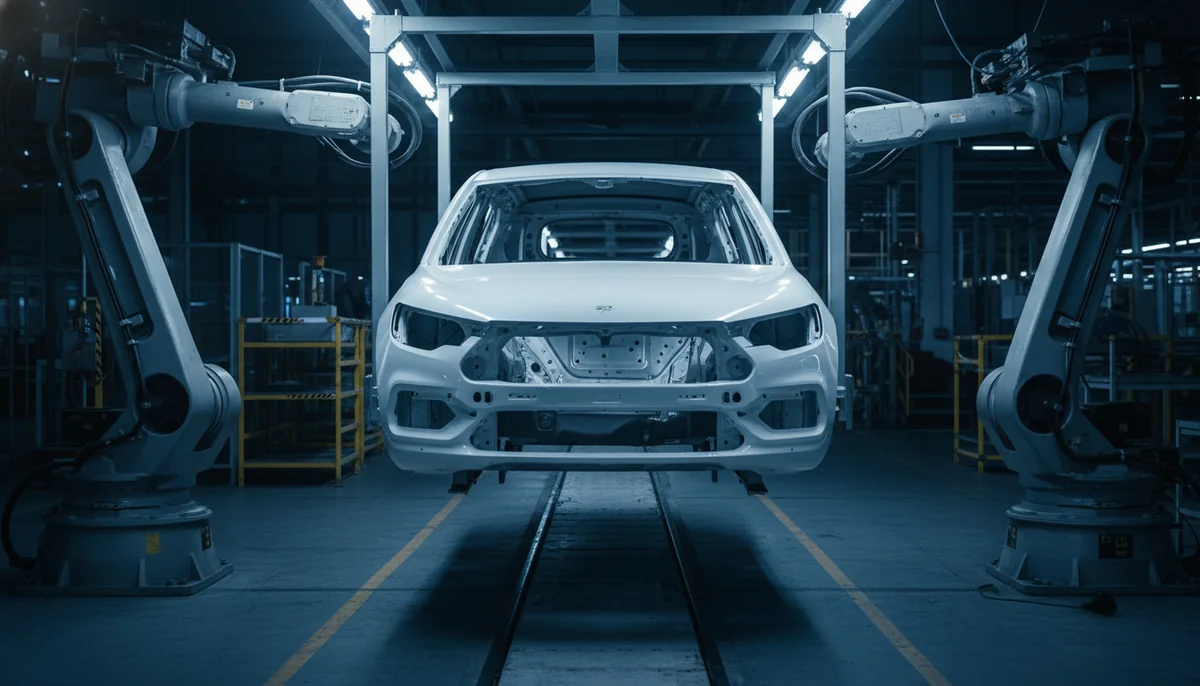


Stellantis is preparing to turn over an entire assembly plant near Madrid to a joint venture controlled in part by a Chinese automaker. That single detail, buried in a dense press release issued Thursday, tells you more about the state of European carmaking than any earnings call this year.
The plan, announced jointly by Stellantis and Hangzhou-based Leapmotor, would transfer ownership of the Villaverde plant in Madrid to the Spanish subsidiary of Leapmotor International, the 51/49 joint venture Stellantis set up in late 2023. New Leapmotor models would roll off that line potentially by early 2028, destined for European and Middle East markets, built to satisfy Made-in-Europe requirements.
That is not a supplier deal. That is not a licensing agreement. That is a European legacy automaker handing factory title to a venture half-owned by a Chinese EV company that didn’t exist before 2015.
It gets deeper. At the Figueruelas plant in Zaragoza — the historic Opel facility where more than 10 million Corsas have been assembled since 1982 — Leapmotor’s C-SUV B10 could enter production as early as this year. A new Opel C-SUV BEV would follow on a separate line, potentially starting in 2028. That Opel would be built using components sourced through the Leapmotor International ecosystem, a polite way of saying Chinese-origin parts selected for cost competitiveness.
Stellantis CEO Antonio Filosa called the arrangement “a true win-win.” Leapmotor founder Zhu Jiangming praised the combination of his company’s “leading-edge technologies” with Stellantis’ “deep regional roots and much-loved automotive brands.” The language is diplomatic. The math is not.
Leapmotor International has already shipped more than 40,000 vehicles into Europe in 2025, built a network exceeding 850 points of sale and service, and expanded into South America, Asia-Pacific, the Middle East, Africa, and Mexico. In under three years, a brand virtually unknown outside China now operates on five continents with Stellantis infrastructure doing the heavy lifting.
The joint purchasing component may be the most consequential piece of the puzzle. Stellantis and Leapmotor plan to use their combined scale to tap China’s new energy vehicle supply chain — batteries, motors, electronics — while maintaining enough European sourcing to claim supply chain resilience. The goal is to push BEV prices low enough to move metal in a European market that has resisted expensive electric cars.
This is Stellantis admitting what the spreadsheets have been screaming: its European BEV lineup cannot compete on price without Chinese technology and Chinese supply chains baked directly into the product. The Citroën C4 is winding down at Villaverde with no obvious Stellantis replacement. Figueruelas needed volume. Leapmotor provides both.
For European industrial policy, the implications are thorny. Brussels has spent the last two years slapping provisional tariffs on Chinese-built EVs to protect domestic manufacturing. Stellantis is now routing around those barriers by building Leapmotor vehicles inside Europe, on European soil, with European workers — and calling it localization.
The parties stress that feasibility studies are ongoing and definitive agreements have not been signed. Regulatory approvals are still required. The usual caveats apply.
But the direction is unmistakable. Stellantis is not partnering with Leapmotor the way Detroit partnered with Japanese firms in the 1980s, bolting on a few shared platforms while keeping the core business intact. It is weaving a Chinese EV company into the fabric of its European manufacturing base — its plants, its supply chain, its brand engineering.
The question is no longer whether Chinese automakers will build cars in Europe. It is whether European automakers can build competitive electric cars without them.

Share this Story