
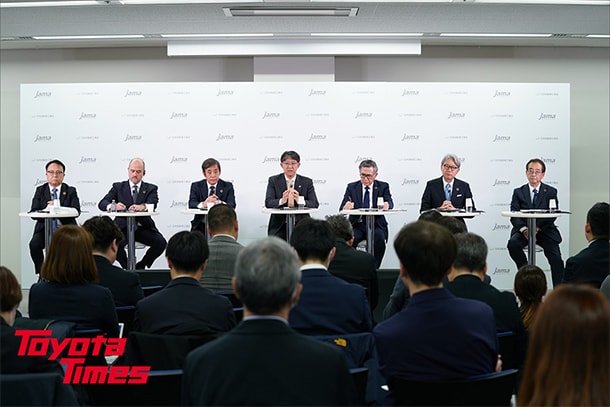


Fourteen automakers walked into a room and admitted something Japanese industry almost never says out loud: going it alone is no longer working.
At its first press conference under new Chairman Koji Sato on March 19, the Japan Automobile Manufacturers Association laid out a blunt assessment. The competitive model that built Japan’s automotive dominance over decades — each company clawing for advantage independently — has hit a wall. Decarbonization, fractured supply chains, geopolitical landmines, and resource scarcity are problems too big for any single nameplate to solve.
JAMA’s answer is a framework called the New Seven Priority Challenges, adopted in December and now entering what the association calls “full implementation” under Sato’s leadership, which began in January. The priorities were visualized in circular progress charts at the conference, showing several areas already moving past the talking stage.
Sato, who also serves as Toyota’s president, drew a sharp line between JAMA’s past and its intended future. The association had been “largely reactive,” he said, built around whatever individual companies happened to be doing. The new model demands intentional collaboration — identifying specific areas where rivals must work together and committing to them over years, not quarters.
Three principles anchor the effort: co-creation beyond the auto sector, a focus on real-world implementation rather than white papers, and leveraging the diversity of JAMA’s membership. That last point matters. JAMA’s 14 members span cars, trucks, motorcycles, and broader mobility — a breadth Sato called “truly unique” and a potential competitive weapon.
Vice Chairman Toshihiro Suzuki, head of Suzuki Motor, pointed to early wins. Under JAMA’s previous framework, the association had started talking seriously with the petroleum industry about clean energy pathways. Those conversations, he said, moved past pleasantries into substantive problem-solving — the kind of cross-industry dialogue Japan historically struggles with.
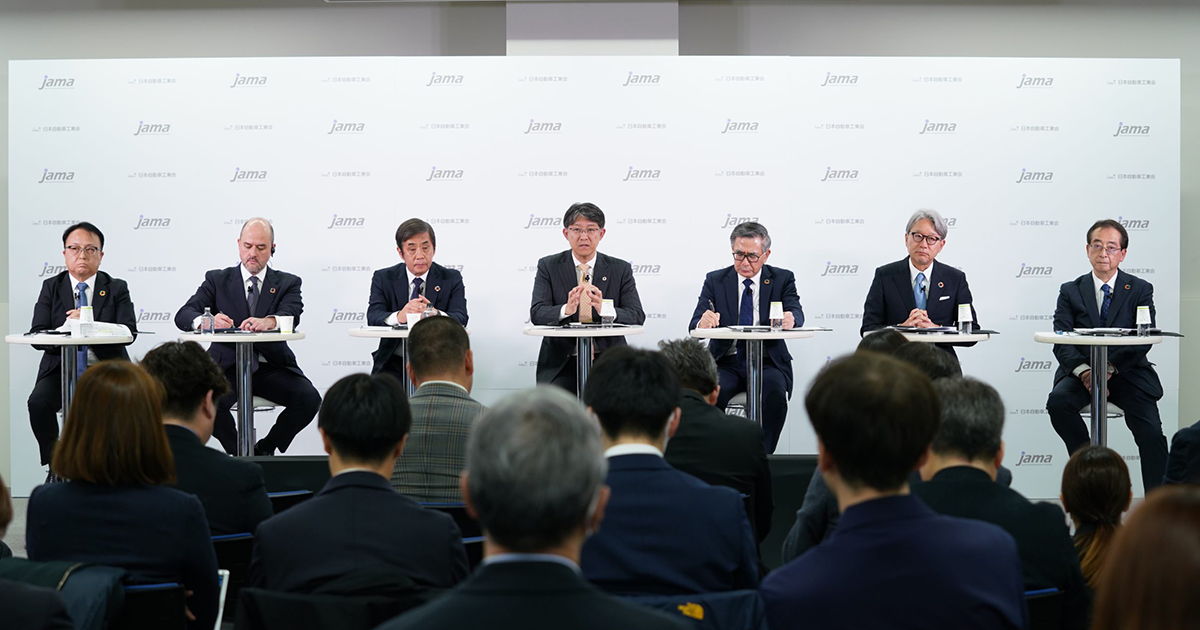
The sharpest words came from Vice Chairman Toshihiro Mibe, Honda’s chief. He said flatly that new competitiveness “cannot emerge without breaking away from legacy structures.” In a country where legacy structures are practically sacred, that sentence landed with weight. Mibe framed the moment as existential: “How quickly we can move forward will be key to survival.”
The backdrop here is impossible to ignore. Japanese automakers are caught between a Chinese EV onslaught, tightening European emissions rules, and an American tariff regime that shifts with every news cycle. Meanwhile, Japan’s domestic market continues to shrink. The old playbook — build better internal combustion engines, protect domestic turf, export relentlessly — is being rewritten by forces outside any single boardroom’s control.
What JAMA is attempting is a structural pivot for an industry that employs 5.5 million people in Japan and anchors the national economy. Collaboration between bitter rivals on supply chains, energy infrastructure, and technology standards is the stated goal. Whether Toyota, Honda, Nissan, Suzuki, and the rest can actually suppress decades of competitive instinct long enough to pull it off is the open question.
Sato acknowledged the tension directly, noting that differences in assumptions and strengths among member companies make alignment on shared goals essential — and difficult. The diplomatic phrasing barely disguises the reality: getting fourteen automakers to agree on anything beyond the color of the conference room walls has always been a monumental task.
JAMA’s press conference was heavy on frameworks and light on specific deliverables. No dollar figures. No joint venture announcements. No timelines with teeth. The circular progress charts showed movement, but circles have a way of going nowhere.
Still, the rhetoric marks a genuine departure. Japanese automakers publicly conceding that competition alone is insufficient represents a philosophical shift decades in the making. The industry built its global reputation on the relentless pursuit of individual excellence. Now its leaders are standing at a podium saying that excellence, by itself, is no longer enough.
Whether action follows words will determine if Japan’s auto industry writes its next chapter or becomes a cautionary tale about the cost of moving too slowly in a world that no longer waits.

Share this Story