
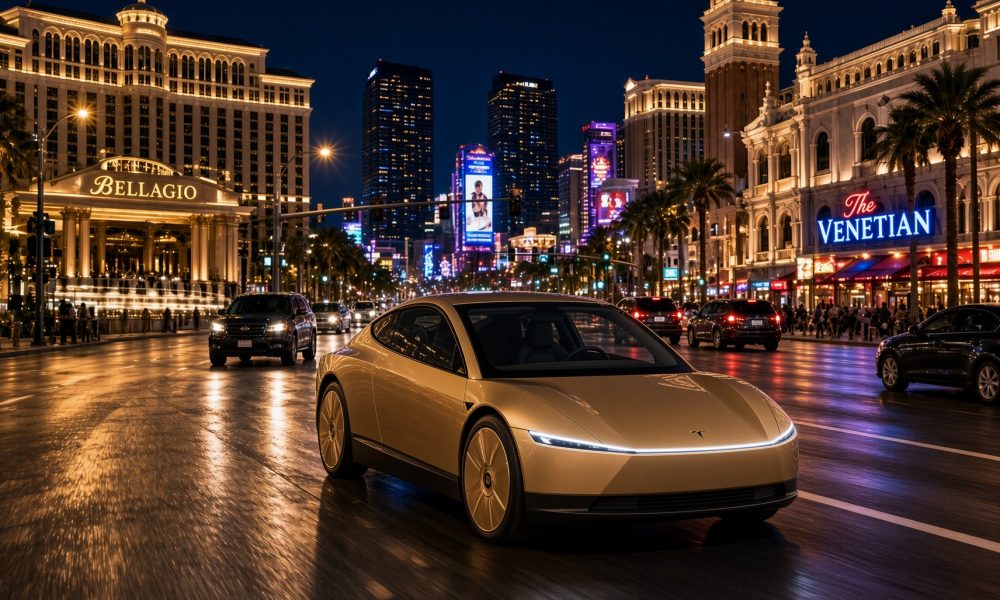


Tesla got its Nevada robotaxi permit. It just didn’t get the one it asked for.
The Nevada Transportation Authority approved Tesla Robotaxi, LLC to operate autonomous vehicles in Clark County, with the permit now listed as active in the state’s carrier registry under Docket 26-05015. The company filed in June requesting authority to run up to 5,000 vehicles within a year. The NTA handed back a cap of ten.
Ten cars. On a geofence along the Las Vegas Strip corridor. With a 45 mph speed limit ceiling, mandatory “Robotaxi” markings on every vehicle, and a requirement for “appropriate human supervision” that suggests Nevada won’t let Tesla ditch safety monitors anytime soon.
Pickups within a quarter mile of Harry Reid International Airport need separate authorization. Every accident, system failure, or stranded vehicle must be reported within five business days. The gap between what Tesla wanted and what it received is wide enough to drive a Cybercab through.
The restrictions read tighter than what Tesla currently operates in Austin, where its supervised robotaxi service has been running since January. Nevada clearly took notes from that deployment and decided to write its own rules.
The state has reason to be cautious and reason to be confident in its own playbook. Zoox, Amazon’s robotaxi subsidiary, has been running under a Nevada autonomous vehicle permit since last year. It has scaled to roughly 100 vehicles and logged around 350,000 rides on the Strip.
That progression from small pilot to meaningful fleet gives the NTA a working template: prove safety at low volume, then earn your way to expansion. Every increase in fleet size or operating area requires the agency’s explicit approval.
Tesla is the second company through Nevada’s door, not the first. And regulators treated it accordingly.
The timing complicates things further. Tesla has publicly stated it won’t meaningfully scale its robotaxi fleet anywhere until FSD v15 ships, a software milestone expected in late 2026 or early 2027. That makes the ten-vehicle cap less painful than the headline suggests, because Tesla probably wasn’t planning to flood Las Vegas with autonomous cars this summer anyway.
The permit is a legal foothold, not an operational launchpad.
Still, the contrast between Tesla’s ambitions and Nevada’s caution tells a familiar story. Tesla habitually asks for the moon and negotiates from there. Regulators habitually respond with measured skepticism.
In Austin, that dynamic played out with a supervised service that Elon Musk once promised would be fully driverless. In Nevada, it’s playing out before a single ride has been completed.
The permit application first surfaced alongside plans for a maintenance hub in southwest Las Vegas, signaling Tesla’s long-term intentions for the market. But long-term intentions and near-term permissions are two different currencies, and the NTA is clearly more interested in the latter.
What Tesla now holds is permission to prove itself, not permission to compete. Zoox already has a 100-vehicle head start and a track record the regulator can measure. Tesla has ten parking spots and a software update it hasn’t shipped yet.
Whether Tesla begins Nevada rides before FSD v15 arrives remains unanswered. The permit grants the right. The technology has to deliver the rest.
Share this Story