
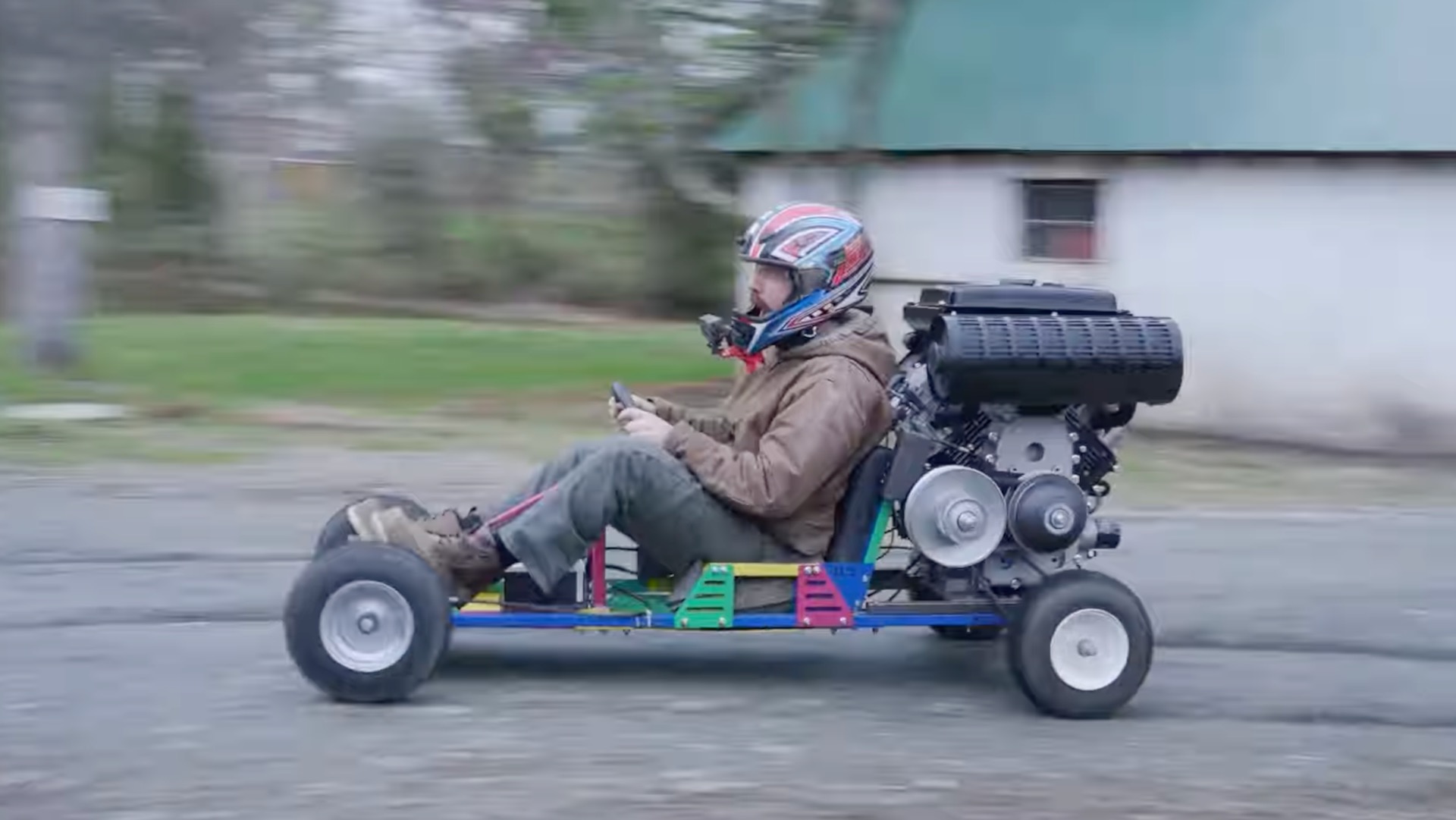


Two grand on AliExpress gets you a 1,300cc V-twin diesel engine that weighs 244 pounds, makes 26.8 horsepower, and arrives months late in a crate with holes in the cardboard. The YouTubers at CarsandCameras bought one anyway and bolted it into a go-kart, because the internet still rewards the beautifully insane.
The engine is designated the 2V98FDE, a model number that sounds like it was generated by the same algorithm that names Chinese industrial pumps. It revs to a dizzying 3,600 rpm and cost exactly $1,999.73 at checkout. The specs printed on the AliExpress listing, the shipping crate, and the engine block itself all disagreed with each other, so they had to weigh it on a scale just to know what they’d actually received.
The quality control was about what you’d expect from a mystery-brand diesel ordered off a marketplace that also sells novelty socks and laser engravers. Poorly cast parts, wet Loctite that wasn’t residual, and overspray on machined surfaces. The manufacturer’s name was stamped upside down on the valve covers, and a stray bolt had been driven clean through the intake manifold for no discernible engineering reason.
And yet, the thing fired right up. It came with electric start, a supplementary electric fuel pump, and an emergency valve lifter designed to kill combustion if the engine tries to run away on its own fuel supply. That last feature is a real concern with diesels, and a surprisingly thoughtful inclusion from a manufacturer that couldn’t orient its own logo.
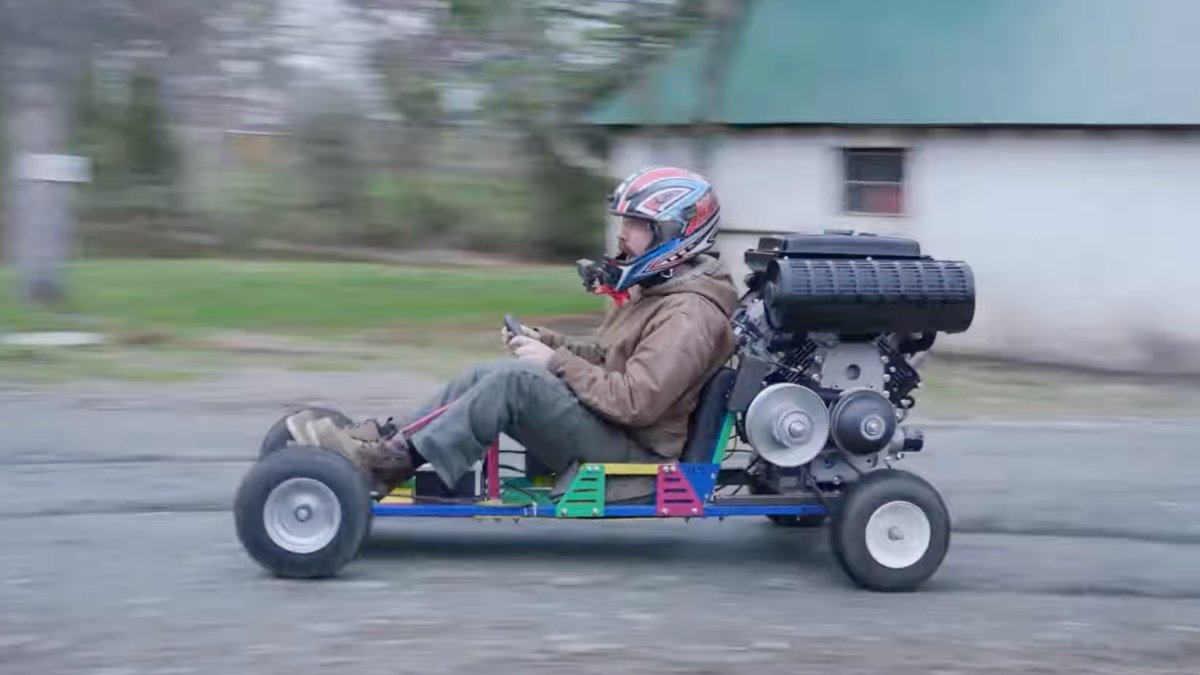
Fitting 1,300cc of diesel V-twin into a go-kart chassis is roughly the equivalent of stuffing a Saint Bernard into a cat carrier. The kart originally came with a 98cc motor, and even 670cc is considered massive in karting circles. Loaded with fluids and mated to the kart’s CVT transmission, the Chinese diesel tipped the scales at roughly 300 pounds, about the same as a complete conventional kart with a driver sitting in it.
The rear axle had to be pushed back six inches. A custom subframe and steel plate reinforced with angle iron were fabricated to hold the beast in place. Once mounted, the engine sat nearly as tall as the driver’s head.
On the ground, 26.8 horsepower and diesel torque delivery meant the kart could spin its rear tires more or less on demand. The transmission needed tweaking to achieve full engagement, but mechanically the V-twin ran without drama. No catastrophic failures, no mysterious fluid leaks, no runaway episode requiring that emergency valve lifter.
China’s mainstream auto industry has moved well past the days of cheap knockoffs and suspect metallurgy. BYD, Geely, and others are building cars that compete on a global stage. But this engine is a postcard from the other China, the vast, unregulated marketplace where a factory nobody has heard of will sell you a crate motor for the price of a decent used transmission and ship it across the Pacific in a box that looks like it survived a bar fight.
CarsandCameras floated the idea that the V-twin could power a full-size car, likely in some hypermiling context rather than anything resembling performance. A more fitting next chapter might be a go-kart tractor pull, where that low-rpm diesel torque could actually do useful work instead of just shredding small tires.
The engine shouldn’t work as well as it does. The kart shouldn’t hold together under that much weight. And nobody should be ordering critical powertrain components from a listing where the specs change depending on which label you read, but here we are, and the tires are spinning.


Share this Story