
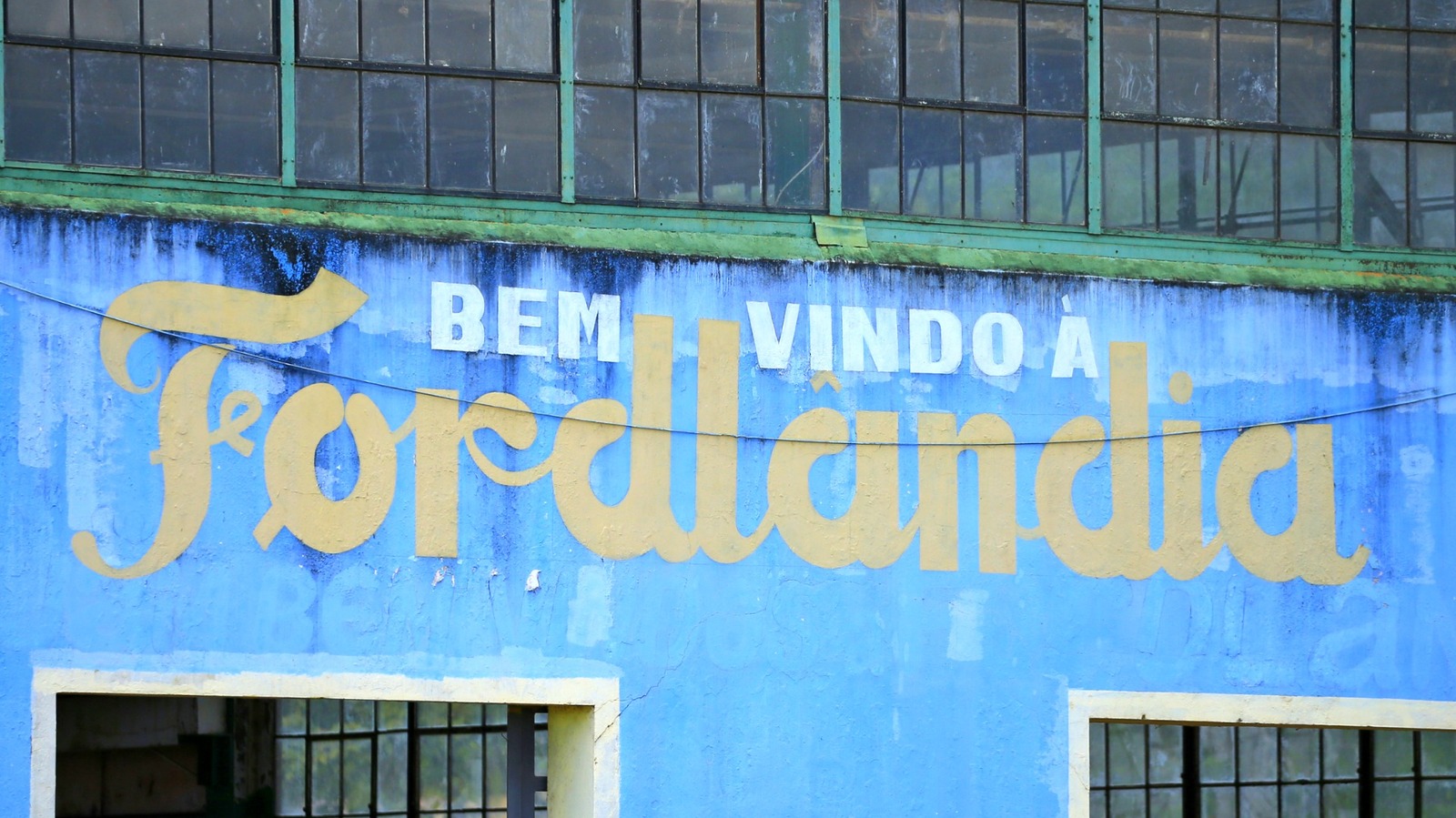


A Brazilian court has ordered local and federal governments to restore Fordlandia, Henry Ford’s doomed rubber plantation town carved out of the Amazon jungle nearly a century ago. The ruling caps a 30-year preservation fight and a decade-old lawsuit, and it comes with teeth — fines if the governments don’t deliver a recovery plan and act on it.
In the 1920s, Ford acquired 2.5 million acres along the Tapajós River in the Brazilian state of Pará. He wanted his own rubber supply, free from the British-controlled market in Southeast Asia. What he built was a miniature American town — complete with running water, a hospital, electricity, and the kind of rigid puritanical values that played about as well in the tropical Amazon as a wool suit in August.
Ford imposed American work schedules and behavioral codes on Brazilian laborers. The jungle pushed back harder. Dry spells, nutrient-poor soil, and leaf blight ravaged the rubber trees.
Workers had no appetite for Ford’s moralism. The project hemorrhaged money and goodwill almost from the start.
Ford eventually shifted most operations 80 miles downriver to Belterra, and by 1945, the Ford Motor Company sold both sites back to the Brazilian government for a laughable $250,000. Fordlandia was left to rot.
But rotting is not the same as forgotten. The town was once the third-largest settlement in the region. Its ruins became a strange monument to American industrial hubris, attracting historians, documentary filmmakers, and preservationists who saw in its crumbling buildings something worth saving.
Those preservationists started pushing for heritage-site status in the 1990s. It took until 2015 for federal prosecutors to file a formal complaint against Brazil’s Iphan architectural agency and the city of Aveiro for letting the place disintegrate. The prosecutors argued that Iphan had sat on preservation applications for an unconscionable stretch of time, which, given the three-decade timeline, qualifies as understatement.
Another eleven years passed before judges finally ruled. The court stopped short of granting Fordlandia official heritage-site status, but it found the location possesses “historical, cultural and architectural significance” that the Brazilian Constitution requires be protected. That legal language matters — it creates an obligation, not just a suggestion.
Now comes the hard part. The governments in question must draft and execute a restoration plan for a site that has spent the better part of 80 years succumbing to one of the most aggressively destructive environments on Earth. The Amazon does not wait patiently for bureaucratic timelines.
The irony is almost too neat. Ford tried to impose order on the jungle and lost. Brazilian governments tried to ignore the ruins and lost. The jungle, as always, kept winning.
Whether the restoration effort produces a meaningful historical site or just another round of underfunded promises depends entirely on enforcement. The court’s willingness to impose fines suggests at least some awareness that without consequences, this ruling will end up like so many others — filed, forgotten, and consumed by the forest.
Fordlandia failed as a factory town, failed as a social experiment, and nearly failed as a piece of history. It took 30 years of legal pressure to give it a fighting chance at survival. Henry Ford couldn’t tame the Amazon with money and ideology. A Brazilian court order might not do much better, but at least now someone has to try.





Share this Story