
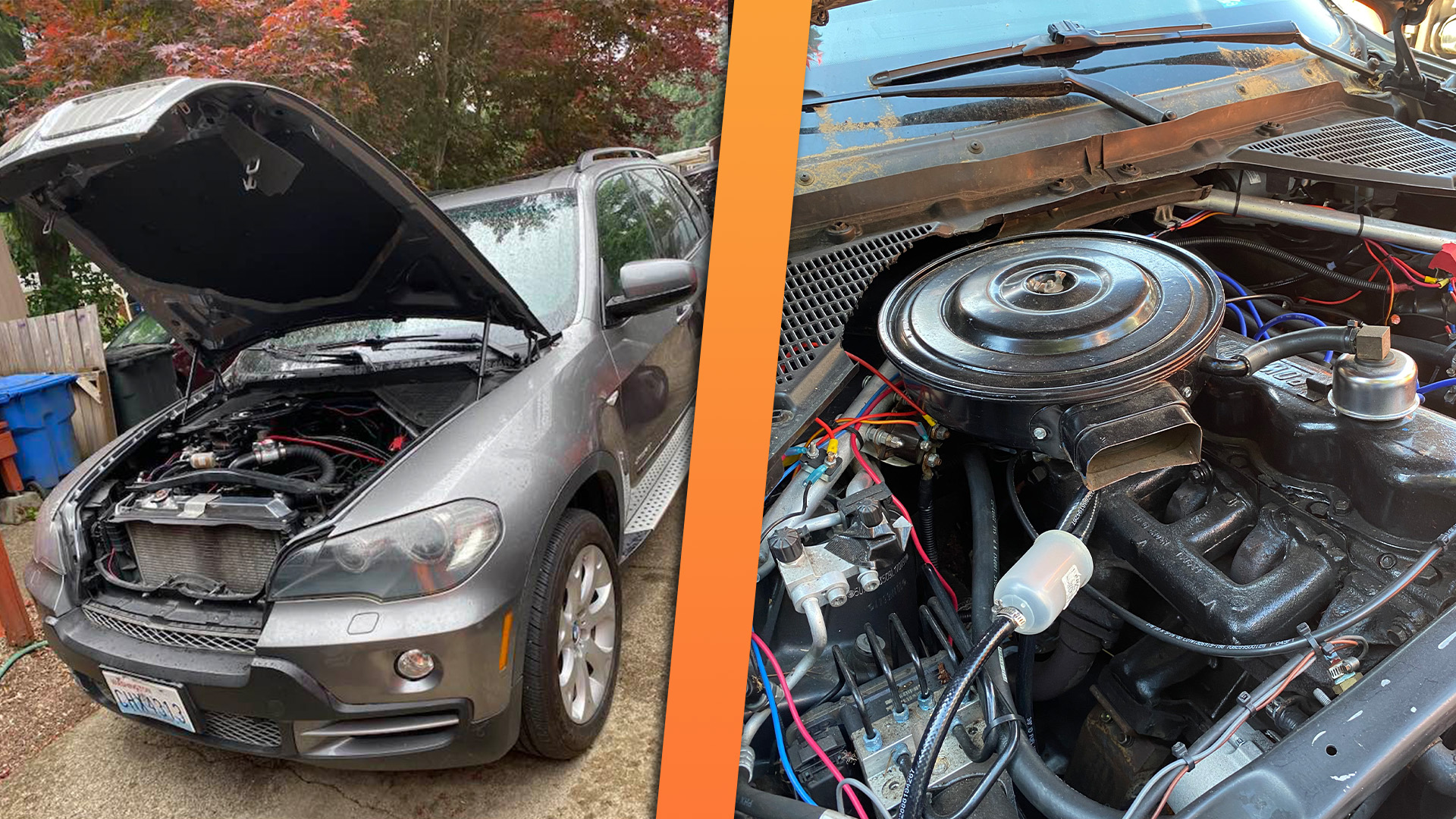


Bruce Mowrey got a 2009 BMW X5 for free. The 4.8-liter V8 had bad valve stem seals, a $5,200 repair on top of the $9,000 the previous owner had already sunk into it. So Mowrey did what no BMW dealer would ever sanction: he ripped out the German V8 and dropped in a carbureted Ford 240-cubic-inch inline-six that’s more than half a century old.
He paid $700 for the engine and a mated-since-new three-speed automatic on Facebook Marketplace. He scrapped the BMW’s all-aluminum block for $60. That math alone tells you everything about the economics of owning a used German luxury SUV versus thinking sideways.
Mowrey is a self-described Ford guy from the Tacoma, Washington, area. His previous project involved stuffing a Caterpillar 3208 diesel into a 1969 Ford one-ton frame with a Peterbilt cab bolted on top. The man does not think inside conventional boundaries. He also lost his right hand in a 1987 trucking accident, which makes the fact that he did this entire swap in his driveway even more remarkable.
The engineering challenges were exactly what you’d expect when mating 1960s American iron to a 2009 German chassis full of networked computers. The BMW’s high-pressure fuel system got tossed. In its place, Mowrey installed a boat fuel tank and a low-pressure pump underneath the car with a nylon tube dipping into it.
The start sequence now involves inserting the key fob, flipping one switch for ignition, another for the fuel pump, then hitting a push-button to fire the engine.
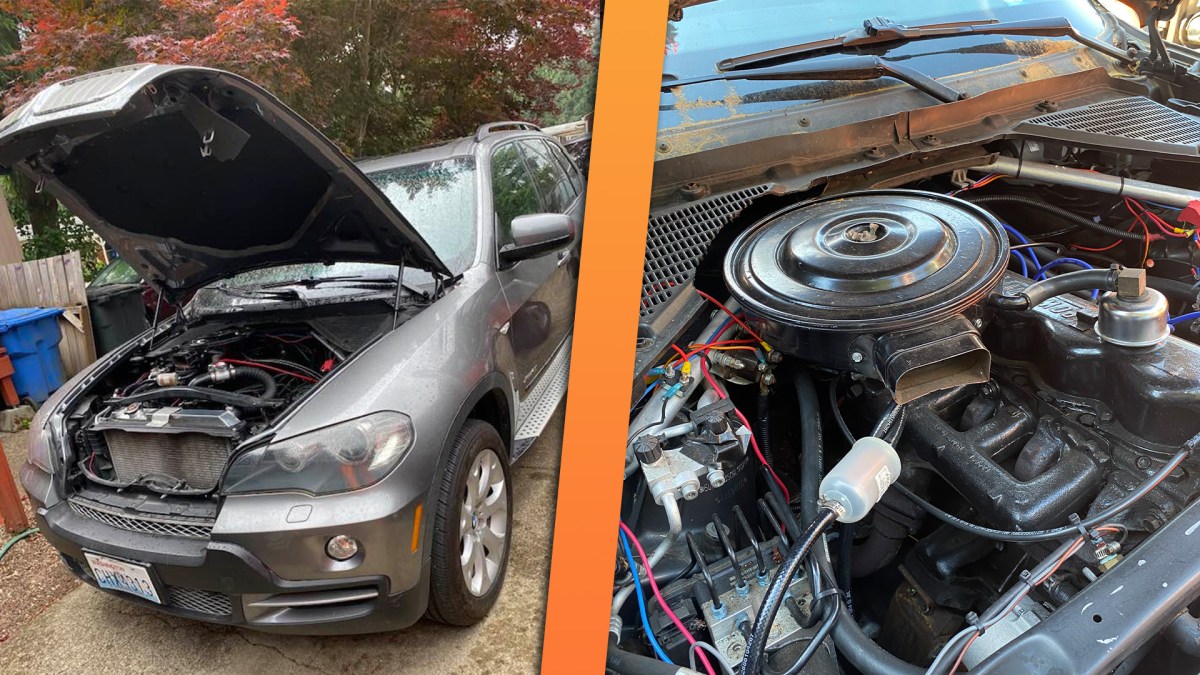
The electronics fought him at every turn. Windshield wipers ran constantly at low speed. Turn signals went dead. The heater blower refused to kick on. Mowrey’s solution was elegant in its bluntness: he pulled the Ford engine onto its own complete electrical circuit, bypassing the BMW’s body control modules entirely. A power wire and a main switch. Done.
The driveline was the last puzzle. A Ford three-speed automatic was never designed to mate with an independent rear suspension. Mowrey found a 1350 U-joint driveshaft adapter from TF Works, a company that normally sells parts for BMW drift cars. It bolted directly to the stock driveline with zero cutting required. Sometimes the universe cooperates.
The result is slow. Genuinely, deeply slow. A 240-cubic-inch Ford six made somewhere around 150 horsepower when it was new, and that was optimistic. Pushing a BMW X5 chassis around requires patience and a fundamentally different relationship with the throttle pedal.
But it starts every time. It runs every time. It goes every time. That’s more than the BMW V8 could say.
His Facebook video has been viewed more than half a million times, and the fascination makes sense. In an automotive world defined by complexity, software dependencies, and repair bills that rival mortgage payments, a guy in his driveway solved a problem with a $700 engine, some creative wiring, and a refusal to be intimidated by a German computer system.
Ford built its inline-six family during the 1960s and ’70s. The 240 sat in the middle of the lineup, bigger than the 170 that powered Econoline vans and smaller than the legendary 300 that hauled everything from pickups to dump trucks. These engines were designed to be simple, durable, and repairable by anyone with basic tools. Fifty-plus years later, that design philosophy just bailed out one of Munich’s finest.
The BMW purists will hate it. The engineers in Bavaria would probably need therapy. But the truck is running, Mowrey is driving, and the total investment remains a fraction of what a single dealer repair would have cost. Sometimes the best solution isn’t the correct one. It’s the one that works.




Share this Story