
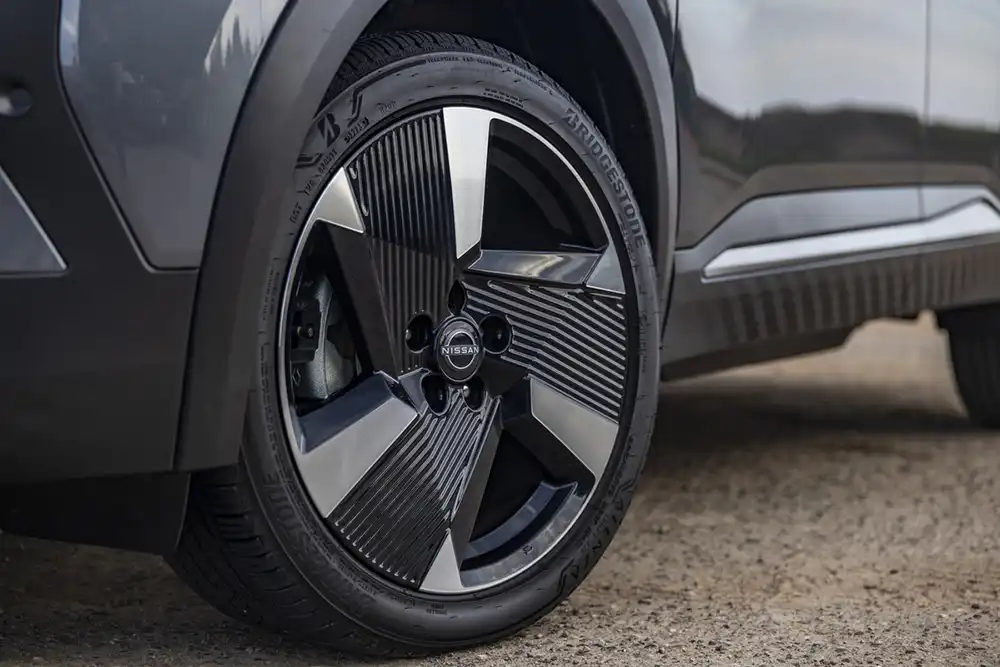


Nissan just laid bare something its hardcore fans have known for decades: the color of a brake caliper isn’t decoration. It’s a spec sheet you can read from twenty feet away.
The company published a full breakdown of its caliper color hierarchy this week, timed neatly to the 2027 Z lineup rolling toward showrooms this summer. Silver, red, bright red, gold, yellow — each shade maps to a specific level of braking hardware, from cast-iron commuter stoppers to carbon ceramic track weapons. It’s a system that started with the R34 GT-R in Japan back in 1999 and has quietly governed Nissan’s performance identity ever since.
Silver is the baseline. Every Kicks, every Altima, every workaday Nissan rolls on silver calipers. They stop the car, and that’s the job.
Red is where things get interesting. On the 2027 Z Performance, red signals a jump to Akebono four-piston fronts and two-piston rears, all aluminum instead of cast iron. The rotors grow to 14 inches up front versus 12.6 on the base Z Sport. The Armada NISMO gets red calipers too, which says something about where Nissan thinks that truck’s personality lies.
Then there’s bright red, and yes, Nissan wants you to notice the difference. The 2027 Z NISMO wears a more vivid shade paired with two-piece iron-aluminum rotors pulled directly from GT-R hardware — a first for the Z. The paint itself is formulated to handle repeated high-heat abuse.
The Z team wanted to take this extra step to make the NISMO model stand out just a bit more,” said Derek Kramer, a product planning manager at Nissan. The distinction between red and bright red is the kind of detail that separates someone who glances at a car from someone who studies one.
Gold means Brembo. Full stop. The R34 GT-R V-Spec II established that link, and the R35 GT-R carried it forward with massive six-piston front and four-piston rear units. The 350Z Track Edition wore gold Brembos starting in 2003. If the calipers are gold, the brakes came from Italy.
Yellow is the rarest tier. Carbon ceramic rotors, designed for punishing track sessions where conventional iron would fade into mush. Only a handful of production Nissans have ever worn yellow — the 2020 GT-R NISMO and 2020 GT-R Track Edition among them.
Kramer noted the caliper paint itself can survive temperatures exceeding 1,832 degrees Fahrenheit without discoloring. That’s not vanity. That’s engineering matched to materials science.
Nissan acknowledges the exceptions. The GT-R 50 by Italdesign wore red Brembos instead of gold. The 2023 Z Proto Spec launched with yellow Akebono calipers that weren’t carbon ceramic. Special editions bend the rules, which only reinforces that the rules exist in the first place.
What runs through all of this is a manufacturer codifying visual language at a time when most automakers treat brake calipers as an afterthought or a dealer-installed accessory. Walk up to a Z on a dealer lot, look through the wheel spokes, and you know exactly what’s behind them before you ever open the door.
It’s also a shrewd bit of positioning. With the GT-R gone from the current lineup, the Z carries the full weight of Nissan’s performance credibility. Trickling GT-R-derived brake technology down to the Z NISMO — and marking it with a distinct color — keeps that lineage alive in the most tangible way possible.
You can see it. You can feel it at the pedal. And if you know the code, you understand exactly what it costs to move up one shade on the spectrum.


Share this Story