
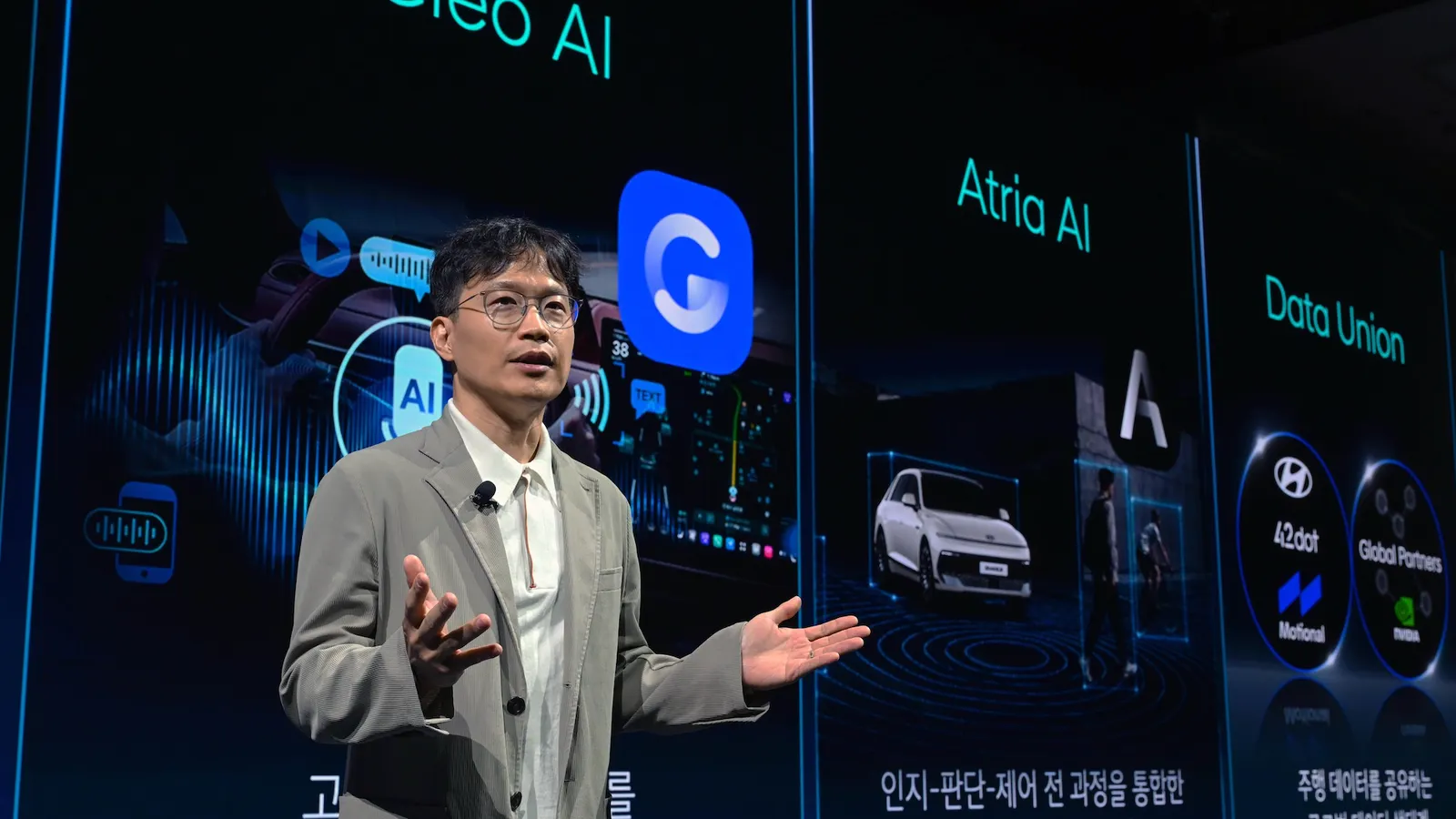


Hyundai Motor Group is turning its global fleet into a rolling data harvesting operation. At the automaker’s 2026 CEO Investor Day on Aug. 26, executives laid out a plan to build what they call a “data flywheel.” It’s a continuous loop where vehicle sensor data feeds AI models that push improvements back to cars via over-the-air updates, which then generate better data, and so on.
The concept is borrowed straight from Silicon Valley’s AI playbook. Tesla has been running a version of this for years. What Hyundai is betting is that sheer volume, millions of Hyundai and Kia vehicles worldwide, can close the gap fast.
Data collection starts with the Grandeur sedan in South Korea, equipped with Hyundai’s Pleos Connect infotainment platform and Gleo AI, a generative AI assistant focused on vehicle controls and convenience features. Gleo AI is the first application. Autonomous driving is the real prize.
Minwoo Park, who runs both Hyundai’s Advanced Vehicle Platform Division and software subsidiary 42dot, outlined a staged rollout. Level 2+ autonomous driving tech arrives in the automaker’s first mass-produced software-defined vehicle in 2028, built on an ongoing collaboration with Nvidia. But before that, by the end of this year, Hyundai’s in-house end-to-end autonomous driving system, called Atria AI, will be deployed on vehicles in South Korea specifically to hunt for edge cases.
Edge cases are the weird, unexpected road situations that trip up self-driving systems. Every autonomous driving developer knows the long tail of rare scenarios is where systems fail. Hyundai’s theory is that flooding Atria AI with real-world data from a massive fleet will compress years of learning into months.
The organizational plumbing matters here too. Hyundai is standardizing its sensor architecture around the Nvidia ecosystem so that data collected by Hyundai, Kia, 42dot, and autonomous driving unit Motional can all flow into the same pipeline. Fragmented data across subsidiaries has hobbled other automakers‘ software ambitions. Hyundai seems aware of that trap.
By 2029, the automaker expects the volume of autonomous driving data to spike dramatically. To handle it, Hyundai is constructing the Saemangeum AI Data Center in South Korea, a 100-megawatt facility capable of housing more than 50,000 GPUs. That is not a modest investment. It signals that Hyundai views data processing infrastructure as a core competency, not something to outsource.
The plan looks tidy on paper. The hard part is execution. Building a data flywheel requires not just collecting data but labeling it, cleaning it, training models on it, validating those models, and then deploying updates that don’t break anything.
At scale, across multiple brands and markets, with different regulatory regimes, the engineering complexity is enormous. Hyundai sold roughly 7.3 million vehicles globally last year across its brands. If even a fraction of those become data-generating nodes feeding a centralized AI pipeline, the potential learning rate is staggering.
But potential and production-ready are different things. The automaker has mapped out a timeline that stretches to 2029 and beyond, with standardized sensor systems and AI computing platforms eventually spreading across most mass-produced vehicles. That is a five-year transformation of the entire product portfolio into networked learning machines.
No other legacy automaker has articulated the flywheel strategy this explicitly. Whether Hyundai can actually spin it up faster than the competition is the open question. The clock started ticking the moment Park walked off that stage.




Share this Story