
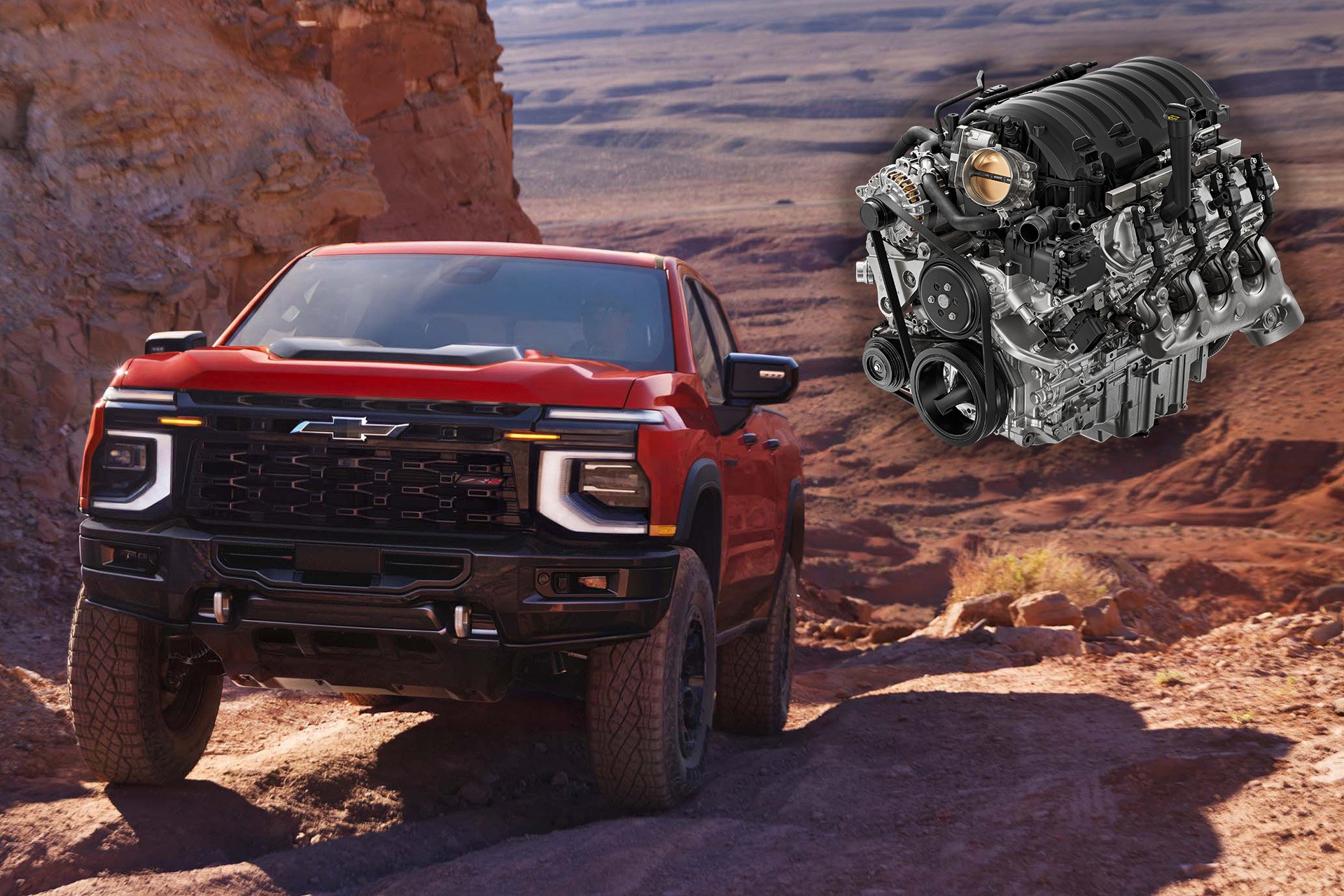


General Motors just laid its cards on the table. The 2027 Chevrolet Silverado and GMC Sierra will carry a pair of all-new sixth-generation small-block V8s, and the numbers are finally public: 481 horsepower and 501 lb-ft of torque from the range-topping 6.6-liter L78. No turbochargers. No hybrid assist. Just displacement, compression, and airflow.
That makes it the most powerful naturally aspirated V8 in the half-ton truck class, and the gap isn’t razor-thin.
Even the smaller 5.7-liter L76 was engineered to land a punch. At 402 hp and 428 lb-ft of torque, it edges past Ford’s 5.0-liter Coyote (400 hp, 410 lb-ft) and Ram’s 5.7-liter Hemi (395 hp, 410 lb-ft). GM clearly benchmarked both rivals and decided that splitting hairs wasn’t enough. It wanted breathing room.
The 6.6-liter gets there through straightforward engineering. Piston stroke grew by 6 millimeters over the outgoing 6.2-liter. Compression climbed from 11.5:1 to 12.5:1. Larger throttle bodies and a redesigned intake manifold with tuned runners manage the increased airflow. Old-school recipe, modern execution.
Towing numbers follow the power. The 5.7-liter L76 is rated for up to 13,700 pounds in the Silverado and 13,500 in the Sierra, making it GM’s most capable tow setup.
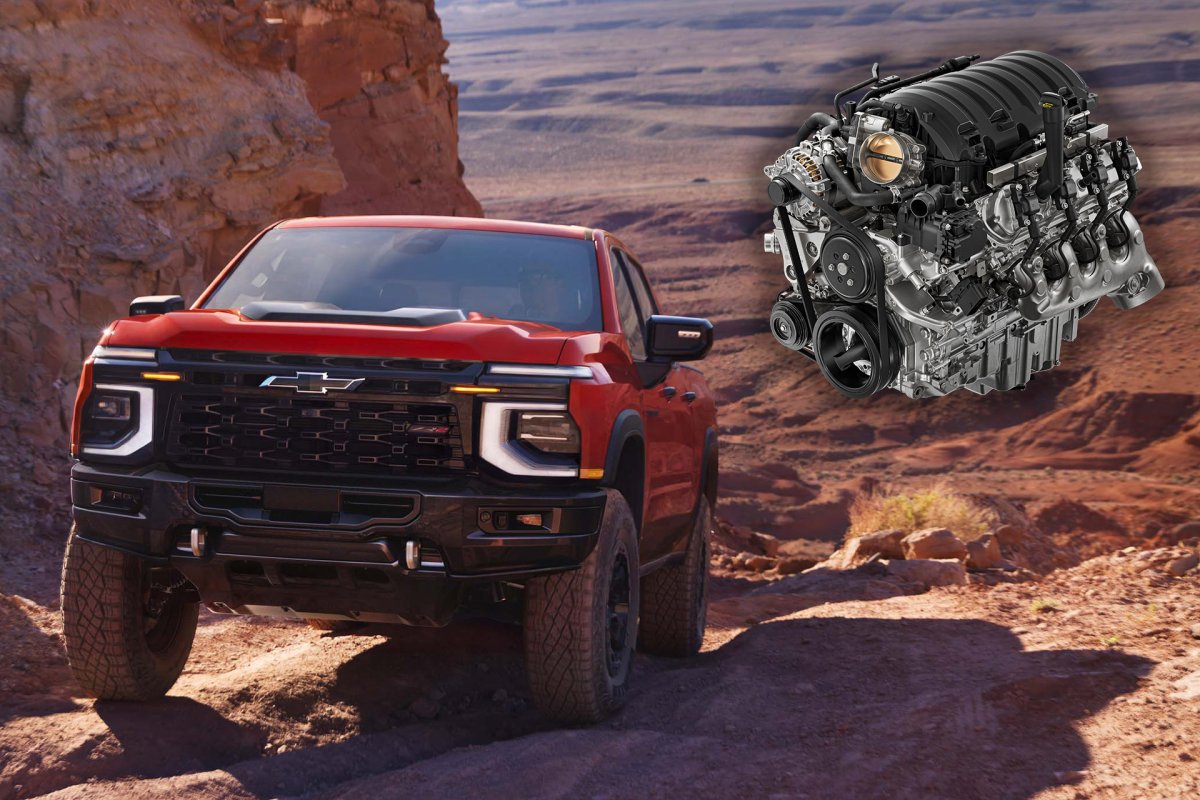
The rest of the engine lineup got attention too. GM’s 2.7-liter TurboMax four-cylinder base engine now produces 350 hp and 455 lb-ft, gains of 40 hp and 25 lb-ft achieved through a new turbocharger, revised fuel injection, and redesigned pistons. The 3.0-liter Duramax diesel holds steady at 305 hp and 495 lb-ft.
Now, some context before anyone starts chiseling a trophy. The L78 is not the most powerful half-ton engine, period. Ram’s high-output Hurricane inline-six, with twin turbochargers, makes 540 hp and 521 lb-ft. Ford’s high-output EcoBoost trails the L78 on horsepower but beats it on torque with 510 lb-ft.
Both of those engines use forced induction to get there, and that distinction matters because GM is making a deliberate philosophical bet. Toyota walked away from V8 trucks entirely. Ram pulled its Hemi from the lineup for roughly a year before customer revolt helped reverse course.
Ford has kept the Coyote alive but largely frozen in development. GM, alone among them, spent the money to engineer a completely new generation of small blocks.
The engines do come with compromises. Cylinder deactivation remains standard because meeting current emissions regulations without it would be nearly impossible. And in a move that will irritate a certain subset of owners, GM deleted the oil dipstick, replacing it with an electronic oil level sensor.
The reason? It needed the space for a new coolant switch. Whether that trade is reasonable depends on how much you trust sensors over a metal stick you can wipe with a rag.
The 6.6-liter L78 shares DNA with the Corvette’s new LS6, though it differs in key areas, including a slightly shorter stroke and a wet-sump oiling system suited to truck duty rather than track duty.
What GM has built is a pair of engines that exist almost in defiance of industry trends. While competitors chase electrification, turbocharging, and hybridization for their volume trucks, Detroit’s largest automaker doubled down on the pushrod V8 formula it has refined for seven decades. The bet is that enough buyers still want exactly that, and will pay for it.
Production 2027 Silverados and Sierras with these engines haven’t hit dealer lots yet, and real-world testing will tell us whether the spec sheet translates to the seat of the pants. The smack talk, at least, is already well underway.

Share this Story