
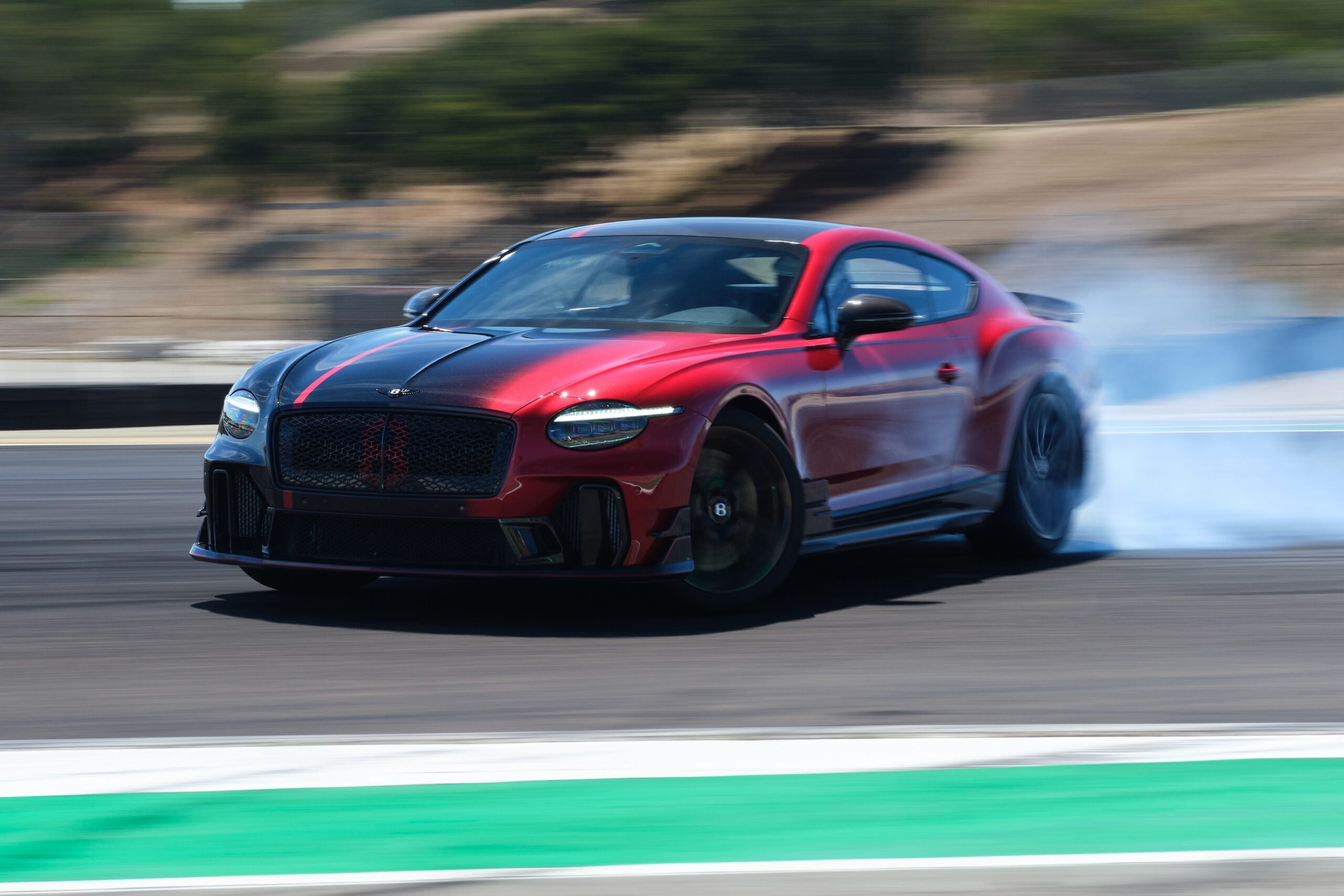


Five hundred cars. All sold. Each starting at $490,350. The 2027 Bentley Supersports hasn’t just arrived — it has already disappeared from the order books before most buyers could reach for their checkbooks.
What Bentley built here is a confession. For two decades, the Continental GT has been a leather-lined ocean liner that happened to have a powerful engine. Quick in a straight line, yes, but always hamstrung by weight, understeer, and priorities that leaned toward wafting, not attacking.
The Supersports strips all of that pretense away. Start with the diet. Bentley ditched the all-wheel-drive system and the plug-in hybrid hardware, shedding roughly half a ton.
The estimated curb weight of 4,500 pounds is still substantial, but consider that a Mercedes-AMG GT63 coupe tips the scales only a couple hundred pounds lighter. For a Bentley, this is positively svelte.
The drivetrain is pure and uncomplicated. A twin-turbo 4.0-liter V-8, rear-wheel drive only, routed through an eight-speed dual-clutch gearbox. Bigger turbos and variable valve timing push output to 657 horsepower and 590 pound-feet, well beyond the sub-600 figures in lesser Continentals.
An electronically controlled limited-slip diff and a rear track widened by 0.6 inches manage the power at the driven axle. Ironically, the Supersports is probably slower to 60 mph than its hybrid siblings, roughly 3.5 seconds versus the all-wheel-drive, electrically assisted Continental’s sub-three-second launches.
That number tells you everything about what Bentley was chasing. This car was not engineered for drag strip bragging rights. It was built to rotate.
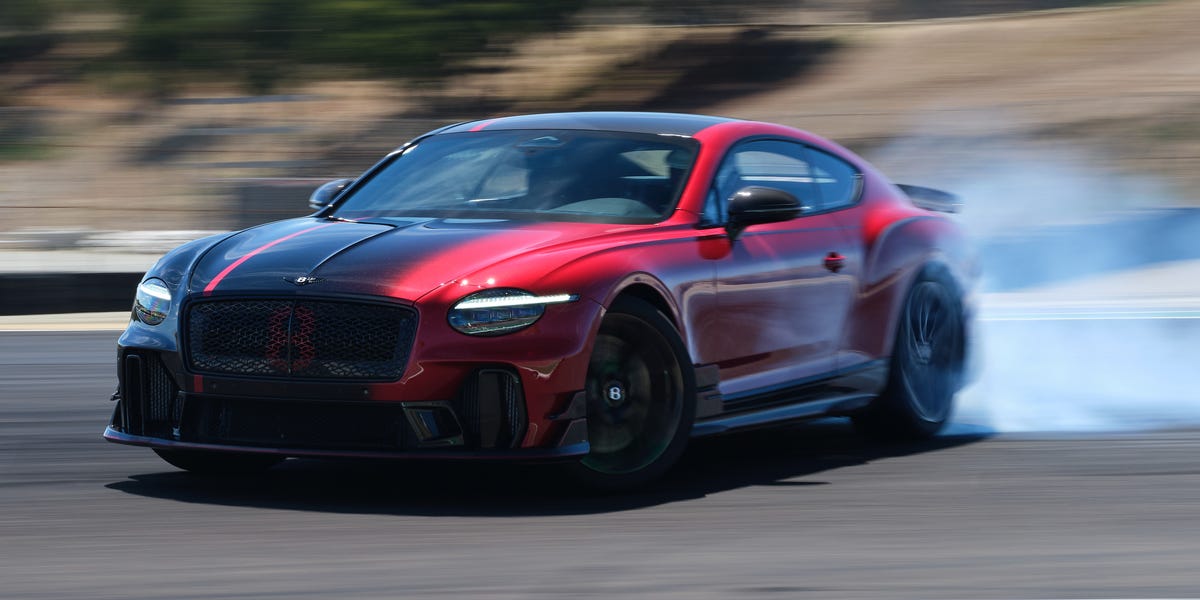
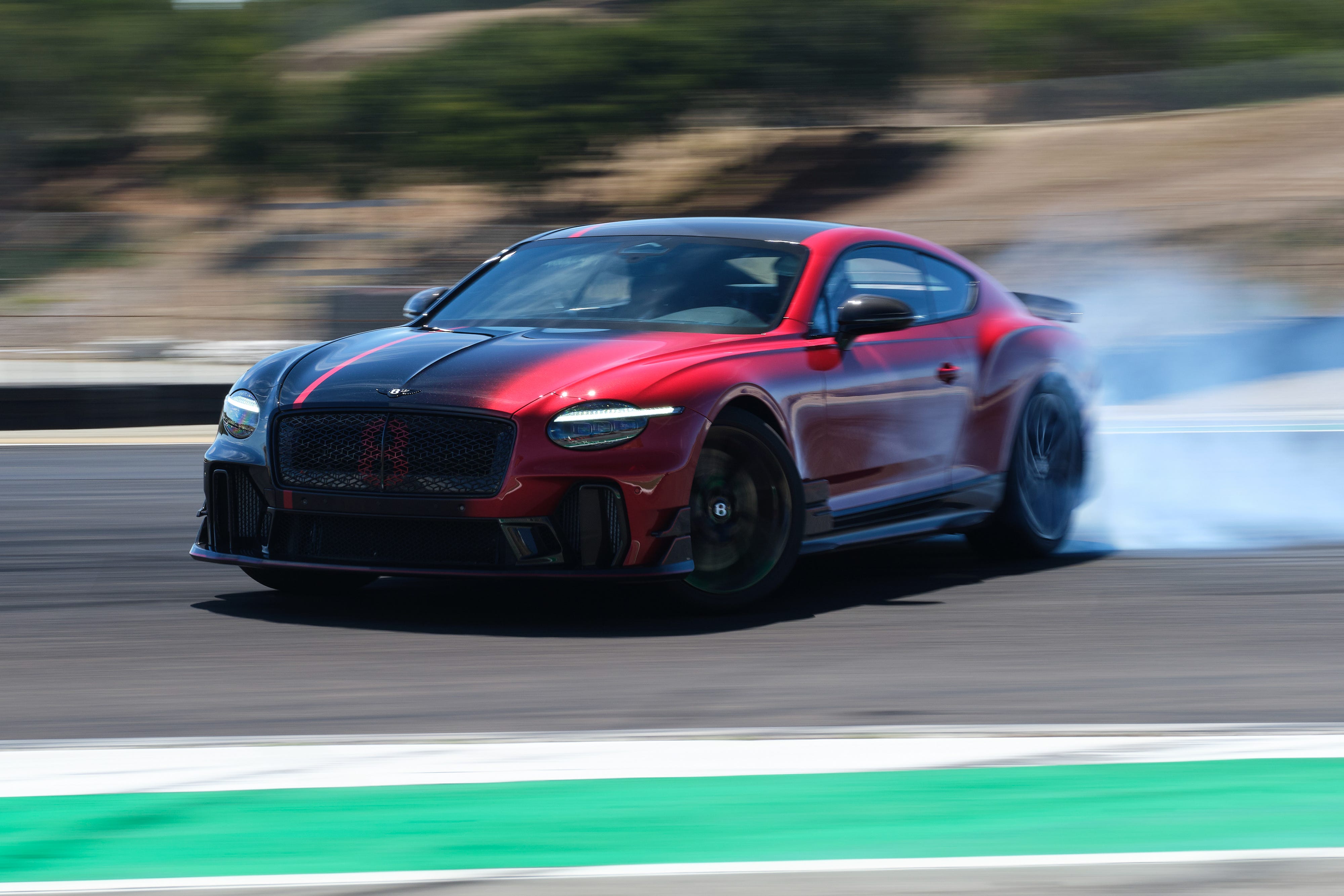
At Laguna Seca, Car and Driver’s first track impressions confirm the transformation. Where a standard Continental would plow through the Corkscrew with stubborn understeer, the Supersports turns in with precision. Revised active anti-roll bars, retuned adaptive dampers, air springs, and rear-axle steering keep the chassis composed through weight transitions.
Optional 22-inch Pirelli P Zero Trofeo RS rubber, sized 275 front and 315 rear, provides the grip. Carbon-ceramic brakes with 17.3-inch front rotors and ten-piston calipers survived a full day of hard lapping without fading.
The aero package means business. Carbon-fiber dive planes, a deep front splitter Bentley calls the largest it has ever fitted to a road car, fender blades, and a fixed rear spoiler combine for more than 660 pounds of additional downforce over a standard Continental. The rear seats are gone, replaced by a leather-and-carbon storage hold.
Yet Bentley refused to make this a hair-shirt track special. The interior remains unmistakably Bentley, with lavish materials, generous sound deadening, and power-adjustable heated sport seats. The default Touring drive mode is calm enough for a long highway stint to your nearest circuit.
The engineering brief explicitly required this car to be comfortable enough to drive to the track, not just around it. An active Akrapovic titanium exhaust system delivers the emotional payoff the hybrid Continentals never could. The V-8 rumbles at idle and builds to a hard-edged roar at 6,000 rpm.
Sound has always been the missing ingredient in Bentley’s recent electrified push, and the Supersports restores it without apology. Only about 170 of the 500 units are destined for the United States.
Bentley’s representatives were careful to frame this as a beginning, not a one-off experiment. The company wants to build more cars like this, driver-focused machines that reconnect the brand with its racing roots. Whether Bentley’s parent company, under increasing electrification pressure, will actually let that happen is the question nobody at Laguna Seca was willing to answer.


Share this Story