
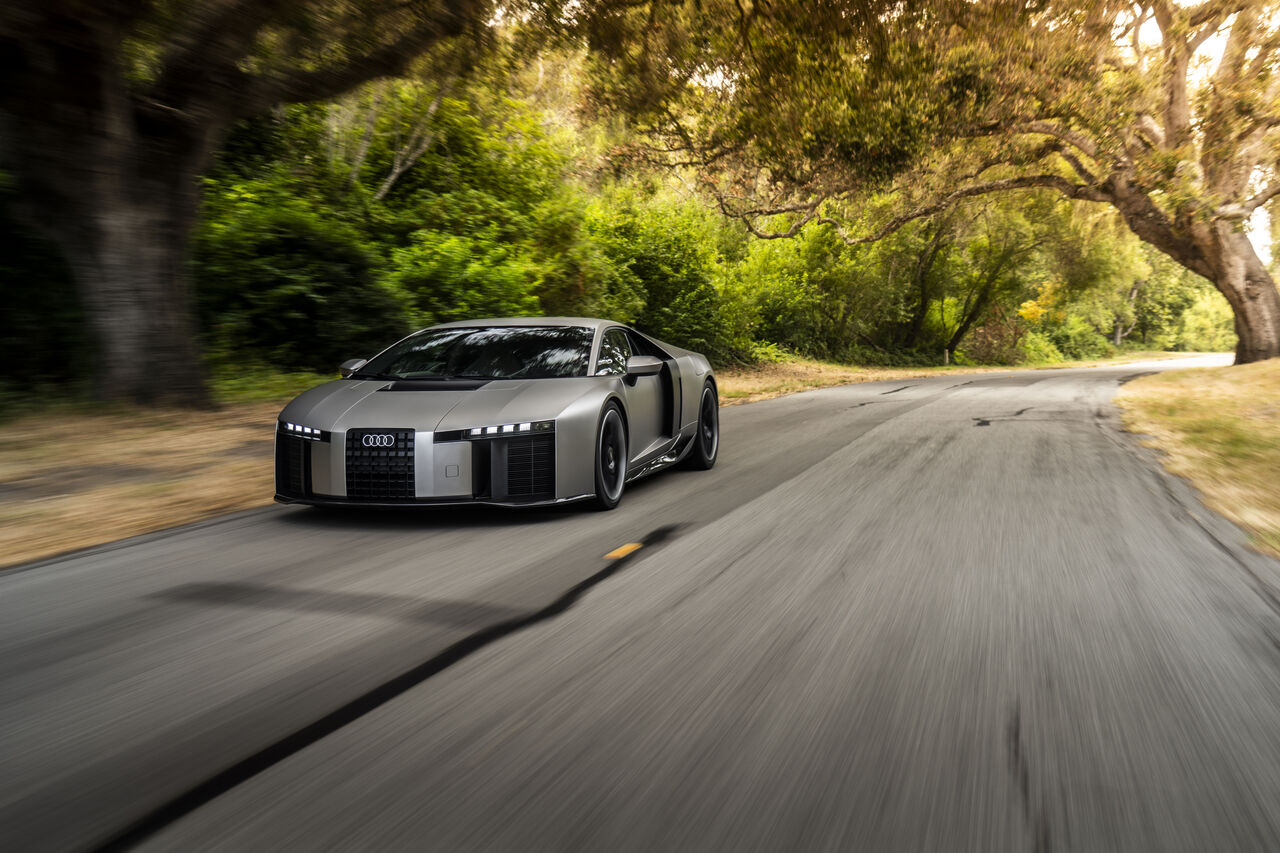


Seventeen days. That is all the breathing room Audi gave between unveiling its new Q9 SUV in New York and rolling a near-production Nuvolari supercar onto the manicured lawns of Monterey Car Week. The pace says as much as the cars themselves.
The Nuvolari landed at Pebble Beach and The Quail with 1,001 PS (roughly 987 horsepower), a high-performance hybrid powertrain, a carbon-bodied Audi Space Frame, and a claimed top speed north of 217 mph. Only 499 will be built. Presales in Europe open in the fourth quarter of this year, with first deliveries slated for the first half of 2027.
Audi has never played in this space before. Not really. The R8 was a mid-engine sports car that punched above its weight, but it was never positioned as a true halo weapon meant to trade blows with the Ferrari SF90, McLaren W1, or Mercedes-AMG One. The Nuvolari is that bet.
Its road debut happened on the twisting tarmac around Carmel-by-the-Sea, just weeks after the car first turned laps at the Monaco Grand Prix. Going from a Formula 1 backdrop to Highway 1 is a calculated bit of theater, and Audi leaned into it. CEO Gernot Döllner framed the Q9 and the Nuvolari as two expressions of one strategy.
Strip away the corporate phrasing and the message is blunt. Audi needs the American market, and it needs Americans to see the brand differently. The U.S. remains the world’s second-largest car market, and Audi has spent years watching its German rivals build halo machines that reset consumer perception overnight.
The AMG One did it for Mercedes. The 918 Spyder did it for Porsche, Audi’s own sibling under the Volkswagen Group umbrella.
Naming the car Nuvolari, after the pre-war racing legend Tazio Nuvolari who drove for Auto Union, is a deliberate reach back into the brand’s motorsport DNA. It is also a tacit admission that the R8’s departure left a void in the lineup that took too long to fill.
The hybrid powertrain is worth scrutinizing. Preliminary figures show combined fuel consumption of 11.3 liters per 100 km and electricity use of 7.8 kWh per 100 km. With the battery depleted, consumption climbs to 14.7 liters per 100 km.
Those numbers earn a CO2 class of G, the worst rating on the European scale. This is not a green machine wearing a fig leaf. It is a performance car that uses electrification to make speed, not to save fuel.
Vito Paladino, president of Audi of America, called Monterey Car Week “the pinnacle premium automotive stage” and the Nuvolari “the brand’s first halo supercar.” That word “first” does a lot of heavy lifting. It rewrites the R8’s legacy and sets the Nuvolari apart as something more deliberate, more exclusive, more expensive.
Audi hosted private events for collectors and potential buyers throughout the week, working the rooms that matter when you are selling a car at this price point. The company says customer interest has already been strong, though it offered no allocation numbers or regional breakdowns.
The real question is whether 499 carbon-bodied supercars can do for Audi what the brand’s volume models have not: shift perception in a market where BMW’s M division and Mercedes-AMG already own the performance conversation. Building a halo car is easy compared to making it stick in the culture.
European presales open in a matter of weeks. U.S. timing has not been confirmed.
Share this Story