
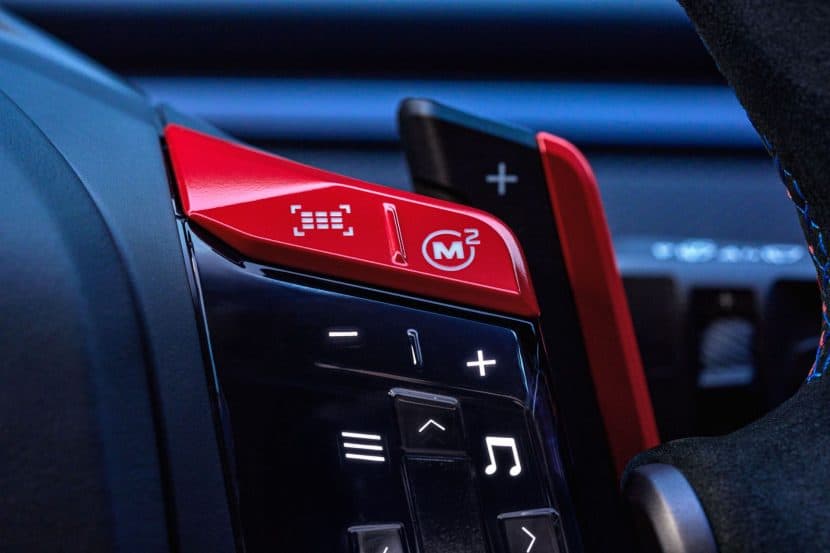


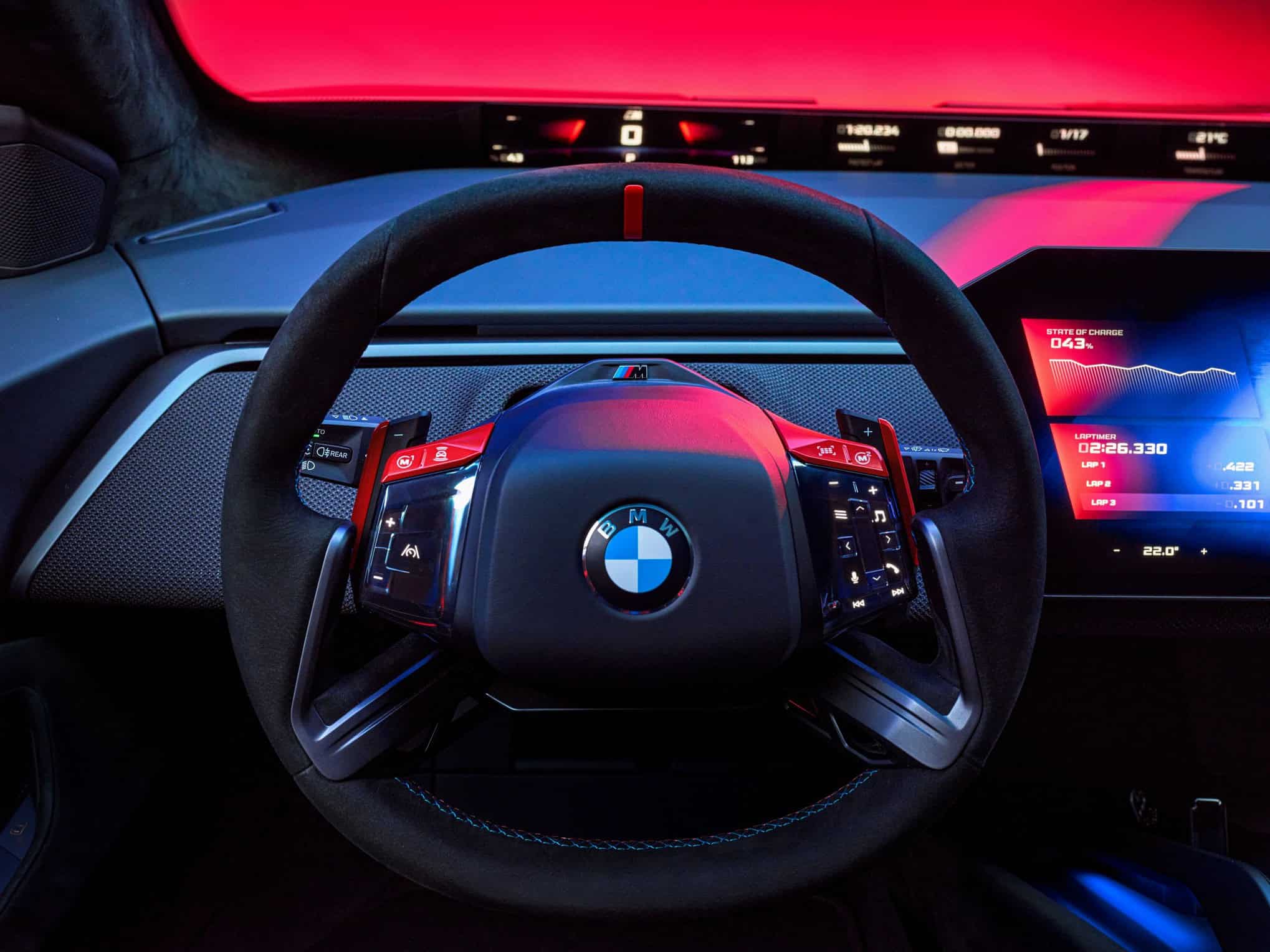
BMW’s M Concept Neue Klasse rolled into Le Mans this weekend with a detail that stopped people mid-sentence: red-accented shift paddles bolted behind the steering wheel of a fully electric car. No engine. No transmission. But paddles.
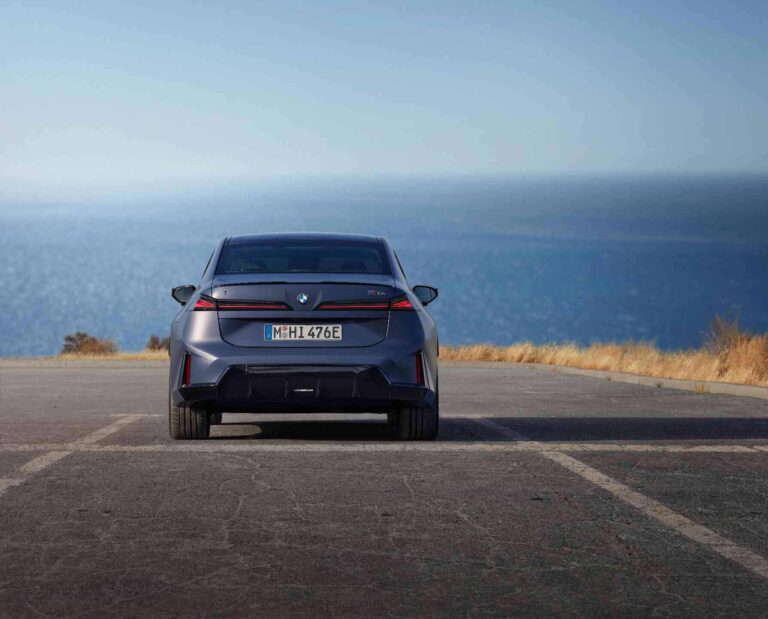
M CEO Frank van Meel and M Head of Design Oliver Heilmer confirmed to BMWBLOG that the production version, due next year, will look very close to the concept. The electric M3, internally coded ZA0, and its combustion-engine sibling, the G84, are both drawn from the same design DNA on display in France.
The paddles aren’t decorative. They control a simulated gearbox — virtual gear ratios that modulate the quad-motor powertrain’s output. BMW’s argument is straightforward: on track, a driver pushing an EV to its limits has no auditory or tactile markers to gauge where they are in the power band.
Everything just goes. Simulated shifts give you reference points, moments of punctuation in what is otherwise one long, unbroken sentence of acceleration.
It’s a reasonable theory. Combustion cars with real gearboxes give drivers something to work with — the rising pitch of an engine approaching redline, the kick of an upshift, the bark on a downshift. Strip all that away and you get what many enthusiasts have complained about since the first performance EVs hit the market: speed without drama.
Fast, yes. Engaging, not always.
BMW is layering on more than fake shifts. M division has developed a synthetic soundtrack that blends acoustic signatures from the company’s inline-six, V8, and V10 engines into something new. It’s engineered to respond under acceleration and work in concert with the simulated gearbox.
The counterargument practically writes itself. Artificially restricting the flow of power in a car that doesn’t need gear ratios is, by definition, making it slower on purpose. The whole mechanical advantage of an electric motor is instantaneous, continuous torque delivery. Adding fake steps to that process doesn’t improve performance — it performs the idea of performance.
BMW seems to understand the tension. The paddles are optional — active only in certain drive modes. Drivers who want the pure, uninterrupted electric experience can ignore them entirely. It’s a concession that tells you even BMW isn’t fully convinced every customer wants this.
The broader context matters. BMW M isn’t abandoning combustion. Engineers have already updated the S58 inline-six and S68 V8 to meet Euro 7 emissions standards, which effectively guarantees both engines survive deep into the 2030s.
The gasoline M3 lives on, though reports suggest it may lose its manual gearbox — an irony not lost on anyone paying attention. The car with the real transmission might ditch its third pedal while the car without a transmission gets fake shift paddles.
An electric X3 M is expected to follow the M3, with a possible X5 M EV as early as 2028. If the simulated gearbox works — if buyers respond to it, if it genuinely changes the way people experience electric performance — it will spread across the lineup fast.
BMW is making a bet that the muscle memory of enthusiast driving is worth preserving even when the mechanical basis for it no longer exists. Whether that’s engineering conviction or nostalgia dressed up in software depends entirely on how those paddles feel at 150 mph into a braking zone. The concept is at Le Mans. The answer comes next year.
Share this Story