
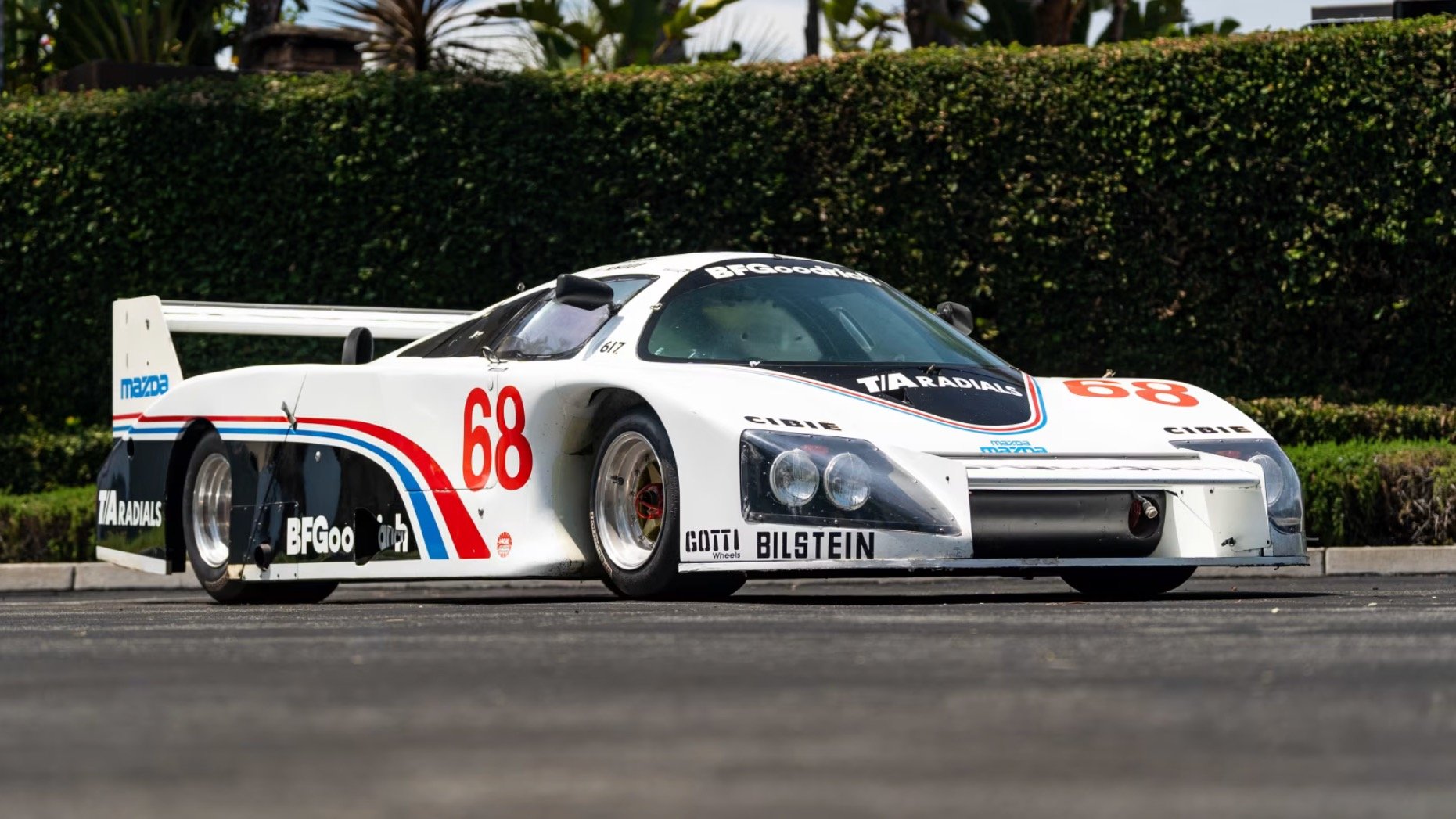


Forty years ago, a rotary-powered Lola prototype won its class at the 24 Hours of Le Mans running on BFGoodrich street tires. Now that car, chassis HU-2, is heading to Mecum’s 2026 Monterey Car Week auction with an expected hammer price around $300,000.
The backstory is one of the most delightfully absurd marketing schemes in motorsport history.
In the early 1980s, BFGoodrich had a problem. Its T/A radial tires were winning IMSA GTU races paired with Mazda RX-7s, but nobody outside the paddock noticed. “The problem was, nobody really cared about any RX-7 doing well,” said Chuck Patrick, a BFG tire engineer at the time, in a 2005 Vintage Motorsport interview. The marketing department wanted something louder.
So BFG went bigger. The tire company hired racing driver Jim Busby to field a two-car team in the FIA C2 prototype class, the second tier of international endurance racing. Busby chose the new Lola T616 chassis powered by Mazda’s 1.3-liter 13B rotary.
The tires retained the same fundamental design as the retail product, though they had to be reshaped for the 13×11-inch front and 13×14-inch rear racing wheels. Three thousand miles of testing followed before the cars turned a wheel in anger.
Both Lolas ran the full IMSA calendar in 1984, including Daytona and Sebring, reportedly becoming the first cars to run street rubber on Daytona’s steep banking. Chassis HU-3 won its class at the Monza 1,000-kilometer race. But Le Mans was the target, and Le Mans delivered.
John Morton, John O’Steen, and Yoshimi Katayama drove HU-2 to a C2 class victory and 10th overall at the 1984 running. The sister car, piloted by Busby, Rick Knoop, and Boy Hayje, finished third in class and 12th overall.
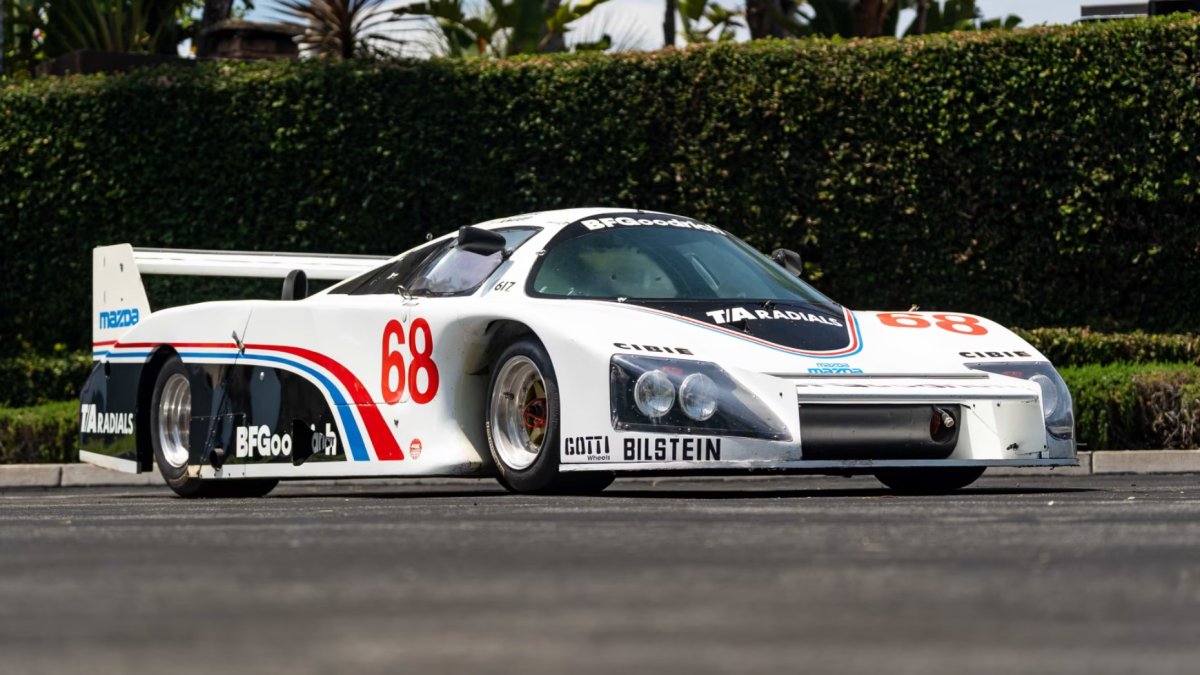
Drivers from the team later admitted the tires were less of a handicap than the engine. The rotary was down on power and thirstier than most of the competition, requiring a conservative driving style to manage fuel consumption. The T616 chassis had been designed for heavier, more powerful engines, which may have actually masked whatever grip deficit the street tires introduced. In other words, the car had bigger problems than its rubber.
That class win also marked the second consecutive Le Mans class victory for a Mazda rotary-powered machine, a thread that eventually led to Mazda’s outright win with the 787B in 1991.
Whether BFG actually sold more T/A radials because of the Le Mans result is anyone’s guess. What’s certain is that both cars survived, which is itself unusual for period prototypes that weren’t Porsche 956s or Jaguar XJR-whatevers. Busby and Knoop acquired and restored the pair in the early 2000s, and they’ve been regulars on the vintage racing circuit since.
Now they’re splitting up. HU-2, the Le Mans class winner, carries the $300,000 estimate. Its sibling HU-3 is expected to fetch roughly $200,000. For context, a Porsche 956 sold at RM Sotheby’s in recent years for north of $10 million.
That gap says something about how motorsport history gets priced. A Porsche carries the badge premium and the aura of Rothmans livery. A Lola-Mazda running tire-company street rubber carries a story that is frankly more interesting, even if the market disagrees.
Monterey Car Week bidders will get to decide what that story is worth. The fact that it even exists, that a tire company’s PR stunt produced a legitimate Le Mans class winner running production-spec radials, feels like something the sport’s current era of spec series and homologation red tape would never allow to happen again.
Share this Story