
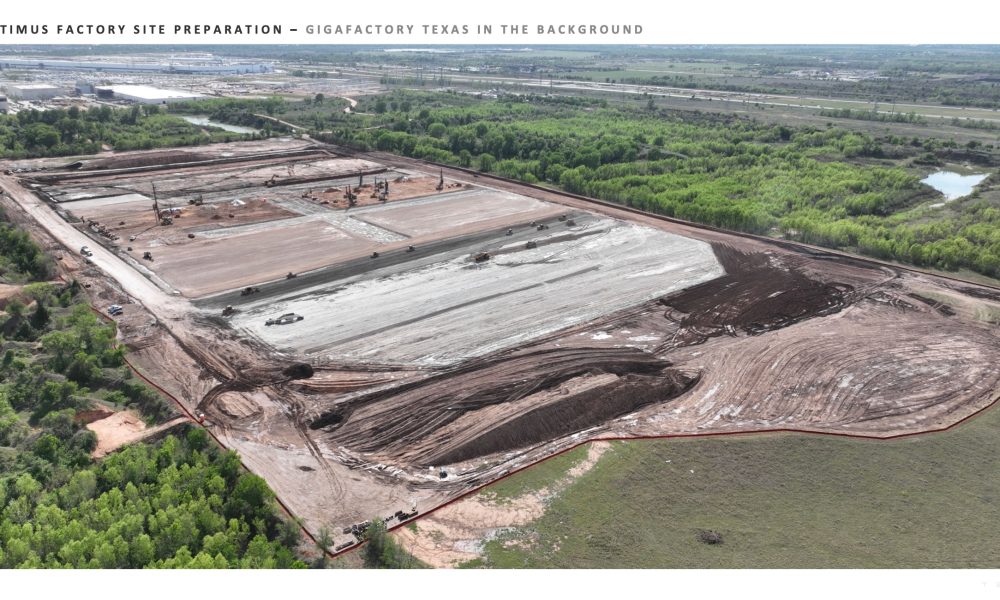


Tesla quietly filed paperwork on July 22 for a $10.1 billion solar cell factory in Fort Bend County, Texas, under the internal codename “Project Crystal Sun.” The application landed the same week SpaceX locked down its $16.8 billion Terafab chip plant in Grimes County. That puts nearly $27 billion worth of new Musk-linked manufacturing commitments into a single state within days of each other.
The solar filing, submitted under Texas’s Jobs, Energy, Technology and Innovation Act, targets roughly 3,000 acres across five parcels off FM 762 and FM 1994 near Richmond, about 40 minutes southwest of Houston. Tesla is asking the Lamar Consolidated Independent School District for a 10-year property tax limitation in exchange for $1.5 billion in real property and $8.6 billion in equipment. The company projects 9,712 permanent jobs and a 2029 start of commercial operations.
Tesla is not fully committed to the site. The filing names an unspecified out-of-state alternative and frames the tax break as the deciding factor. Walk away from the incentive, Tesla says, and the factory goes elsewhere.
That kind of leverage play is standard in mega-project negotiations, but the scale here is not.
The plant would cover the entire solar cell production chain under one roof: ingot and wafer manufacturing, coating, metallization, printing lines, cell testing, cleanroom infrastructure, and automated material handling. Tesla currently sources most of its solar cells from overseas partners, so this facility would represent a dramatic shift toward vertical integration in a segment the company has historically treated as a side business.
It stopped being a side business the moment Tesla’s AI ambitions started consuming electricity at data-center scale. Musk has talked openly about needing domestic solar manufacturing capacity to feed the compute infrastructure behind Full Self-Driving, Optimus, and xAI’s Grok models. A captive solar cell supply chain solves two problems at once: it cuts dependency on foreign suppliers and generates the raw energy feedstock Tesla’s own operations increasingly demand.
The geography tells its own story. Tesla’s Megapack factory in Brookshire sits just up the road in Fort Bend County, already producing grid-scale battery storage across two buildings. A solar cell plant nearby would create a corridor where Tesla manufactures both the panels that harvest energy and the batteries that store it, all within a short trucking distance of the Port of Houston.
Zoom out further and the Texas footprint becomes almost absurd. Giga Texas in Austin builds Cybertrucks, Model Ys, and is adding Optimus production lines. Terafab in Grimes County will fabricate the AI chips for Tesla’s robots and autonomy software. The Boring Company runs its R&D tunnels out of Bastrop, SpaceX launches from Boca Chica, and now a solar megafactory near Richmond.
The state’s willingness to offer aggressive tax incentives has clearly shaped this concentration. Texas has no corporate income tax, and the property tax abatement programs give companies like Tesla a further discount on precisely the kind of capital-heavy investment that would face a larger bill in other states. Whether Fort Bend County’s school district sees 9,712 jobs as worth a decade of reduced property tax revenue is a question local officials will have to answer with real numbers, not press release projections.
Construction is listed to begin this year with a build window running through 2028. That timeline overlaps almost exactly with Terafab’s, meaning Texas will be absorbing two of the largest industrial construction projects in the country simultaneously, both tied to the same man.
The out-of-state alternative Tesla mentioned in the filing has not been identified. Nobody expects it to be.
Share this Story