
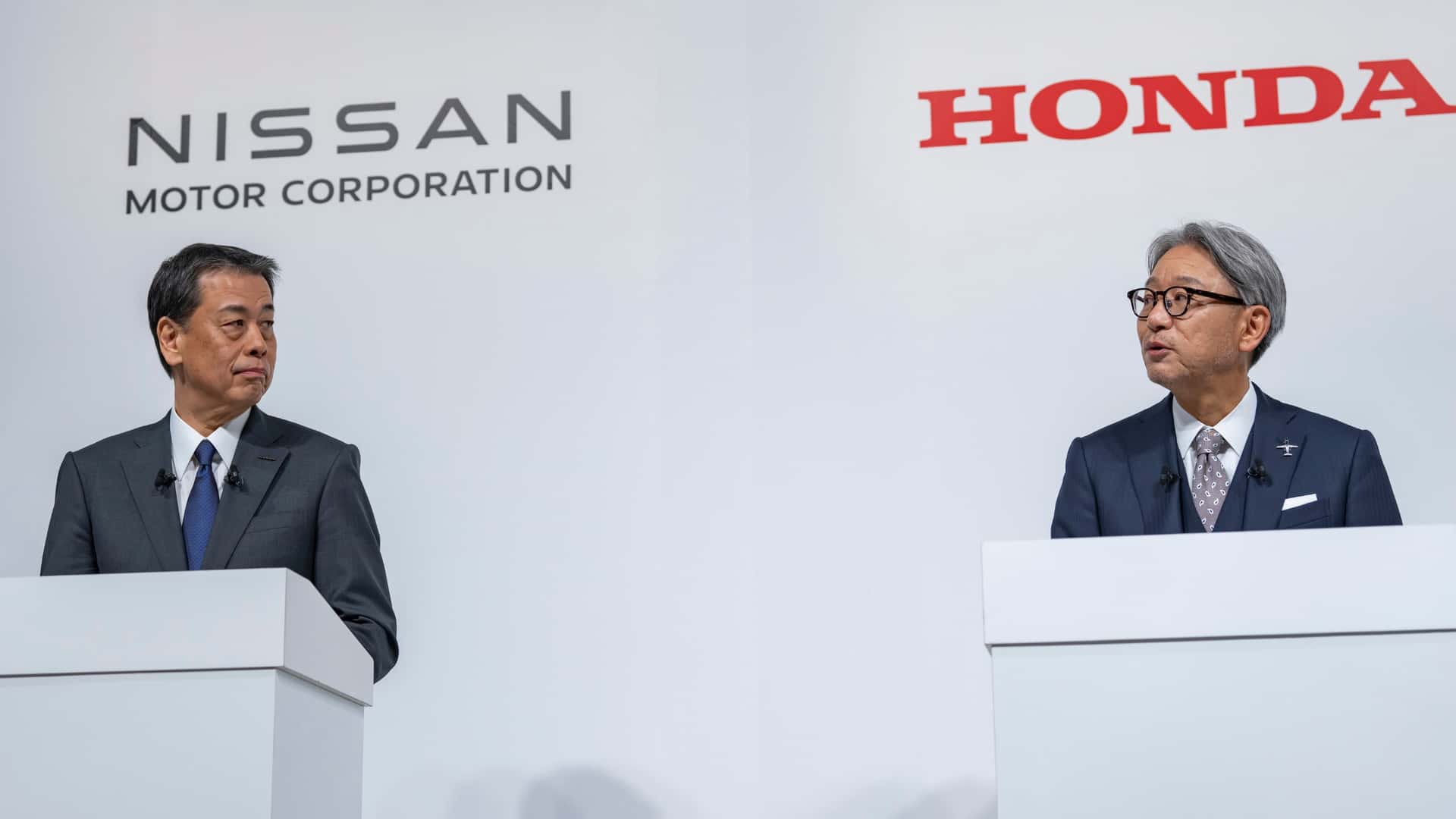


Eighteen months after their merger talks fell apart, Honda and Nissan signed a joint development agreement on August 31 that skips the corporate marriage entirely and goes straight for the nervous system.
The deal covers four layers of vehicle software: core electronic control units, the in-vehicle operating system, middleware, and the vehicle-control software that governs how a car actually behaves. Every gas, hybrid, and electric model from both companies built on this architecture will run the same jointly developed code. The target date is fiscal year 2029.
No new company gets created. No shared platform. No capital tie-up. Just two automakers who couldn’t agree on who would run a merged entity now agreeing to let their engineers write the same lines of code.
South Korean outlet Biz Chosun reported that the new OS and ECU architecture are based on Nissan technology. Neither Honda nor Nissan has confirmed that claim in official statements. Honda’s regulatory filing pins the fiscal 2029 timeline but notes the agreement won’t materially affect consolidated results for the year ending March 2027. Translation: the real money doesn’t start flowing until later.
The backstory makes this deal sharper. Honda, Nissan, and Mitsubishi signed a memorandum of understanding in late 2024 to explore full business integration. By early 2025, those talks were dead, killed by disagreements over control and corporate structure.
Honda’s CEO hinted at a broader Nissan collaboration in the months that followed, then separately shot down speculation about sharing body-on-frame platforms. The message was clear: some things get shared, some things stay locked in the vault.
Software is what made it through the gate. That choice is telling. Both companies trail Tesla and a growing roster of Chinese EV makers in their ability to push meaningful over-the-air updates to cars already sitting in customer driveways.
A common operating system is the fastest route to closing that gap without either company surrendering its brand identity, its vehicle architecture, or a board seat.
Neither automaker has named a specific model that will debut the shared software. Honda has shown hybrid sedan and SUV prototypes that hint at where its powertrain strategy is headed. Nissan’s upcoming hybrid system could theoretically run on the same shared computing hardware once it arrives, but “could” and “will” remain separated by years of engineering integration.
The deal also carries a quiet financial logic. Developing a modern vehicle OS from scratch costs billions. Splitting that bill across two product lineups, spanning two global sales networks, drops the per-unit cost dramatically.
For Honda, which sold roughly 3.9 million vehicles globally last fiscal year, and Nissan, which moved about 3.4 million, the combined volume gives shared software a much wider runway to pay for itself.
What stays unanswered is how deep this cooperation actually goes once code starts flowing between two engineering cultures that spent decades competing. Shared software has a way of pulling hardware decisions along with it. Suppliers get consolidated, specifications converge, and development timelines interlock.
Every automaker alliance that started with “just” software or “just” powertrain sharing eventually faced the question of where the boundary sits.
Honda says this is not a prelude to reviving merger discussions. The clock toward fiscal 2029 production is now running, and with it, the test of whether two companies that couldn’t agree on a corporate structure can agree on millions of lines of code.


Share this Story