
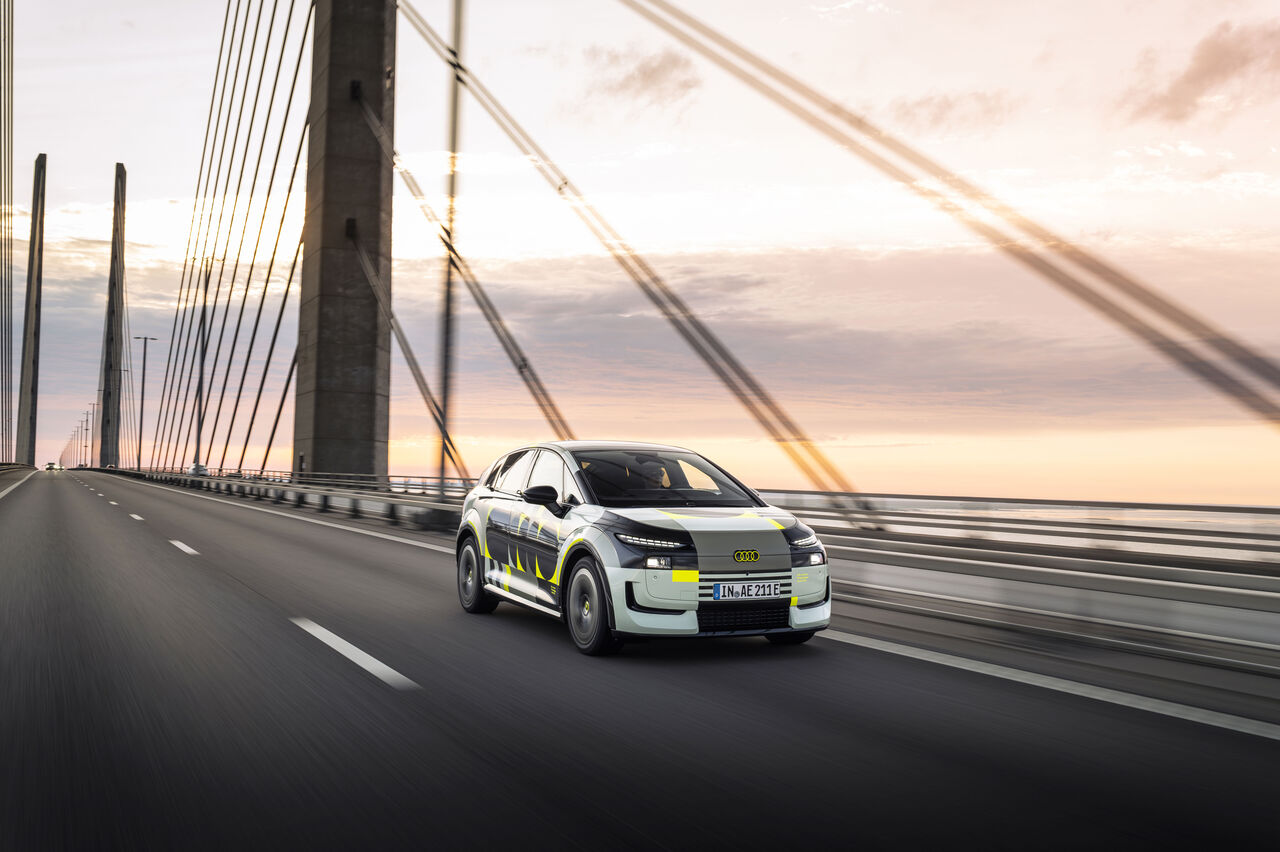


Audi just posted a number that should make every EV engineer in the industry look up from their desk. The upcoming A2 e-tron, in its 140 kW configuration with the optional efficiency package, consumes a preliminary 12.8 kilowatt-hours per 100 kilometers under WLTP testing. That makes it the most efficient Audi ever built.
For context, a Tesla Model 3 Standard Range sits around 14 kWh per 100 km in WLTP. The Hyundai Ioniq 6, one of the slipperiest EVs on sale, manages roughly 14.3. Audi is claiming a figure that undercuts both, and it is doing so in a compact car, not a wind-tunnel-optimized sedan with a 77 kWh battery.
The name itself is a deliberate callback. The original A2, launched in 1999, was Audi’s aluminum-bodied efficiency experiment. Its “3-liter” diesel variant consumed just three liters per 100 km.
CEO Gernot Döllner, who joined the Volkswagen Group in the 1990s, made the lineage explicit. “This is precisely the vision we are carrying forward,” he said.
Getting to 12.8 required attacking every source of energy loss at once. The drag coefficient hits 0.24, the lowest in Audi’s compact lineup. That alone trims up to 0.9 kWh per 100 km versus a version without the aero package.
Air curtains at the front flanks suppress turbulence. Gap reducers narrow the space between tire and wheel arch. An active cool-air intake stays sealed at highway speed, opening only when the battery or electronics demand cooling.
The drivetrain is new from the semiconductors out. Silicon carbide replaces silicon in the power electronics, slashing switching losses under partial load by up to 33 percent. The electric motor uses thinner laminations, 0.2 mm instead of 0.3 mm, to cut iron losses, and the stator winding shifts from star to delta configuration.
A new low-friction transmission oil and a tall 10.2:1 gear ratio keep motor speeds down at highway pace.
Then there is the battery. Audi chose lithium iron phosphate cells in a cell-to-pack layout, bonding cells directly into the housing to maximize packing density. The pack holds 61 kWh.
LFP chemistry avoids rare earth elements, ages more slowly than nickel-based alternatives, and allows daily charging to 100 percent without degradation anxiety.
The real trick is software. An adapted cooling strategy pushes wallbox charging efficiency to 89.6 percent. A custom algorithm tuned specifically to LFP chemistry tracks state of charge and state of health with a precision that older NMC-calibrated systems cannot match.
The flat voltage curve of the LFP pack maintains high voltage deep into discharge, keeping power delivery consistent rather than tapering.
Bidirectional charging is baked in. Vehicle-to-Load lets the car power external devices. Vehicle-to-Home, launching initially in Germany, Austria, and Switzerland, turns the A2 e-tron into a domestic energy storage unit paired with rooftop solar.
Audi plans to unveil the A2 e-tron in fall 2026 as its all-electric entry point in the compact segment. Pricing has not been announced, and that will determine whether this car is a statement piece or a volume play. A 12.8 kWh consumption figure is useless to most buyers if the sticker demands a premium over a Volkswagen ID.3 built on the same MEB+ platform underneath.
The engineering is sharp. The efficiency numbers are real, at least under WLTP conditions. What Audi has not yet revealed is how much the efficiency package costs, what the range looks like without it, or what happens to that 12.8 figure on a cold January morning at 130 km/h on the autobahn.



Share this Story