
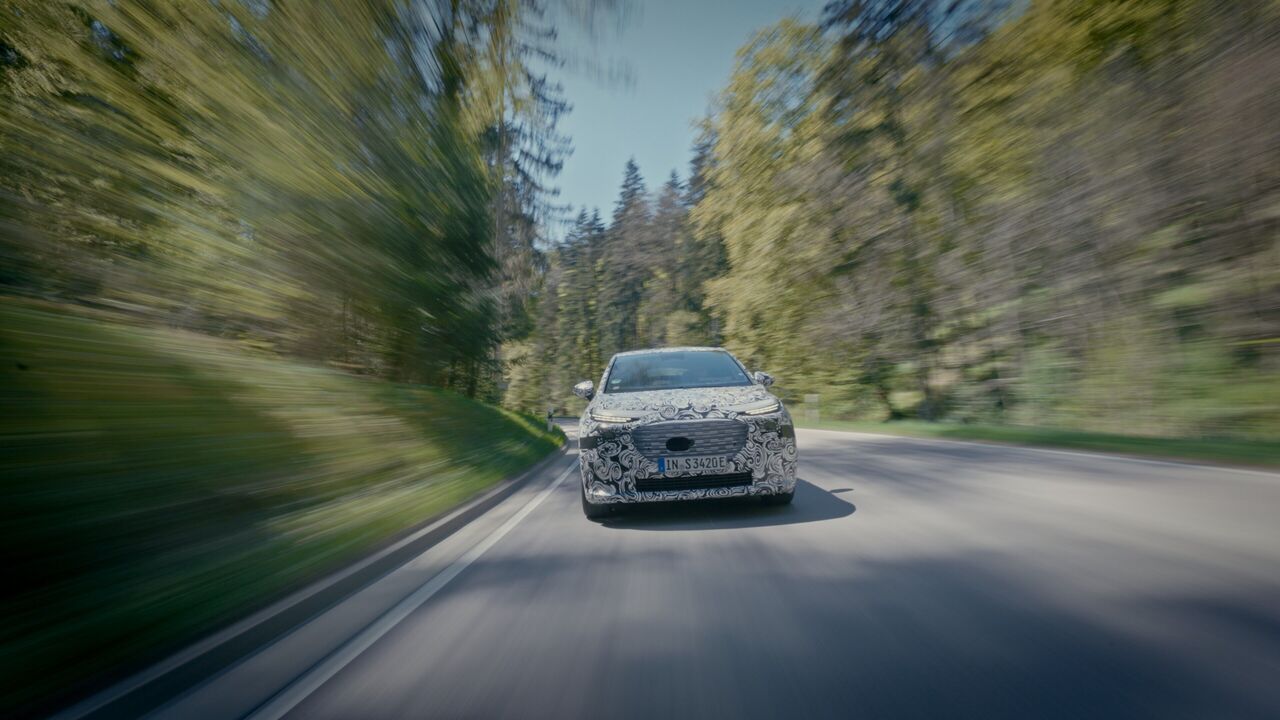


Twenty-three years after Audi quietly killed the original A2 — a lightweight, aluminum-bodied oddball that was ahead of its time and behind on sales — the name is coming back. This time it’s battery-electric, built in Ingolstadt, and aimed squarely at making Audi’s cheapest point of entry into the EV world.
The company confirmed the A2 e-tron will premiere this fall, with camouflaged prototypes already grinding through winter testing in Swedish Lapland, wind tunnel sessions at Audi’s Ingolstadt technical center, and real-world road validation on the twisting routes of Bavaria’s Altmühl Valley.
CEO Gernot Döllner framed it at the Audi Annual Media Conference as the brand’s next major move toward a fully electric lineup. The language was predictably corporate, but the underlying strategy is telling. Audi needs a compact EV, and it needs one badly.
The original A2, produced from 1999 to 2005, was a fuel-efficiency marvel wrapped in an aluminum spaceframe that cost too much to build. It earned a cult following and a commercial shrug. The new car shares nothing but the name — and the ambition to do something different at the bottom of the range.
Audi says the A2 e-tron’s distinctive roofline drives both its character and its aerodynamic efficiency, though no drag coefficient has been disclosed. Wind tunnel testing at speeds up to 300 km/h and a 235 km/h rolling road suggest Audi is sweating the details on range optimization. That’s exactly where compact EVs live or die.
Winter testing in Lapland focused on the usual checklist — driving dynamics, thermal management, battery performance in brutal cold — but also on the calibration loop between electric drivetrain, brakes, and suspension. That’s the tuning work that separates a credible compact from a forgettable one. Audi is clearly trying to push its premium DNA down into a lower price bracket without diluting it.
Production stays in Ingolstadt. That’s a significant commitment to German manufacturing at a time when cost pressure is pushing volume EVs toward cheaper production locations. Audi frames it as transforming its plants in Germany and Europe, which sounds noble until you remember the brand doesn’t really have a choice — Ingolstadt needs product, and the A2 e-tron is it.
The competitive landscape the car enters is brutal. Volkswagen’s ID.3 owns the group’s compact EV floor. BMW’s iX1 and the upcoming Neue Klasse compacts are circling the same buyers.
BYD’s Atto 3 and the Seal U undercut everyone on price. Stellantis is flooding the zone with electric compacts from multiple brands. For Audi, the challenge isn’t just building a good small EV — it’s justifying the premium over its own parent company’s offerings while fending off Chinese competitors who don’t carry German labor costs.
Audi claims it now has the youngest model portfolio among its premium rivals after launching more than 20 new models across 2024 and 2025. The A2 e-tron extends that wave into 2026 and fills the one gap that mattered most: an affordable gateway car for buyers who want the four rings but don’t want a $50,000 SUV.
No pricing, no range figures, no battery specs. Audi is still playing coy with the numbers that will ultimately decide whether the A2 e-tron is a real market force or just a halo exercise for the compact segment. The fall reveal will have to deliver substance, not just another camouflaged teaser on a frozen lake.
The name worked once as a cult curiosity. This time, Audi needs it to work as a volume play.
Share this Story