
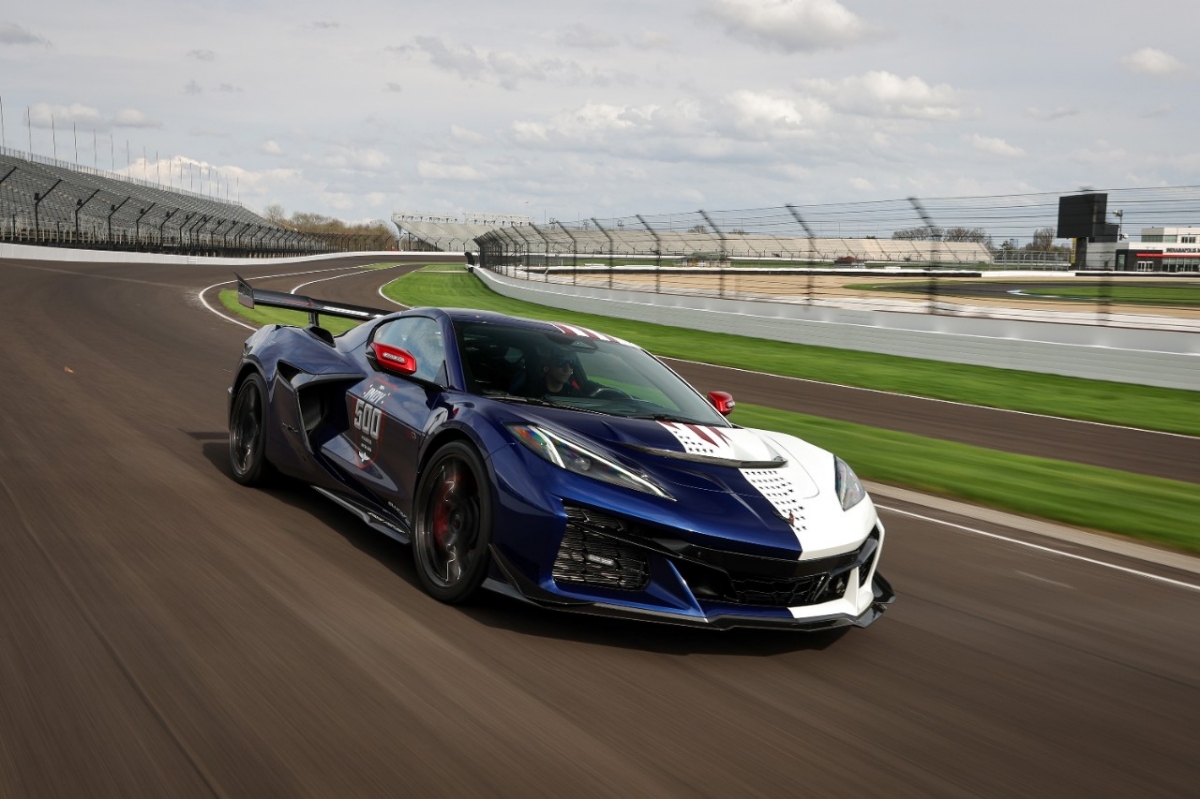


A 1,250-horsepower hybrid Corvette will lead 33 IndyCars to the green flag on May 24. For the first time in the race’s 110-year history, the pace car could genuinely keep up with the field it’s supposed to restrain.
Chevrolet announced Wednesday that the 2026 Corvette ZR1X will pace the Indianapolis 500, marking the 23rd time a Corvette has drawn the duty and the 37th overall for the Chevrolet brand dating to 1948. This isn’t your grandfather’s pace car. The ZR1X hits 233 mph and cracks zero to 60 in under two seconds, sitting uncomfortably close to qualifying speeds at the Brickyard.
The powertrain tells the story of where GM’s performance engineering has landed. A 5.5-liter twin-turbocharged flat-plane-crank V8 sends 1,064 horsepower to the rear wheels while a 186-hp electric motor drives the front axle. Combined output: 1,250 horsepower across all four wheels.
The Carbon Aero package — dive planes, underbody strakes, rear wing — generates more than 1,200 pounds of downforce at speed. This is a production car wearing a pace car livery, not the other way around.
Indiana University head football coach Curt Cignetti will serve as honorary pace car driver, a nod to the Hoosiers’ undefeated national championship season. It’s the kind of cross-sport celebrity cameo IMS has perfected over decades. One suspects the real star on race morning will be the machine idling beneath him.
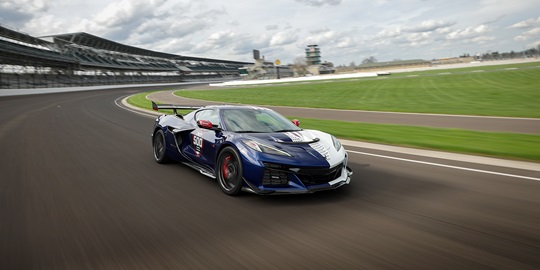
The livery leans hard into the nation’s 250th birthday. Arctic White on the driver’s side, Admiral Blue on the passenger side, stars-and-stripes decals across the body, red accent seat belts and stitching inside. Subtle it is not.
What’s remarkable is how completely the ZR1X collapses the gap between production car and racing machine. Pace cars have traditionally been showpieces — fast enough to look credible on the front stretch, slow enough that nobody confused them for competitors. The C4 Corvette that paced the 1986 race made 230 horsepower.
The gap between pace car and race car used to be a canyon. Now it’s a crack in the sidewalk.
GM clearly sees the Indy 500 as a stage for something bigger than a ceremonial lap. The ZR1X is the tip of a performance portfolio that now includes hybrid architecture, advanced aerodynamics, and output figures that would have seemed delusional a decade ago. Parking it in front of the field at Indianapolis isn’t tradition for tradition’s sake.
Corvette holds the distinction of being the longest-running nameplate in the American auto industry, and its relationship with the Speedway has become almost reflexive. But this year’s pairing feels different. When a pace car’s top speed makes you do a double-take against the qualifying chart, the exercise stops being ceremonial.
The 110th Indianapolis 500 runs May 24. Thirty-three drivers will follow the ZR1X into Turn 1. For one lap, at least, the slowest car on the track will still be making 1,250 horsepower.

Share this Story