
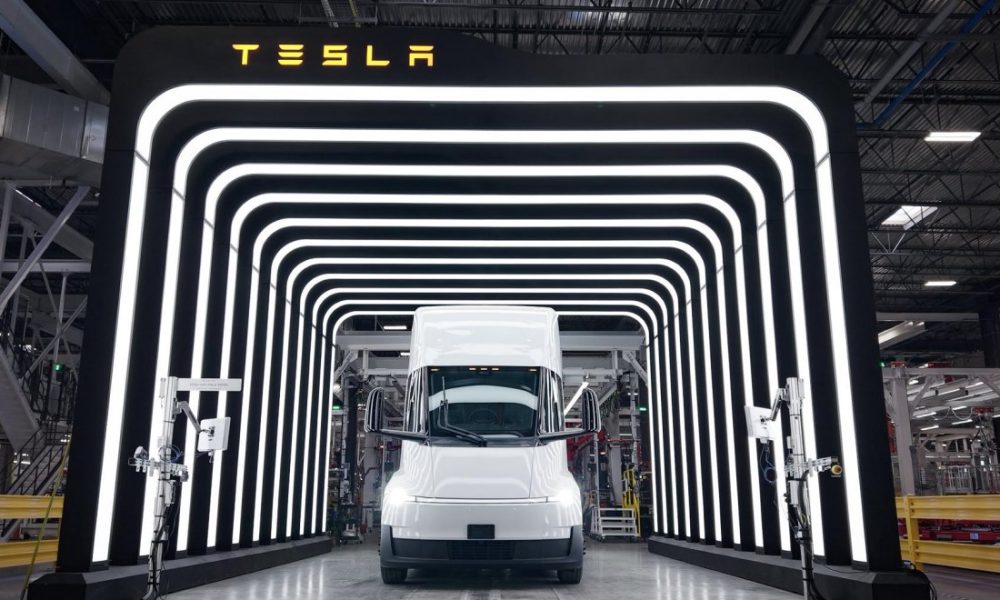


Forty-six hundred cells per module, 1,200 miles between factories, and not a single human hand on the battery from start to finish. That is the vision Tesla laid out at its September 24 Semi Handover event in Sparks, Nevada, where the company launched high-volume production at a new 1.8-million-square-foot plant purpose-built for electric trucks.
The facility sits next to Gigafactory Nevada and is designed to produce 50,000 Semis per year. After a four-year redesign that swapped the original 2170 cells for Tesla’s in-house 4680s manufactured in Austin, the truck finally has a battery architecture the company believes can scale.
Here is where it gets interesting. Tesla says trailers loaded with 4680 cells will leave Giga Texas, arrive in Nevada, and be unloaded by a dedicated automated system that stations the cells and feeds them directly into pack and vehicle assembly. No human intervention at any point.
Lars Moravy, VP of Vehicle Engineering, and Dan Priestley, head of the Semi program, both used the phrase “zero human touch point” to describe the pipeline from trailer dock to finished truck.
The plant itself reflects the same obsession. Tesla claims it uses the highest-capacity electric monorail conveyance in vehicle manufacturing to move frames-in-white simultaneously. Powder-coating replaces conventional paint, and processes that normally require operators have been engineered out of the sequence entirely.
The logic is straightforward. Batteries represent the largest share of the truck’s cost and weight. Every time a human handles a cell, you introduce risk of damage, quality variation, and delay.
Eliminating those touchpoints across two factories separated by half a continent would be a genuine manufacturing achievement, if Tesla actually pulls it off. That qualifier matters. The first trucks rolled off the new line in April 2026, but volume is ramping gradually.
Early customers include PepsiCo, DHL, and U.S. Foods. Whether the automated trailer-to-line process truly reaches zero-touch will become visible as production scales over the coming months.
There are practical reasons to watch closely. The Semi now shares a bar-wound stator and other components with the Cybertruck, linking Tesla’s commercial and passenger vehicle supply chains more tightly than any previous program. A disruption in 4680 output at Austin would ripple across both product lines simultaneously.
Tesla has talked about “the machine that builds the machine” since the Model 3 ramp in 2018, when the original attempt at extreme automation in Fremont famously stumbled. Elon Musk himself admitted at the time that humans were underrated. The Semi factory represents a second, more measured attempt at the same philosophy, applied across multiple sites rather than within a single building.
The 50,000-unit annual target is ambitious for a Class 8 electric truck. The entire U.S. Class 8 market typically moves around 250,000 units per year, and battery-electric trucks remain a fraction of that. Tesla recently landed what has been called the largest electric truck deal in U.S. history, so demand signals exist.
But converting those signals into a steady stream of trucks built without human contact is an engineering problem no one has solved at this scale. The automated unloading system, the monorail conveyance, the powder-coat line — all of it sounds impressive in a presentation. The real test starts now, one trailer at a time, rolling east from Austin into a factory that promises to never let a person touch what is inside.
Share this Story