
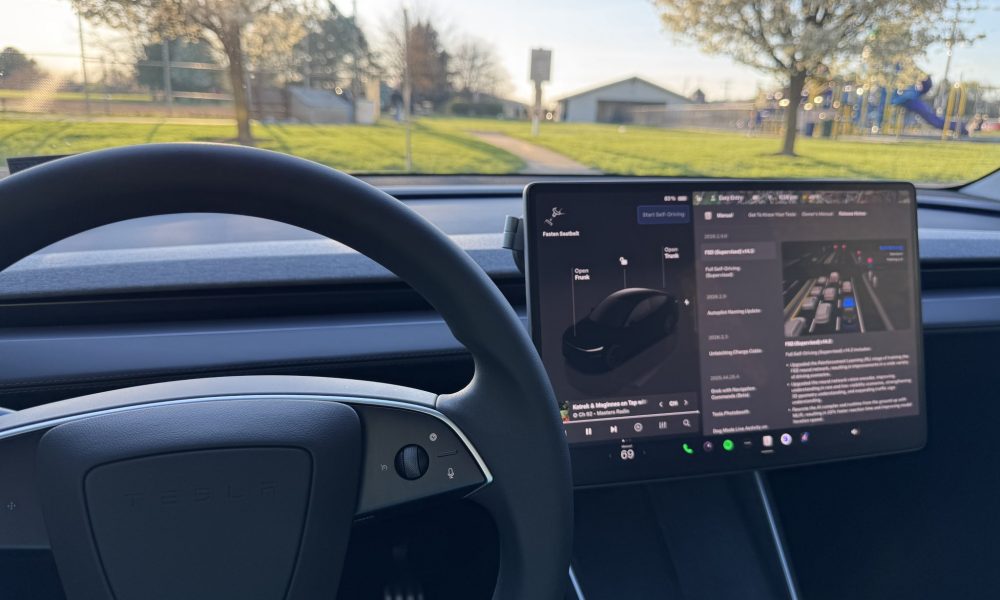


Tesla’s Full Self-Driving system is about to get ears that matter. Not the kind that play your podcast or set a reminder, but the kind that listen when you say “it’s the white house on the left, just past that SUV” and remember it forever.
Ashok Elluswamy, Tesla’s VP of AI Software, confirmed this week that the company is building a feature allowing drivers to give FSD contextual, natural-language instructions the car will store and recall on every subsequent trip. The confirmation came after a Tesla owner publicly flagged one of FSD’s most stubborn blind spots: it has no mechanism for the kind of simple, human guidance you’d give any ride-share driver pulling up to your house for the first time.
Grok, Tesla’s AI assistant, has lived inside its vehicles since July 2025. It spread to European cars in February 2026 and picked up hands-free activation and natural-language navigation in the Spring 2026 update. But until now, Grok has been a passenger. It could talk, but it couldn’t steer.
Lane changes, braking, parking — all locked inside FSD’s autonomous decision loop, untouchable by voice. That wall is coming down.
Elon Musk confirmed on June 23 that Grok voice commands will feed directly into FSD’s planning layer by September 2026. Three months from confirmation to deployment.
Elluswamy acknowledged the obvious risks back at a January 2026 conference: “You shouldn’t be able to tell the car to crash, and it shouldn’t crash.” Bridging conversational AI and vehicle control opens a testing domain Tesla has never faced before — one where adversarial inputs aren’t sensor noise or weather but human speech, with all its ambiguity and potential for misuse.
The safety challenge is real. But so is the strategic calculus behind this feature, and it’s worth understanding what Tesla is actually building here.
Every spoken correction — pull into this driveway, not that one; wait by the side gate, not the front door — becomes a training data point for an edge case that no simulation could manufacture. Multiply that across millions of vehicles and you get a crowdsourced layer of hyper-local intelligence that no competitor without a comparable fleet can replicate at speed.
Google Maps pins that land on the wrong house are a punchline. Tesla is trying to make them an artifact.
The timing lines up with Tesla’s expanding robotaxi ambitions. Cybercab operations launched in Austin and have since spread to Miami, with rider profiles already collecting preference data. Attach voice-taught contextual memory to those profiles and a Cybercab could eventually know which entrance to use, where to idle, and how to navigate the last hundred feet of a trip it’s made before — without the passenger saying a word.
That final hundred feet has always been autonomy’s ugliest problem. Highway driving is largely solved. Urban intersections are getting better. But the driveway, the apartment complex entrance, the unmarked alley behind a restaurant — these are the places where generic mapping data falls apart and local knowledge is everything.
Tesla is betting that its customers will teach its cars what no satellite image can.
The risk is scope creep. Letting a conversational AI influence a two-ton vehicle’s driving decisions is a fundamentally different proposition than letting it read your calendar. Elluswamy’s January comments suggest Tesla knows this. Whether three months is enough time to build the safety layer this feature demands is another question entirely.
If it works, Tesla will have turned every owner into an unpaid driving instructor feeding a proprietary intelligence network. If it doesn’t, the company will have handed regulators exactly the kind of headline they’ve been waiting for.
September will tell us which one it is.

Share this Story