
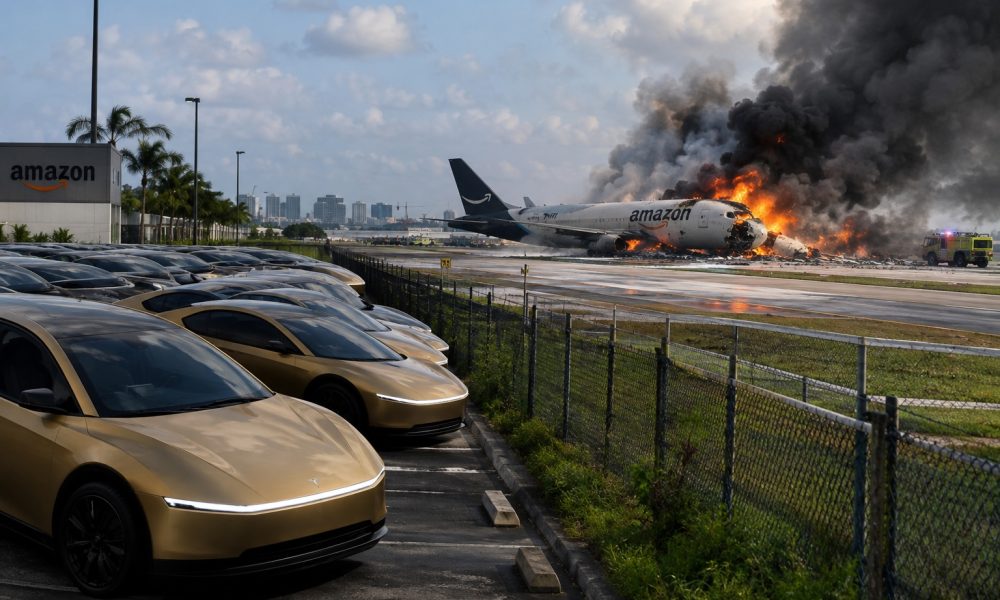


Five people died Sunday when an Amazon Prime Air Boeing 767 overran the runway at Miami International Airport, crossed a six-lane road, struck multiple vehicles, and caught fire. The wreckage came to rest feet from a fenced staging lot packed with dozens of gold-painted Tesla Cybercabs that had not yet entered service.
The jet, operated by 21 Air as Flight 7598, arrived from San Juan and touched down around 2 p.m. Flight data reviewed by aviation outlets shows an approach speed near 170 knots, roughly 30 knots above the normal range for a 767. Investigators have not yet determined why.
Five additional people were injured. Miami-Dade Fire Rescue confirmed the plane hit “multiple vehicles” but has not specified whether any Cybercabs were among them. Tesla has said nothing. Airport officials have said nothing.
Elon Musk said one word. Replying on X to a Zero Hedge post showing the Cybercabs sitting in the shadow of the wreckage, he wrote “Weird.” That was it.
The Cybercabs in that lot represent Tesla’s next commercial chapter. The company launched the steering-wheel-free robotaxi on Austin streets just last week, on September 3, to considerable fanfare and immediate federal scrutiny. The National Highway Traffic Safety Administration opened an audit into how Tesla self-certified a vehicle with no steering wheel and no pedals as compliant with federal motor vehicle safety standards.
That inquiry has nothing to do with the Miami crash, but the two stories now share a news cycle. Optics have a way of compounding.
Miami already has a Tesla robotaxi operation. It runs on modified Model Y vehicles and has been fully unsupervised since at least July, when Tesla’s head of Autopilot, Ashok Elluswamy, confirmed the detail publicly. The Cybercabs parked near the runway were apparently staged for a future expansion of that service.
Their proximity to one of the country’s busiest airports was either a logistical convenience or a marketing decision. Either way, it backfired in the most literal sense possible.
The FAA and NTSB are focused on the aircraft. Amazon said it is cooperating with authorities and that safety is its priority. Standard language for a nonstandard event.
What sticks is the image. A new, unproven autonomous vehicle sitting untouched beside a burning fuselage, surrounded by emergency crews and body bags. Tesla did not cause this crash.
Tesla had no operational role in it. But Tesla’s most visible new product was parked right there, and no amount of silence from the company changes the fact that every news camera on scene captured the same frame.
The Cybercab launch was supposed to be the story of the week. Austin rides, no steering wheel, a new era for Tesla’s autonomy ambitions. Instead, the vehicle’s first major appearance in the national press comes courtesy of a cargo plane that couldn’t stop.
Musk has built an empire on controlling narratives. He picks the timing, the platform, the spectacle. This time the spectacle picked him.
A freak accident, a parking lot, and a fleet of gold robotaxis that weren’t supposed to be famous yet. No one at Tesla, the FAA, or Miami-Dade has said when or whether those Cybercabs will be moved. The wreckage is still being cleared.
The investigation is just starting. And dozens of Tesla’s future are still sitting right where Sunday left them.
Share this Story