
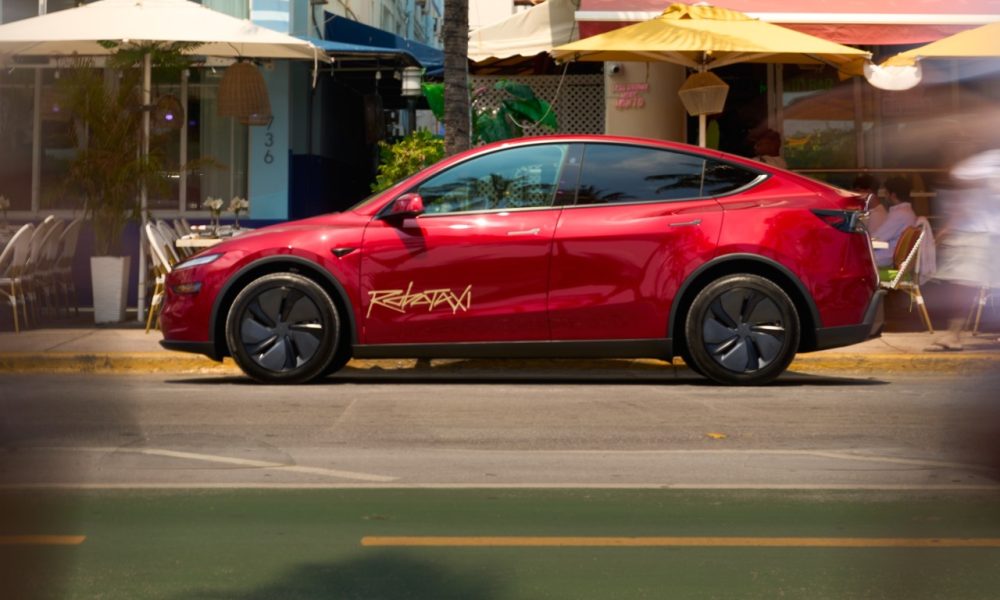


Thirteen months after its first autonomous ride rolled through Austin, Tesla’s Robotaxi network just touched down in Miami, marking its third state and sixth metropolitan area. The initial geofence covers roughly 10 to 14 square miles of western and central Miami, including Miami International Airport and major arteries like the Palmetto Expressway and Tamiami Trail.
It’s a deliberate, airport-first footprint, smaller and more targeted than Waymo’s initial eastern Miami rollout. Tesla is clearly prioritizing high-traffic corridors where ride-hailing demand is a sure thing before fanning out into broader coverage.
The trajectory tells you everything about Tesla’s expansion playbook. Austin launched in June 2025 with limited commercial operations. San Francisco’s Bay Area followed weeks later.
Full commercial service in Austin didn’t arrive until November. Then came Dallas, Houston, and San Antonio in April 2026, blanketing Texas before crossing state lines again.
Florida is a different animal. It’s a tourism machine, funneling millions of visitors through airports and coastal routes annually from Fort Lauderdale to Palm Beach and the entire Gold Coast corridor. If Tesla can prove its autonomy stack in Miami’s chaotic traffic mix of rental cars, rideshare vehicles, and confused tourists, scaling to other Florida cities becomes a much easier pitch to regulators and riders alike.
The timing is no accident. Tesla dropped this Miami news on July 3, the day before a holiday weekend when millions of Americans are thinking about travel, airports, and getting somewhere without driving. It’s marketing precision dressed up as an operational update.
Zoom out, though, and the Robotaxi expansion is just one piece of a company moving aggressively on multiple fronts this week. Tesla launched the Model Y L in the United States at $61,990, a six-seat, three-row, longer-wheelbase variant that’s been available in China since last year. With the Model X now discontinued, Tesla needed something to fill the gap for families who want more room than a standard Model Y provides.
The Model Y L Launch Series lands with 325 miles of range, ventilated captain’s chairs in the second row, a 16-inch front touchscreen, and deliveries slated for September or October. At $61,990, it undercuts most three-row luxury EVs by a wide margin. Features like adaptive damping, staggered tires, and 89 cubic feet of cargo space push it closer to premium territory.
Meanwhile, Elon Musk was on X tamping down expectations for Optimus, Tesla’s humanoid robot. Limited production begins on a converted Model S/X line at Fremont in late July or August, but Musk was blunt: “Optimus production will be extremely slow at first, as everything is new. This is not like making a car.” A dedicated factory at Giga Texas targets higher volume around summer 2027.
Three major product lines, three very different timelines. The Robotaxi network is scaling city by city with methodical discipline. The Model Y L fills an obvious product gap with a vehicle already proven in China.
Optimus crawls toward its first production units with roughly 10,000 unique parts and zero established supply chain to lean on. That alone makes it the wildcard in this portfolio.
Tesla has spent years promising a future built on autonomy, energy, and robotics. The company is now executing on all three at once, something no other automaker or tech company is attempting at this scale. The Robotaxi reaching Florida is a milestone, but it’s the velocity across the entire portfolio that separates this moment from the slideshow promises of years past.
Whether Miami riders embrace driverless Teslas the way Austin and the Bay Area have remains to be seen. Florida’s regulatory environment is friendly to autonomous vehicles, and the state’s flat, grid-heavy road networks are arguably easier terrain than San Francisco’s hills.
Six cities. Three states. Fourteen months in. Tesla’s autonomous ambitions are no longer theoretical. They’re accumulating zip codes.


Share this Story