
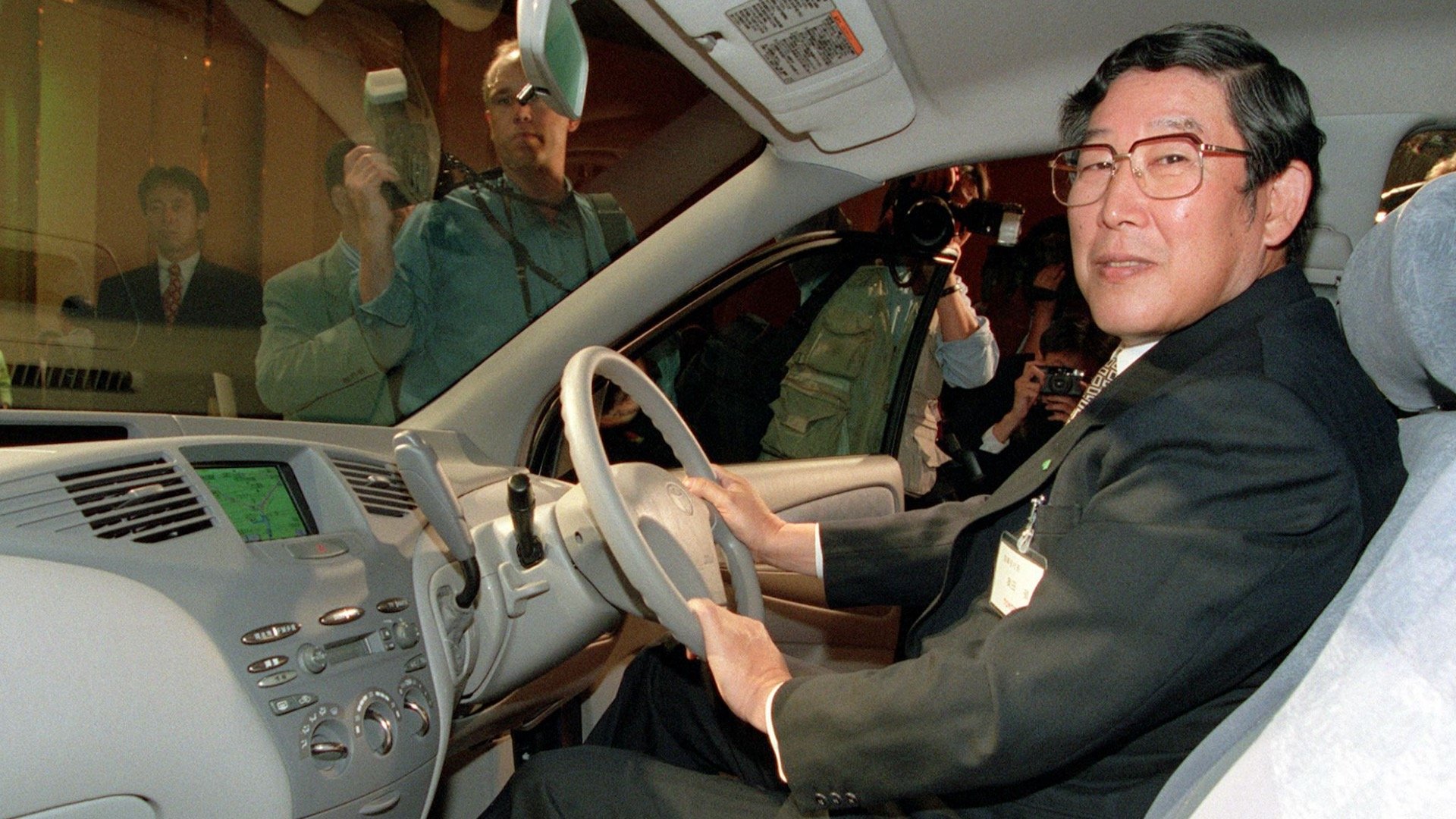


Hiroshi Okuda, the Toyota executive who shoved the Prius into production a full year ahead of schedule and helped turn a modest Japanese automaker into a global titan, died this week at 93. Toyota confirmed his death Thursday, citing natural causes.
Okuda ran Toyota as CEO and then chairman from 1995 to 2006, capping a 45-year career that began almost immediately after his 1955 graduation from Hitotsubashi University in Tokyo. He was not a member of the founding Toyoda family, which still holds enormous sway over the company. That made his ascent to the top job all the more unusual.
The Prius launched in Japan in 1997, and Okuda is the reason it existed at all. He pushed for its development and then demanded the production timeline be compressed by a year. Takeshi Uchiyamada ran the engineering program and also carries the “father of the Prius” title, but Uchiyamada was executing Okuda’s vision. Without the executive mandate from the top, the world’s first mass-market hybrid would have arrived later, if it arrived at all.
It is easy to forget now, with every automaker chasing electrification, that the Prius was a bizarre bet in 1997. Gas was cheap. SUVs were ascendant. Nobody was asking for a slow, oddly shaped sedan that prioritized fuel economy above all else. Okuda saw something the rest of the industry missed, or chose to ignore.
But the Prius was only part of the story. Okuda oversaw Toyota’s aggressive expansion of production capacity in Europe and the United States during the very years the Camry was cementing itself as the best-selling car in America. He positioned the company to capitalize on a market that was shifting toward reliable, affordable transportation. While Detroit chased truck profits, Toyota planted flags on factory floors across the globe.
He also pushed to promote younger managers, a move that sounds unremarkable until you understand mid-1990s Japanese corporate culture. “Younger” in this context meant executives in their 50s rather than their 60s. Even that modest acceleration was a challenge to deeply entrenched norms. Okuda was a pragmatist, not a revolutionary, and that pragmatism is precisely what made Toyota so dangerous to its competitors.
The late 1990s were arguably the peak of Japanese automaking dominance. Honda had the Civic and Accord firing on all cylinders. Nissan was about to be rescued by Carlos Ghosn. And Toyota, under Okuda, was building the infrastructure and product pipeline that would carry it to the top of global sales charts for decades.
Okuda’s cars were never exciting. The Camry is appliance transportation. The Prius became a cultural punchline before it became a cultural force. But both vehicles reshaped how the entire industry thinks about what consumers actually want versus what enthusiasts wish they wanted.
Toyota today sells more cars than almost anyone on Earth, and its hybrid technology remains the backbone of its electrification strategy while rivals scramble to make battery-electric vehicles profitable. The roots of that position trace back to a non-family executive who had the authority and the nerve to push a hybrid nobody asked for into showrooms before anyone thought it was ready.
Okuda was 93. The company he shaped is still running on decisions he made three decades ago.



Share this Story