


Four hundred thousand electrified vehicles sold in America last year, and not one of them needed a Supercharger. Honda just dropped a brand campaign called “Relentless Spirit” that pairs its hybrid lineup with IndyCar machines and Baja-ready CR-V racers. The message underneath the slick visuals is unmistakable: hybrids are not a transitional technology. They are the strategy.
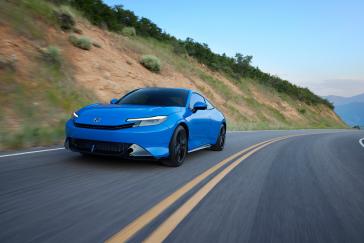
The campaign, launching across broadcast, streaming, and social channels, threads the Civic, Accord, CR-V, and the freshly returned Prelude through city streets and mountain switchbacks while ghostly motion trails of Honda race cars follow in their wake. It will blanket the Indianapolis 500 broadcast, FIFA World Cup coverage, NBA and NHL playoffs, and WNBA matchups. Honda is spending real money here, not on EVs, but on the cars already moving off dealer lots in record numbers.
Three consecutive years of all-time hybrid sales records. The CR-V hybrid now accounts for more than half of all CR-V sales, and the Accord hybrid crossed the same threshold. Civic hybrid makes up a third of Civic volume, and the Civic itself owns over 25 percent of the compact car segment at retail. These are not niche products limping along on tax credits.
And they are cheap, or at least cheaper than the competition. The Civic hybrid starts at $30,100. The Accord hybrid at $32,100, the CR-V hybrid at $36,000. Every one of them lands well below the national average transaction price hovering near $46,000. In a market where affordability has become a crisis, Honda is selling 50-mpg sedans for the price of a loaded Camry.
The EPA backs up the efficiency claim. Honda holds the title of most fuel-efficient full-line automaker in America according to the agency’s latest Automotive Trends Report. The Civic hybrid hits 50 mpg city, and the Accord manages 51. Even the CR-V, a compact SUV with real utility, returns 43 city in two-wheel-drive form.
The new Prelude, a hybrid sports coupe borrowing its chassis hardware from the Civic Type R, posts 46 city. That makes it the most fuel-efficient sports coupe on sale in the country.
That Prelude is doing interesting work for Honda’s image. Wrapping Type R suspension geometry and a two-motor hybrid powertrain inside a coupe body sends a pointed message to buyers who think electrification means dull. Honda is leaning into “fun to drive” as a differentiator, and its dominance among young buyers suggests the pitch is landing. Strategic Vision’s 2025 study placed the Civic, Accord, and CR-V hybrids at the top of the industry with younger demographics.
The broader context makes Honda’s hybrid bet look even sharper. The EV market has cooled, and inventory is piling up on dealer lots from brands that went all-in on batteries. Charging infrastructure remains patchy outside major metros. Meanwhile, Honda quietly sold more electrified vehicles than ever without asking a single customer to change their refueling habits.
Honda is not abandoning EVs entirely. The Prologue exists, and 15 next-generation hybrid models are slated globally by 2030 with an all-new hybrid system arriving in 2027. But the company clearly sees the next several years belonging to hybrids, and it is putting its marketing budget where its sales data already points.
The “Relentless Spirit” campaign wraps racing heritage around a fundamentally pragmatic product lineup. Strip away the IndyCar imagery and the muddy trail footage, and the pitch is simple: 50 miles per gallon, under $32,000, no range anxiety, and it is actually fun to drive. In a market drowning in overwrought EV promises and six-figure electric trucks, Honda is selling common sense at scale and winning.
Share this Story