
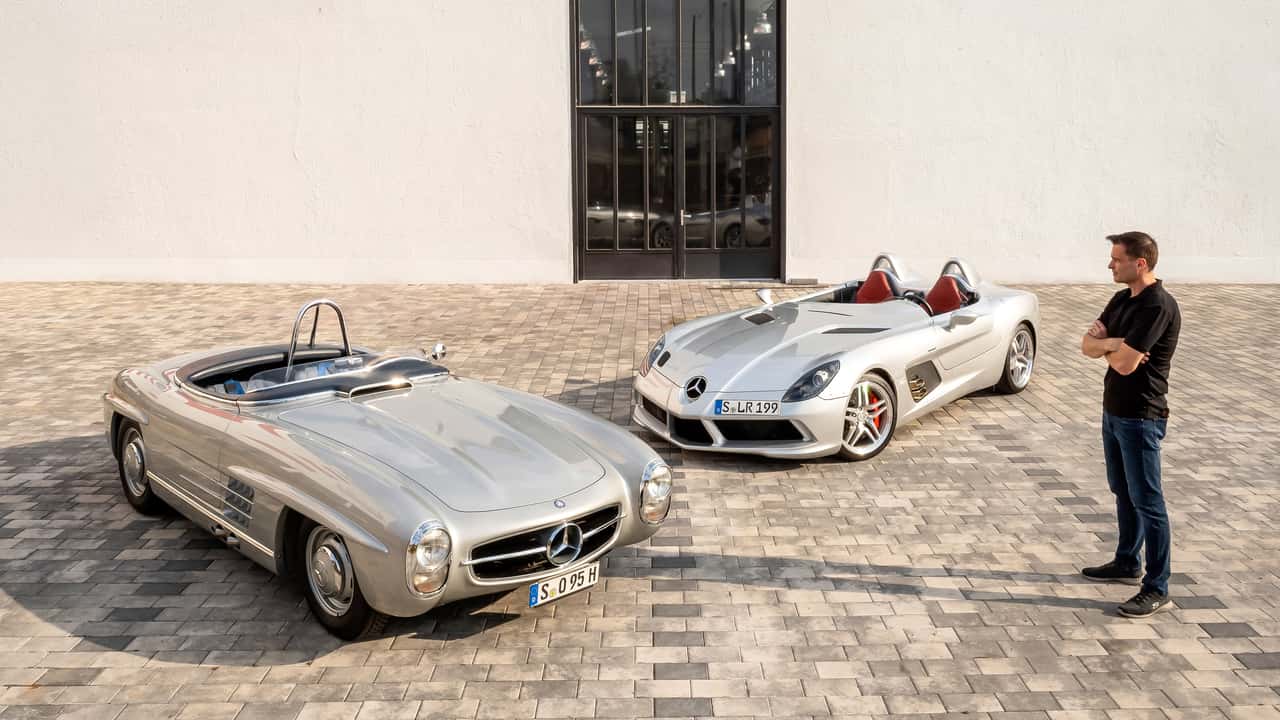


Mercedes-Benz built exactly two 300 SLS race cars in 1957. Only 75 SLR McLaren Stirling Moss editions rolled out of the factory in 2009. Getting behind the wheel of either one sits somewhere between improbable and absurd. Driving both on the same day, back to back, on public roads around Stuttgart? That’s the kind of thing that doesn’t happen twice.
The 300 SLS came first. Born because the Sports Car Club of America wouldn’t let the production 300 SL Roadster race in its desired class, Mercedes stripped nearly 800 pounds out of the car, ditched the bumpers, swapped the windshield for a tiny racing screen, and extracted 235 horsepower from the inline-six. Paul O’Shea won the American D-class championship with it. Both originals are locked away, untouchable, so Mercedes-Benz Classic built a faithful recreation from historical records. That’s what was sitting in the parking lot.
Climbing inside is a full sensory reset. No screens, no assists, no drive modes. A large steering wheel, a few gauges, two sport seats. The transmission feels notchy at standstill, the steering heavy. Once rolling, the car transforms.
It turns light, communicative, alive. Every steering input transfers directly to the narrow tires, which remind you quickly that grip was a negotiation in 1957, not a guarantee. The brakes reinforce that message.
The driver has to think ahead, plan every corner, every downshift, every braking zone. Nothing is automated. Nothing is forgiven.
Then there’s the sound. The virtually unmuffled exhaust exits from the rocker panel on the right side. Under load, the inline-six produces something no modern car can replicate.
Lift off the throttle and it crackles on its own, no software involved. The smell of hot oil and unburned fuel fills the open cockpit. This is what racing actually smelled like before it was sanitized.
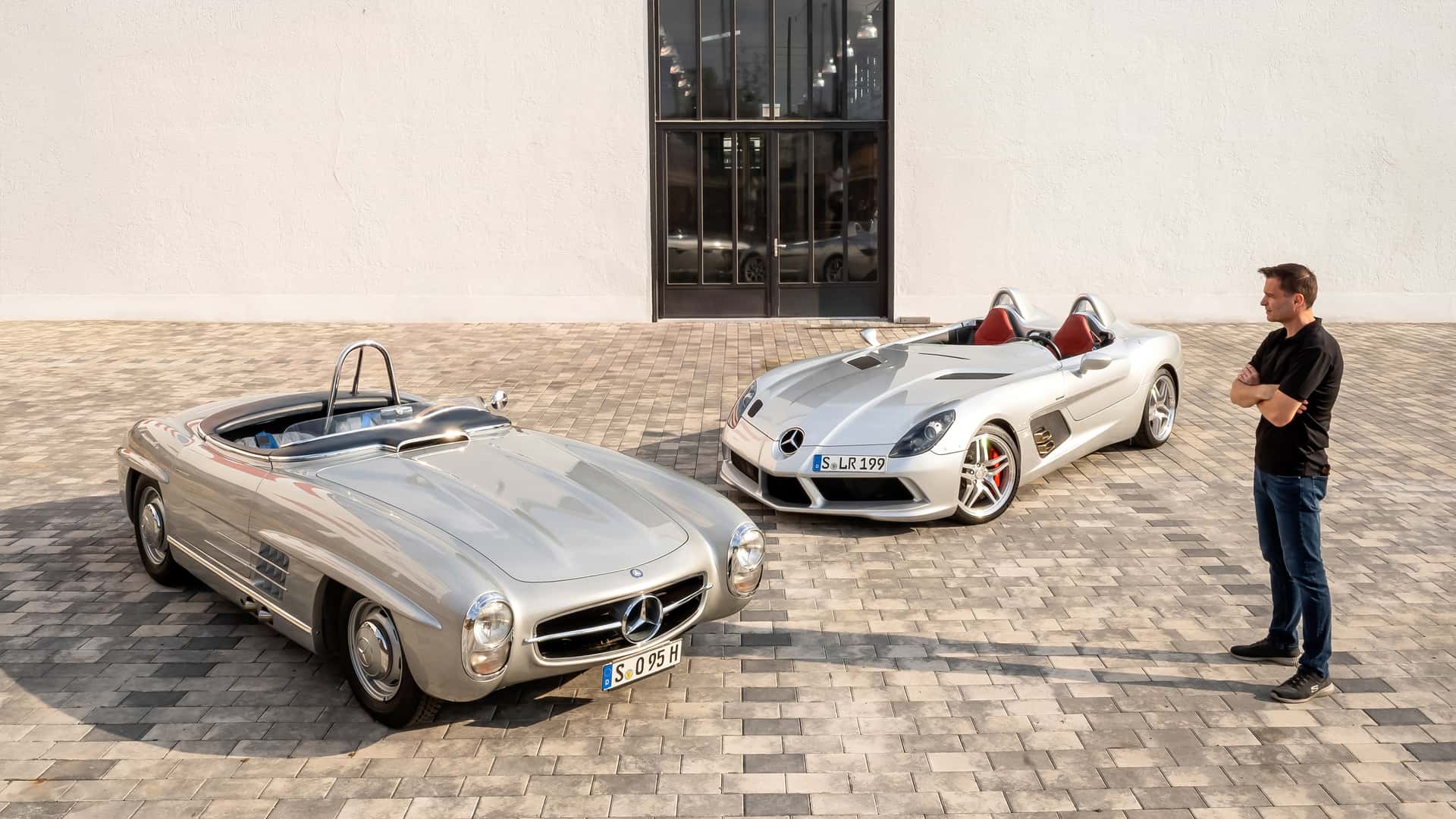
The switch to the SLR McLaren Stirling Moss spans five decades in a single walk across the parking lot. Carbon fiber replaces steel. A supercharged 5.4-liter V8 making 650 horsepower replaces the inline-six.
The car was conceived as a tribute to Stirling Moss and his 1955 Mille Miglia victory in the 300 SLR, and Mercedes limited production to 75 units, each priced well north of a million dollars.
Getting in requires stepping over absurdly wide carbon sills into a deeply recessed bucket seat. The seating position is closer to a formula car than anything street-legal. There is no real windshield, just a small deflector. Mercedes-Benz Classic staff suggested a helmet. The journalist declined. Sunglasses would have to do, same as in the 300 SLS.
Push the start button and the supercharged V8 announces itself through side-exit exhaust pipes that look like sculpture and sound like a threat. In automatic mode around town, the car is almost docile, a predator pretending to be polite. Pull the left paddle, drop two gears, go to full throttle, and the pretense ends.
The supercharger whines, then the V8 takes over with a metallic roar that intensifies all the way to the rev limiter. Tunnels become echo chambers. Load changes become percussion.
What links these two cars across half a century is not engineering lineage or shared components. It’s philosophy. Both are roofless, windshield-less, stripped to the essentials, built to overwhelm the senses rather than insulate them.
The 300 SLS does it with mechanical purity and analog feedback. The Stirling Moss does it with carbon fiber and brute force. Neither car hides anything from the driver.
Stuttgart’s locals, presumably accustomed to seeing exotic Mercedes hardware, still couldn’t resist pulling out their phones as both cars passed. Even on home turf, among people who’ve seen it all, these two stopped traffic.
Mercedes-Benz Classic doesn’t just store these machines. They exercise them, which is the only real way to preserve what they actually are. A car behind a rope is furniture.
A car on the road, with hot oil in the air and exhaust bouncing off tunnel walls, is still alive. Both keys went back at the end of the day, but the inline-six crackle and the supercharger shriek are still rattling around somewhere in the back of the brain, refusing to settle.

Share this Story