
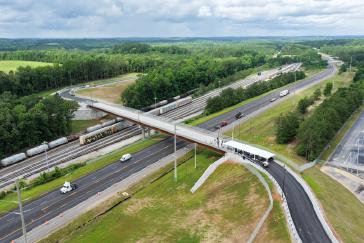


A mile-long land bridge over a highway and active rail tracks isn’t the kind of project that makes headlines in a world obsessed with battery chemistry and autonomous driving. But Mercedes-Benz just cut the ribbon on exactly that in Tuscaloosa, Alabama, and the numbers behind it tell a sharper story than any concept car reveal.
The Marshalling Yard Access Bridge and Road, completed in 2026 after construction began last year, directly connects the plant-adjacent marshalling yard at Mercedes-Benz U.S. International to the Domestic Marshalling Yard across U.S. Highway 11 and Norfolk Southern rail lines. Vehicles no longer need to be loaded onto trucks, hauled across public roads, and unloaded on the other side. They just drive across.
The payoff: a 70 percent reduction in vehicle shuttling costs and nearly a full day shaved off dealer dwell time.
That last figure matters to anyone who has ever waited for a car to arrive at a dealership. One day across hundreds of thousands of vehicles is not trivial. It’s the kind of unglamorous gain that accumulates into real money and real customer satisfaction, the operational bedrock that luxury brands need but rarely talk about publicly.
Mercedes-Benz has been building vehicles in Tuscaloosa since 1997. The plant currently produces SUVs including the GLE, GLE Coupe, and GLS for both domestic and global markets. As production volumes have grown, the logistics bottleneck between the two yards became an increasingly expensive headache.
Trucks crossing live highway traffic and active rail operations introduced risk, cost, and unpredictability into every single vehicle’s journey from assembly line to dealer lot.
“By removing the need for truck movements across public roads, we improve safety, protect vehicle quality, and simplify daily operations,” said Federico Kochlowski, president and CEO of MBUSI. That’s a polite way of saying every truck trip was a chance for a door ding, a delay, or worse.
Jason Hoff, CEO of Mercedes-Benz North America, tied the project to the company’s North American sales target of 400,000 vehicles annually by decade’s end. The bridge, he said, reflects “the same long-term approach behind our investments in Alabama — strengthening local manufacturing, improving resilience, and positioning our U.S. operation for continued growth.
The project required complex engineering, land acquisition, permitting, and coordination with both state highway authorities and Norfolk Southern, all while keeping the highway and rail lines running. It’s the kind of infrastructure work that doesn’t photograph well but separates manufacturers who are serious about domestic production from those who are simply assembling vehicles here to dodge tariffs.
And that distinction is worth paying attention to right now. With trade policy in flux and import costs rising, automakers with deep, efficient U.S. manufacturing footprints hold a structural advantage. Mercedes-Benz isn’t just building cars in Alabama; it’s investing in the connective tissue that makes building cars there sustainable at scale.
Nobody’s going to put a land bridge on a poster. But the 70 percent cost reduction in shuttling alone will pay for itself faster than most factory expansions. While competitors chase headlines with billion-dollar battery plant announcements, Mercedes-Benz quietly poured concrete over a highway and a rail line in Tuscaloosa and solved a problem that had been costing them money every single day for nearly three decades.
Sometimes the smartest investment in the auto industry isn’t the flashiest one. It’s a bridge.




Share this Story