
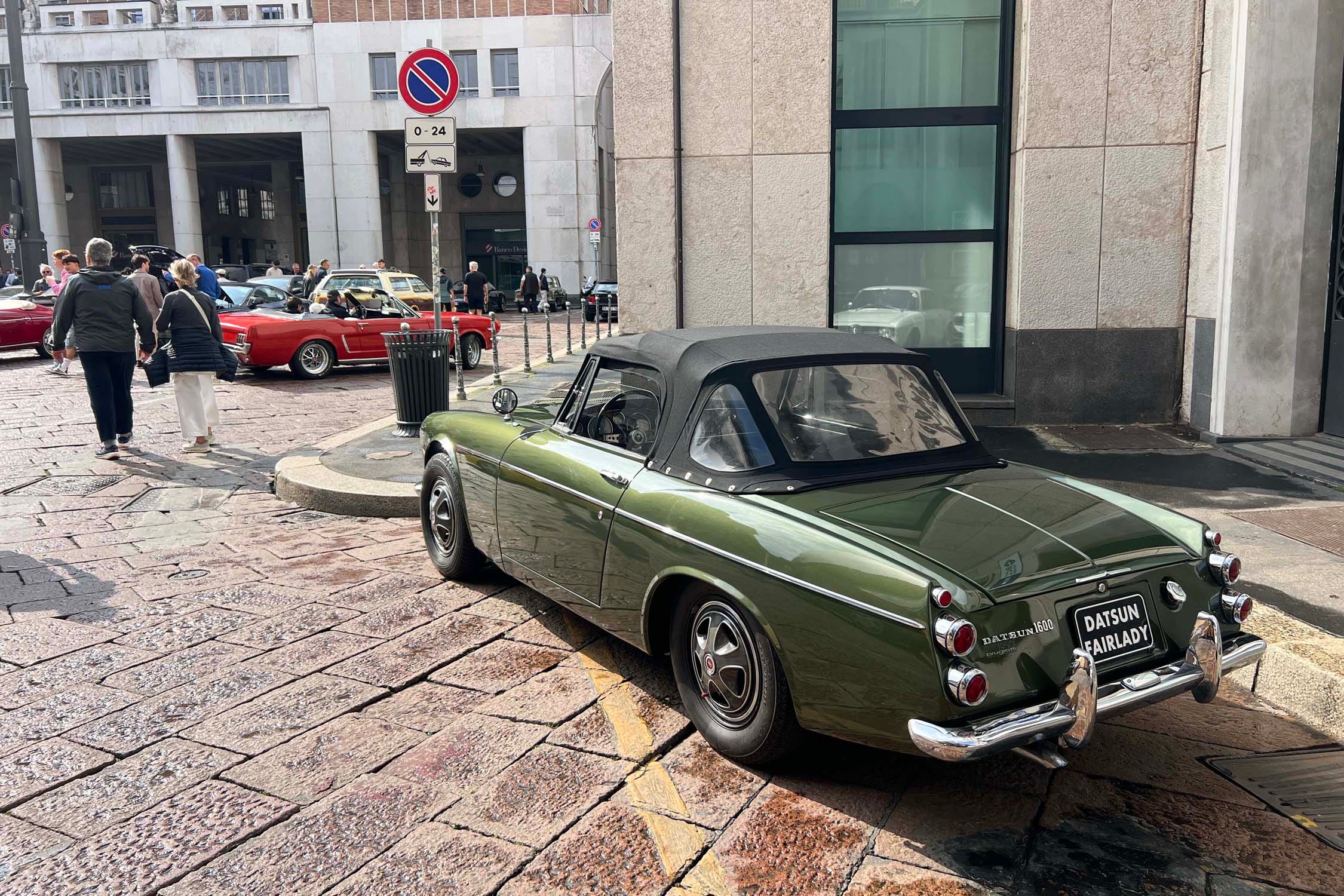


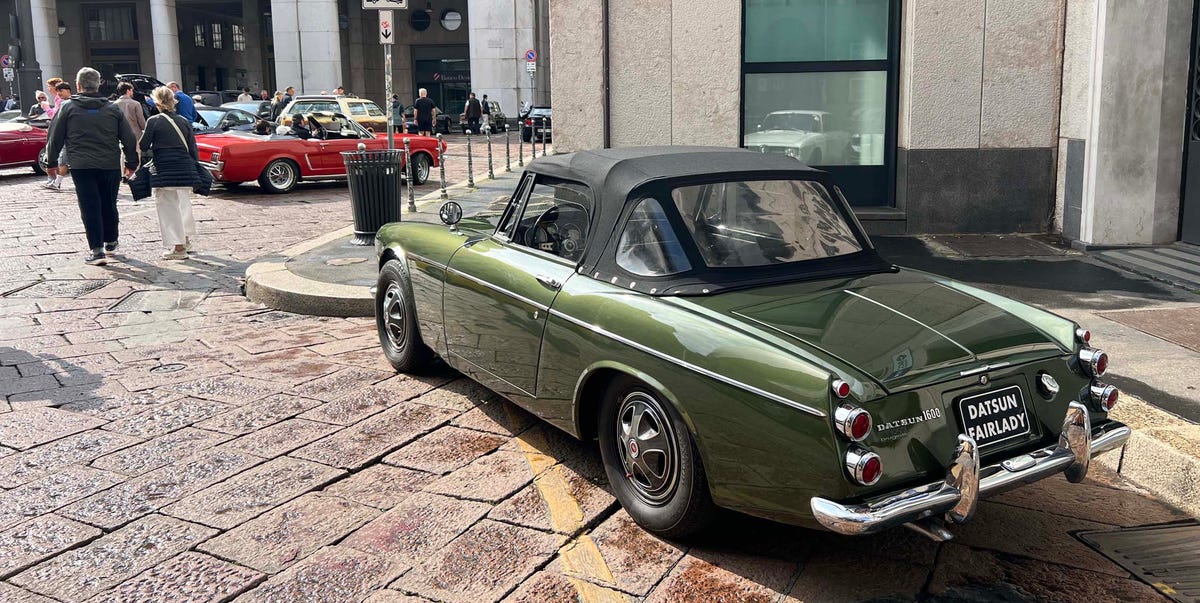
Every Sunday morning, while the Italian stock exchange sits dark and locked, its cobblestone courtyard fills with something far more valuable than derivatives. Ferraris park next to Porsche 928s. Mustangs share curb space with Alfa Romeo Giulias, kids on bicycles weave between six-figure fenders, and nobody flinches.
The Piazza Affari meet — “Quelli di Piazza Affari” — is a grassroots gathering that’s been running for about a year in central Milan, organized by Carlo Vulnera through little more than an Instagram account and word of mouth. There are no entry fees, no pre-registration forms, no concours judges with clipboards. Cars start rolling in before 10 a.m., and by mid-morning every side street within earshot is lined with metal.
This is the kind of car culture that money can’t manufacture and marketing departments can’t replicate.
Vulnera told Car and Driver’s Elana Scherr that his goal is simple: get classic and collector cars out of garages and onto the street. He wants tourists stumbling into the square to fall for a pretty grille. He wants kids to see a rumbling V-12 as something more than a YouTube thumbnail.
“People feel at home,” he said, and the evidence backs him up. Under a giant statue of a middle finger pointed squarely at the stock exchange — you cannot make this up — attendees passed around salami and bread.
The democracy of the thing is what makes it special. A 1949 Lancia Aprilia showed up alongside a Meyers Manx the color of an Aperol Spritz. Someone drove a full-size Ford wagon through Milan’s medieval streets, a feat of courage that deserves its own trophy.
An Alfa Romeo Arna — that cursed 1980s lovechild of Alfa and Nissan, with Japanese body panels bolted to Italian running gear — sat proudly in the mix. Show awards existed, but nobody seemed particularly interested in them. A Jack Russell terrier wore a beret.
Compare this with what was happening across town during Milan Design Week, where Lotus staged a polished exhibition around its Theory 1 concept. The all-wheel-drive electric prototype, first revealed in September 2024, has been on a global tour ever since, showing off its vertical doors, recycled carbon-fiber composite body, and a three-seat interior that prioritizes visual drama over comfort. Surrounding displays traced Lotus’s engineering lineage from the 1972 Type 72 Formula 1 car to futuristic yoke-style steering controllers and 3D-printed seat structures.
It was slick, curated, and purposeful — everything a brand activation should be.
Both events happened in the same city, drawing people who love cars. But they operate on entirely different frequencies. Lotus was selling a vision of the future: lightweight, electric, digitally optimized.
The Piazza Affari crowd was celebrating something that already exists — the unfiltered pleasure of mechanical things gathered in a public square with no gatekeepers.
Milan’s car culture, it turns out, is big enough for both. The city hosted Fashion Week spectacle and neighborhood trattorias with equal conviction long before anyone tried the same trick with automobiles.
What sticks, though, is the image of that courtyard. No ropes, no influencer walls, no QR codes. Just engines, cobblestones, and a terrier in a beret.
The best car shows have always worked this way — they start with someone saying “bring whatever you’ve got” and end with strangers sharing lunch. Vulnera figured that out with nothing but a piazza and an Instagram handle. Some automakers spend billions trying to generate the same feeling and never get close.



Share this Story