
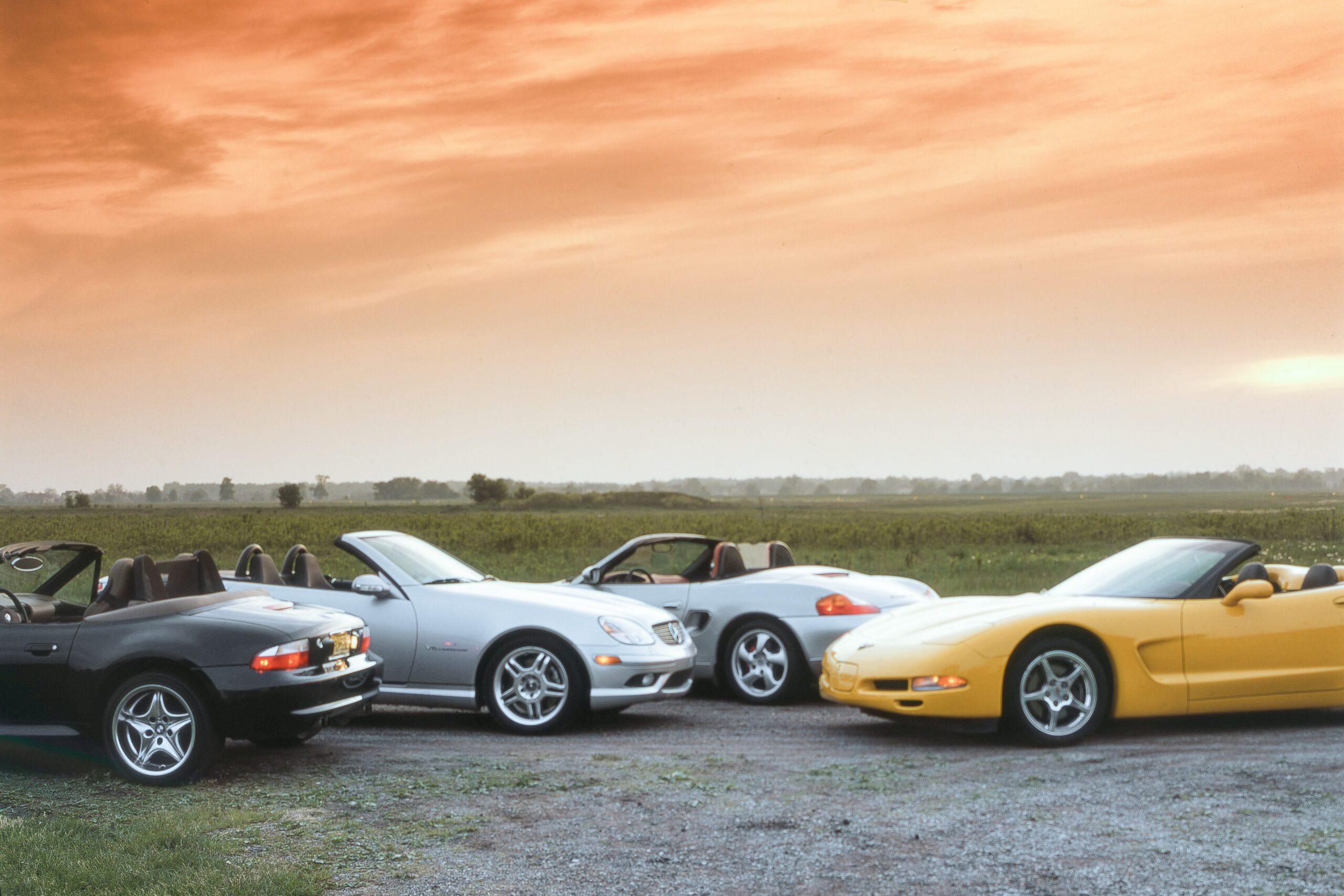


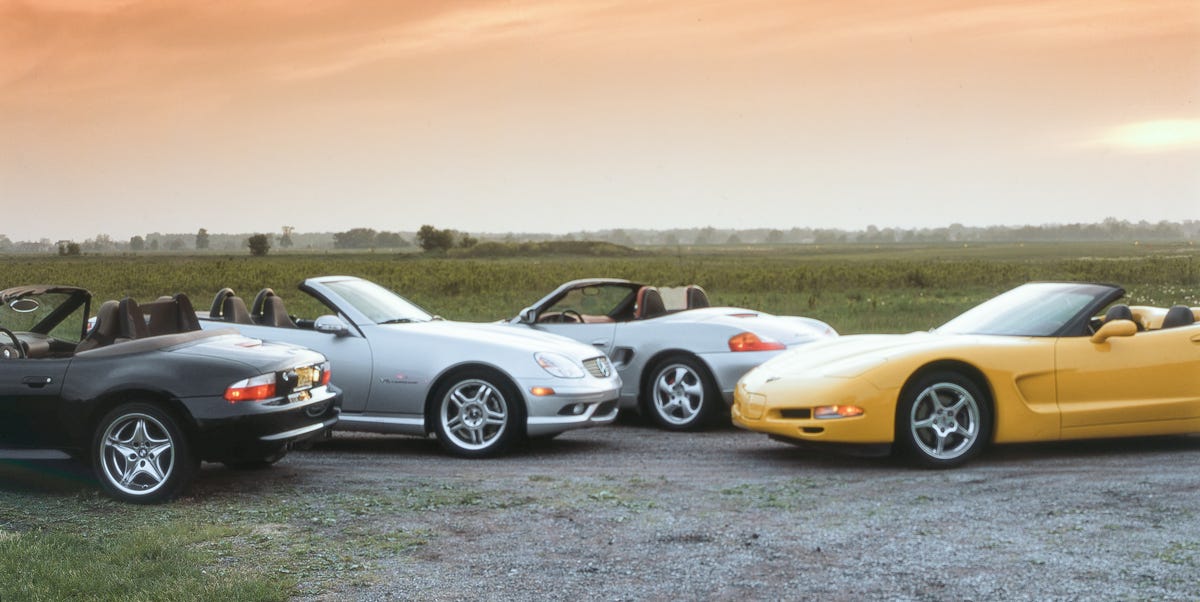
Twenty-four years ago, Car and Driver lined up four topless sports cars in the hills around Athens, Ohio, and the result still stings if you bleed German. The Chevrolet Corvette — the car nearly excluded from the prior year’s test for being too crude — beat the BMW M Roadster, the Mercedes-Benz SLK32 AMG, and the Porsche Boxster S. All of them.
This was 2001. The M Roadster had just received a new 315-horsepower inline-six. Mercedes had turned AMG loose on the SLK with a supercharged V-6 pumping 349 horses. Porsche had bored out the Boxster’s flat-six to 3.2 liters and raided the 911 parts bin for brakes. Each manufacturer brought its sharpest engineering to the knife fight. The Corvette showed up from Bowling Green with a pushrod V-8, plastic body panels, and a base price that undercut the Germans.
Three of the four cars hit 60 mph in exactly 4.5 seconds. The Boxster trailed by less than a second. At the drag strip, the SLK32 AMG actually posted the quickest quarter-mile — 13.0 seconds flat at 110 mph — edging both the Corvette and the BMW by a tenth. By 140 mph, the Mercedes had pulled nearly two seconds clear of the Chevy.
Raw speed didn’t decide this test. Character did.
The BMW M Roadster finished last. Fourth place. That gorgeous S54 inline-six — 1.6 horsepower per cubic inch from a naturally aspirated engine — couldn’t overcome a rear suspension two generations old, Nintendo-quick steering that lacked feedback, and a stability control system that kept telling the driver things were going wrong. The car felt nervous at the limit, and testers couldn’t fully trust it despite monstrous brakes that stopped it in 162 feet from 70 mph.
The SLK32 AMG landed third. Its IHI supercharger delivered thrust with zero lag, each engine hand-assembled by a single AMG technician. The retractable hardtop was a genuine trump card. But a recirculating-ball steering system — archaic even then — couldn’t fake the natural feel of a proper rack, and the automatic transmission, the only gearbox AMG would offer, overrode the driver’s manual inputs like a teenager who knows better. One editor would have given it the win. The rest wanted more involvement.
The Boxster S took second and probably earned the most lyrical praise. Mid-engine layout, a flat-six singing through both intake and exhaust, 911-derived brakes, and a chassis that made the driver feel like the world revolved around them in every corner. It was, as the testers noted, a study-hall doodle brought to life. But the well-used test car’s warped rotors hinted at durability questions, and 250 horsepower left it trailing the pack in outright thrust.
Which left the Corvette standing on top. The car that had been deemed too unrefined for the previous year’s comparison had been quietly improved with detail changes that brought added calm and composure. It matched the BMW’s best braking distance. It delivered the most grip in the lane-change test, pulling 2.6 mph more than both the Benz and the Bimmer. It did all of this with 5.7 liters of pushrod V-8 and the kind of torque that doesn’t need a supercharger or variable valve timing to make its point.
The Germans brought technology. Chevrolet brought results. In a test where the sole mission was generating grins, the car from Kentucky grinned widest.
What’s striking from this distance is how little the fundamental dynamic has changed. German sports cars still chase refinement and engineering sophistication. The Corvette still brings a sledgehammer to a scalpel fight — and still wins more often than the brochures would suggest. The 2001 test wasn’t an anomaly. It was a pattern establishing itself, one that would repeat through C6s, C7s, and the mid-engine C8 that finally adopted the layout Porsche had been using all along.
Sometimes the kid on the Huffy was dreaming about the right car after all.
Share this Story