
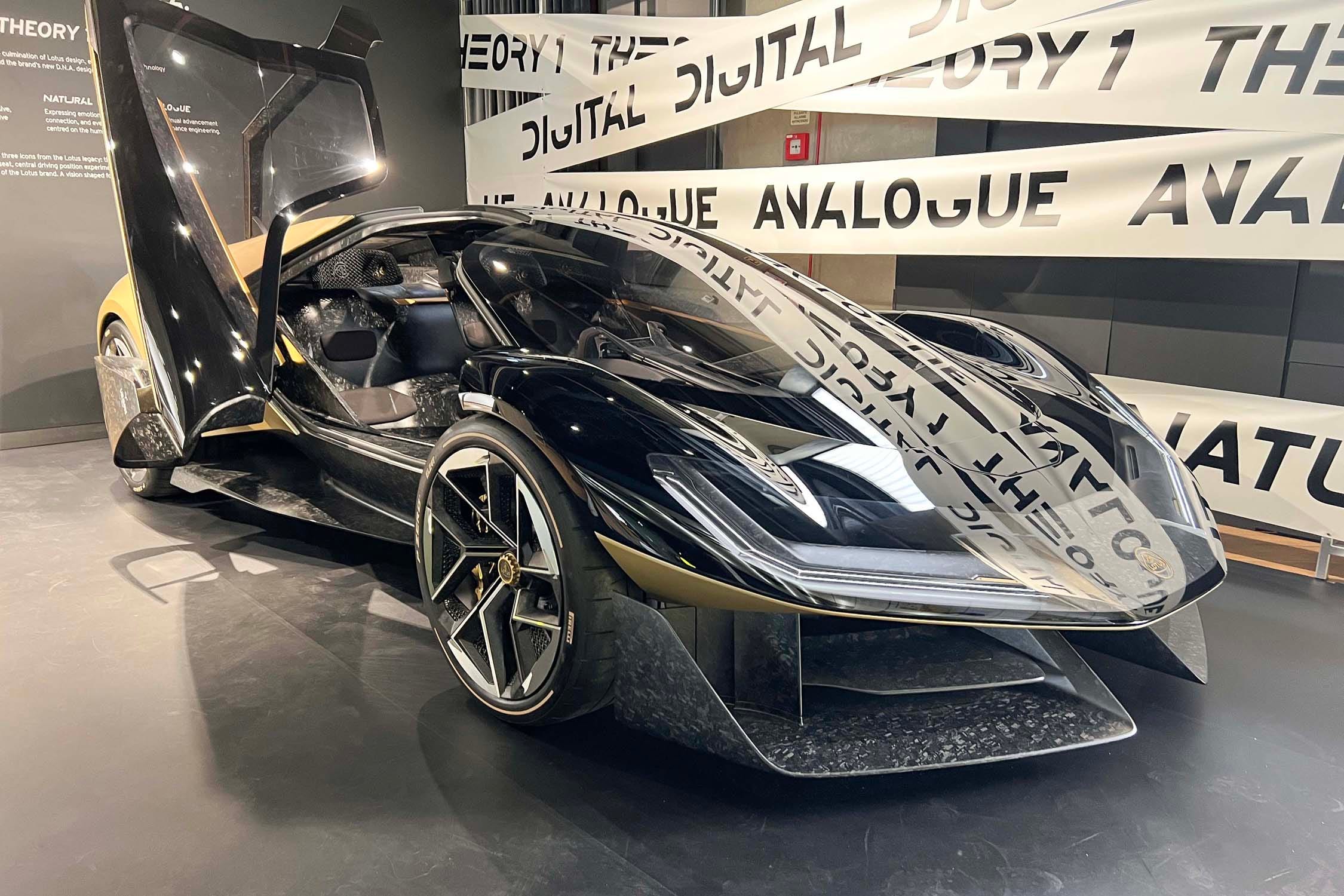


Down a cobblestone street in Milan’s Tortona district, past installations of rippling water projections and mood-lit color swatches, Lotus parked a rolling contradiction. The Theory 1 concept — an all-wheel-drive electric wedge first revealed in 2024 — sat at the center of a mini museum dedicated to Colin Chapman, racing suits, and a brand that once defined lightness in motorsport. The message was clear: remember who we were, and trust where we’re going.
Milan Design Week, which started in the 1960s as a furniture expo, has become a playground for automakers chasing audiences that wouldn’t be caught dead at a traditional car show. Kia and Hyundai brought concepts. Mini teamed with fashion designer Paul Smith. Range Rover, Škoda, and Lexus all had installations, and most leaned hard into vibes — sculptures, textiles, ambient everything.
Lotus went the other way. Its “In Progress” exhibit opened with a room of yellow-and-black animated wedges racing across the walls, more Speed Racer than spa day. A hallway of viewing pods played vintage footage of Chapman at work. Racing helmets — replicas of Senna’s and Fittipaldi’s 1972 lid — sat in glass cases at the end.
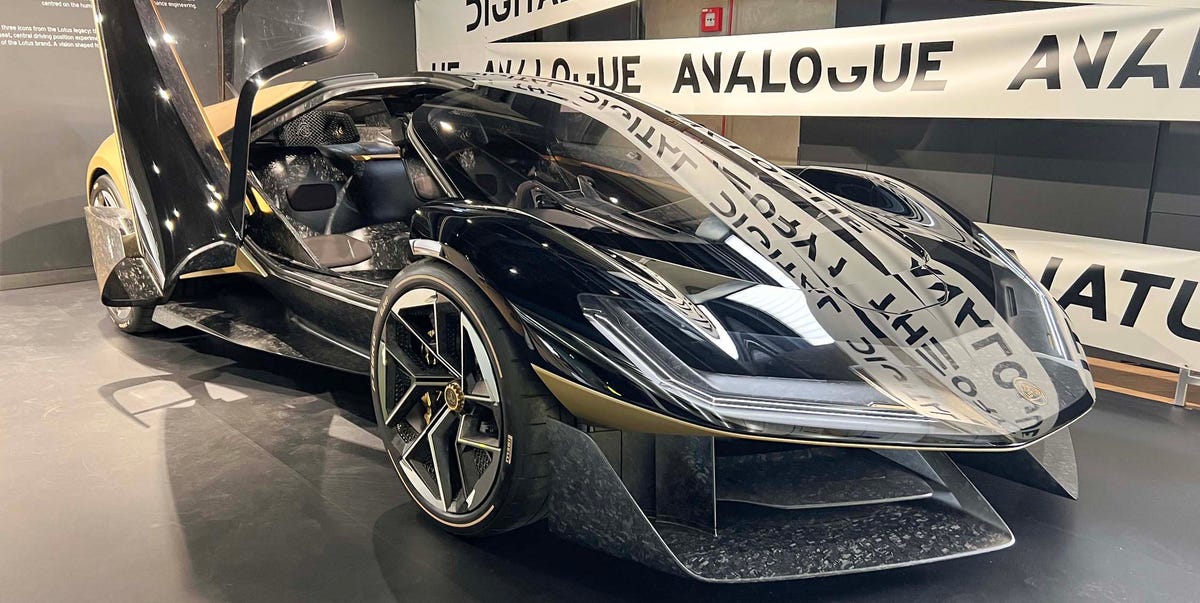
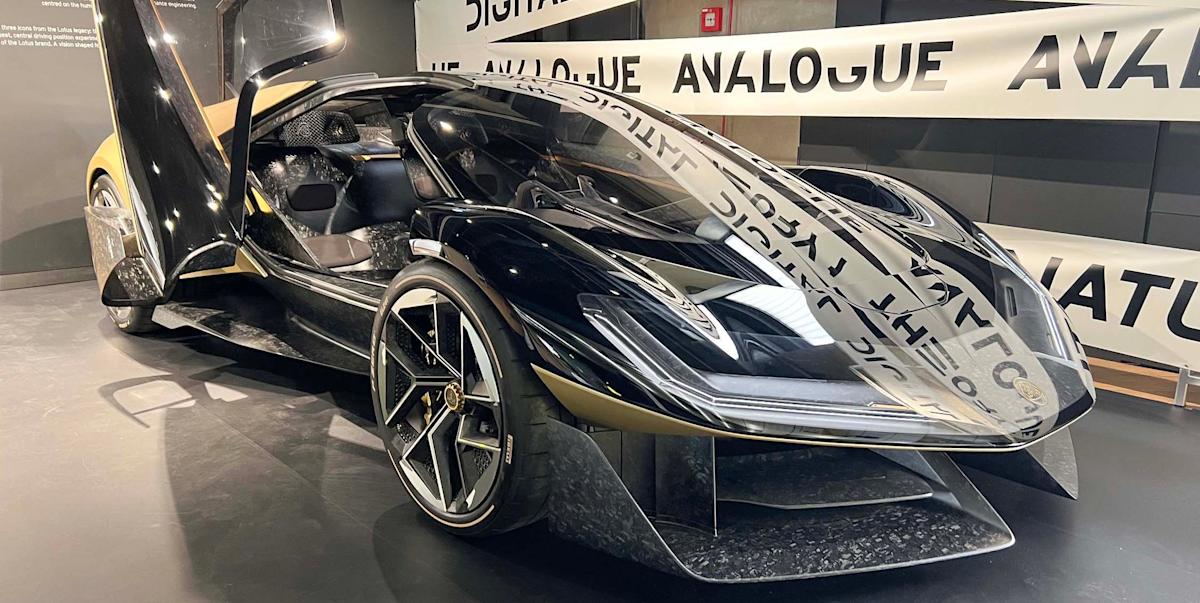
Then came the Theory 1 itself: low, angular, smoked glass cockpit, folding vertical doors, forged carbon body panels made from recycled composite, and a 3D-printed interior that seats three in what can generously be described as style over comfort. It’s a car that promises the space-capsule future automakers have been dangling in front of us for decades.
Ben Payne, Lotus’s vice president of design, framed the Milan appearance as an opportunity to hook people who don’t already know the brand. Captivate them with the high-tech concept, then walk them backward through the heritage displays. That meant the evolution of steering wheels, dashboards, tire-to-sidewall ratios, and driver’s seats from the 1972 Type 72 Formula 1 car to the Theory 1’s carbon-fiber shell with 3D-printed mesh.
It’s a smart play for a company that desperately needs it. Lotus under Geely ownership has been trying to reinvent itself as an electric performance brand, but the path from the Elise to the Emeya hasn’t exactly been a straight line. The Evija hypercar remains a unicorn. The Eletre SUV looks nothing like anything Chapman would have recognized.
The Theory 1 is supposed to thread the needle — a lightweight, driver-focused EV that evokes the brand’s roots while justifying its new direction. Whether it ever reaches production is another question entirely. Right now it remains a concept, a touring showpiece that’s been making the rounds for over a year.
Concepts age fast. The longer this one stays on the circuit without a production announcement, the more it starts to feel like a mood board rather than a business plan.
Behind the displays in Milan, surrounded by the helmets and the suits and the steering wheels that got progressively more complicated over 50 years, the tension was impossible to miss. Lotus has one of the richest legacies in motorsport and one of the most uncertain futures in the sports-car business.
Chapman’s philosophy was radical simplicity — add lightness, subtract everything else. The Theory 1 tries to honor that with recycled materials and a minimal cockpit, but it’s also an electric concept car with trick doors and 3D-printed seats. That’s about as far from a Seven as you can get.
The exhibit worked. It was the best automotive installation at Design Week, full of genuine artifacts and real engineering history instead of just projections and perfume. But a traveling museum is not a product roadmap. Lotus has the story and it has the concept — now it needs to build the car.


Share this Story