
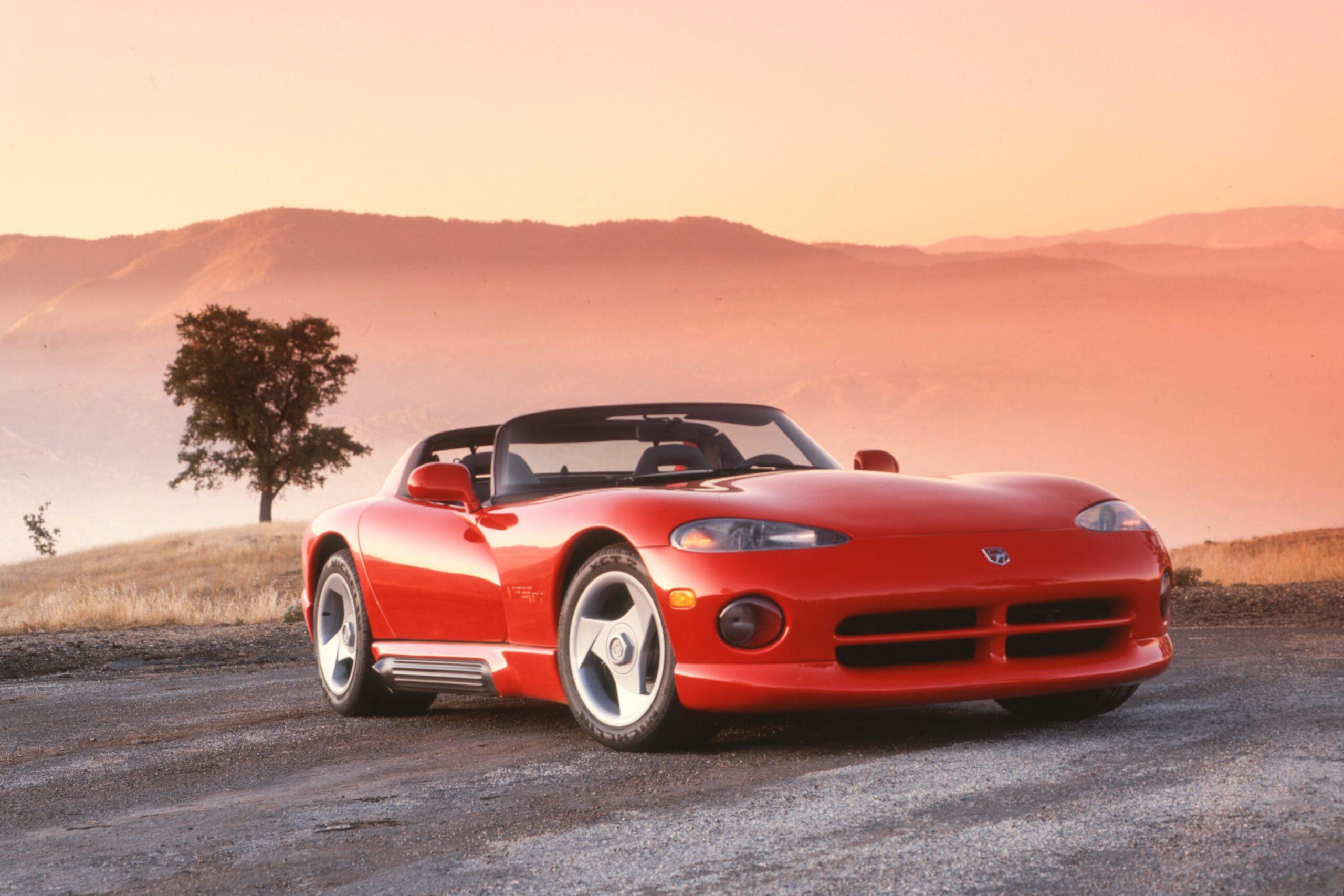


No windows. No outside door handles. No apologies. When Car and Driver strapped timing gear to the first 1992 Dodge Viper RT/10 back in March of that year, the magazine clocked a 13.2-second quarter-mile at 107 mph. That was quicker than the Corvette ZR-1, which at the time was the most technologically advanced American performance car ever built.
The ZR-1 had four camshafts, 32 valves, and Lotus engineering. The Viper had a truck-derived V-10, a canvas top, and the aerodynamic subtlety of a clenched fist. Chrysler brought a club to a knife fight, and somehow won.
Revisiting that original test today, what strikes you isn’t the raw numbers — 0-60 in 4.6 seconds, 159-mph top speed — though those were savage for 1992. It’s the honesty of the machine. The pedals were offset to the left because the 488-cubic-inch V-10 physically intruded into the cabin.
The exhaust note below 3,000 rpm sounded, per the testers, “oddly like a UPS truck.” The side-exit exhaust pipes got hot enough to burn your leg climbing in. The government forced Chrysler to install door locks accessible from the outside because there were no exterior handles. A $54,640 car with the refinement of a kit-car and the soul of a Saturn V rocket.
That price was roughly half what a ZR-1 commanded. For the money, buyers got 400 horsepower, 450 pound-feet of torque, a six-speed manual, 13-inch disc brakes, and rear tires wide enough to land a Cessna on. What they didn’t get was air conditioning, power windows, or any pretense of comfort.
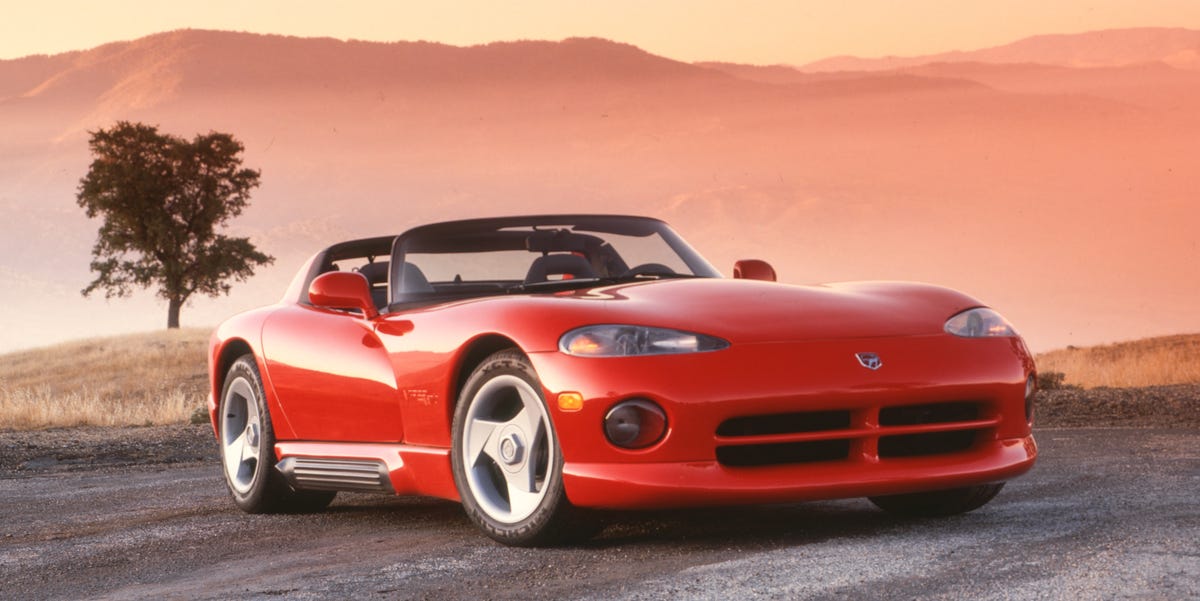
Car and Driver’s testers found the Viper surprisingly docile in city traffic — smooth clutch, easy shifter, an engine that pulled cleanly from 1,200 rpm to 5,000. But visibility was atrocious even without a roof, the thick windshield frame forcing drivers to duck and crane to see traffic lights. Those massive Michelin XGT-Z tires tracked every groove and ripple in the pavement, occasionally delivering what the magazine diplomatically called “a sharp lateral feint” mid-corner over bumps.
The real revelation came on California’s Route 33 north of Ojai, where the Viper proved itself balanced, predictable, and devastatingly quick through sweeping turns. It pulled 0.85 g on the skidpad, rode with surprising compliance, and felt structurally rigid in a way that belied its plastic-over-tube-frame construction. The testers noted a crucial truth: the car generated so much power and grip that it could build terrifying speed without drama, and when those high limits were finally exceeded, the consequences would be proportionally severe.
That was the Viper’s bargain with its driver, the same deal the original Shelby Cobra struck three decades earlier. Respect the machine or it will eat you. No electronic nannies, no traction control, no stability management — just 488 cubic inches of American pushrod engine, a rear axle, and your right foot’s judgment.
The automotive press in 1992 didn’t quite know what to make of a car this deliberately crude from a corporation best known for minivans. Chrysler, under Bob Lutz’s product leadership, had built a concept car for the road. The engineers openly admitted they couldn’t make it sound good and still meet the 80-decibel noise limit.
Nobody cared. The Viper sold out instantly and spawned a racing program, a coupe variant, and five generations spanning 25 years. It proved that passion projects from unlikely sources could rewrite brand perception overnight.
The original test’s final line landed the real punch: the Viper had introduced a new word into the lexicon of automotive desire — “Chrysler.” That sentence reads differently now, after Stellantis, after bankruptcy, after decades of corporate reshuffling. But in the spring of 1992, a company that built K-cars had just out-muscled Corvette with a ten-cylinder roadster that didn’t even have roll-up windows. Sometimes the most audacious move is the simplest one: more engine, less everything else.
Share this Story