
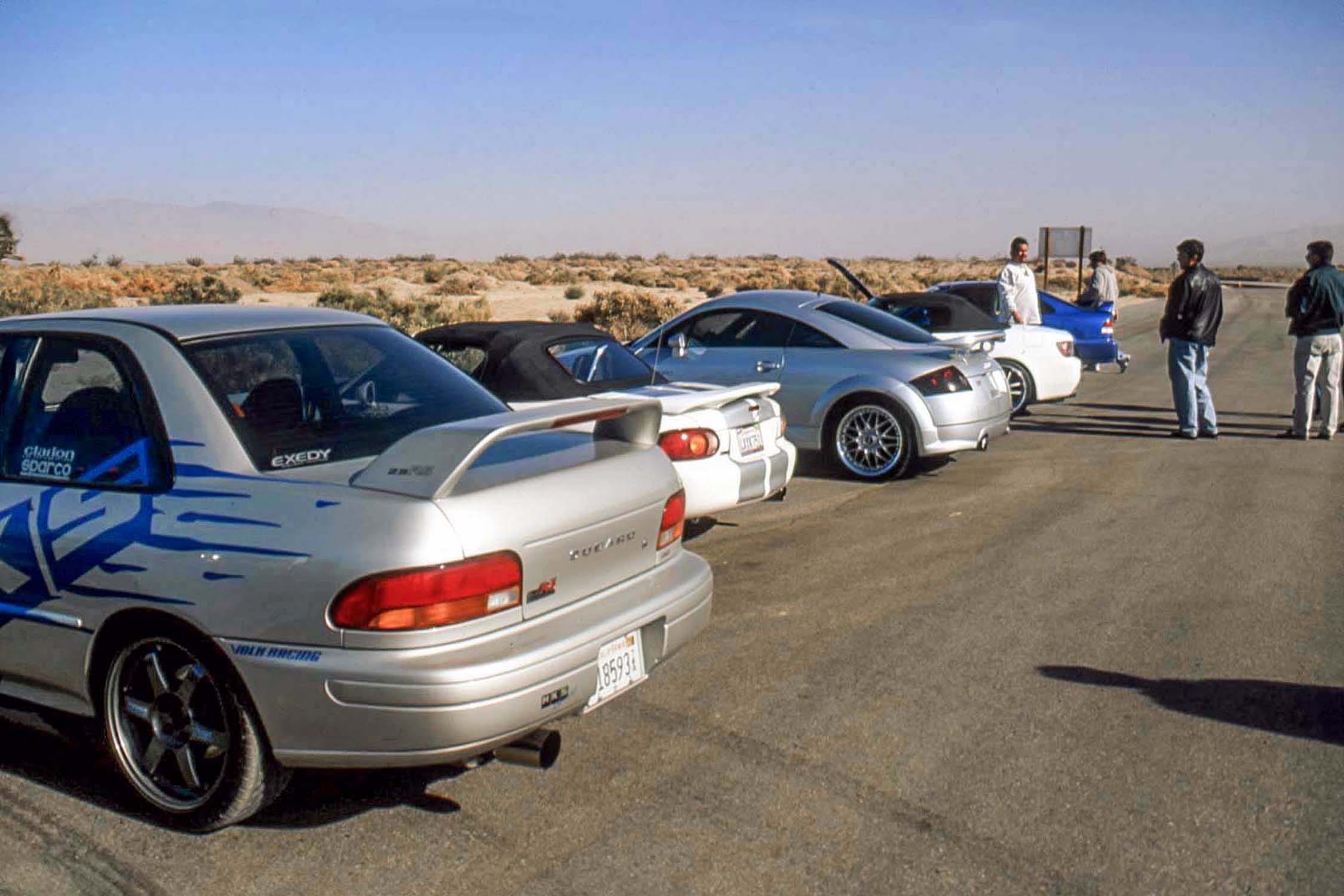


Six sport-compact tuner cars walked into a Car and Driver comparison test in the year 2000. Four walked out. The magazine has just resurfaced the original photography from that quarter-century-old shootout, and the images land like a time capsule from an era the modern car world has spent two decades mythologizing.
The lineup reads like a who’s who of late-1990s tuner culture at its most unhinged: an HKS Subaru Impreza 2.5RS Turbo, a King Motorsports/Mugen Acura Integra Type R, a Neuspeed Audi TT Quattro, a ProSpec Honda S2000, a Racing Beat Mazda Miata, and a Vortech Honda Civic Si. Every single one was a four-cylinder, and every single one was modified by an aftermarket shop with something to prove.
The photos, shot by Jeffrey Dworin and Tom Cosgrove, show cars built in a completely different philosophical universe than today’s tuner machines. No standalone engine management laptops visible. No carbon-fiber aero packages pulled from CFD simulations. Just bolted-on turbo kits, color-coded suspension components hidden behind aftermarket wheels, and rear wings sized to announce their presence from three zip codes away.
The Integra Type R, prepped by King Motorsports with Mugen parts, could reportedly approach a 9,000-rpm redline — a figure that still makes modern turbocharged four-cylinders feel wheezy by comparison. Its enormous rear wing, the magazine noted, hurt top speed. Nobody cared. The import scene in 2000 treated rear wings like peacock feathers.
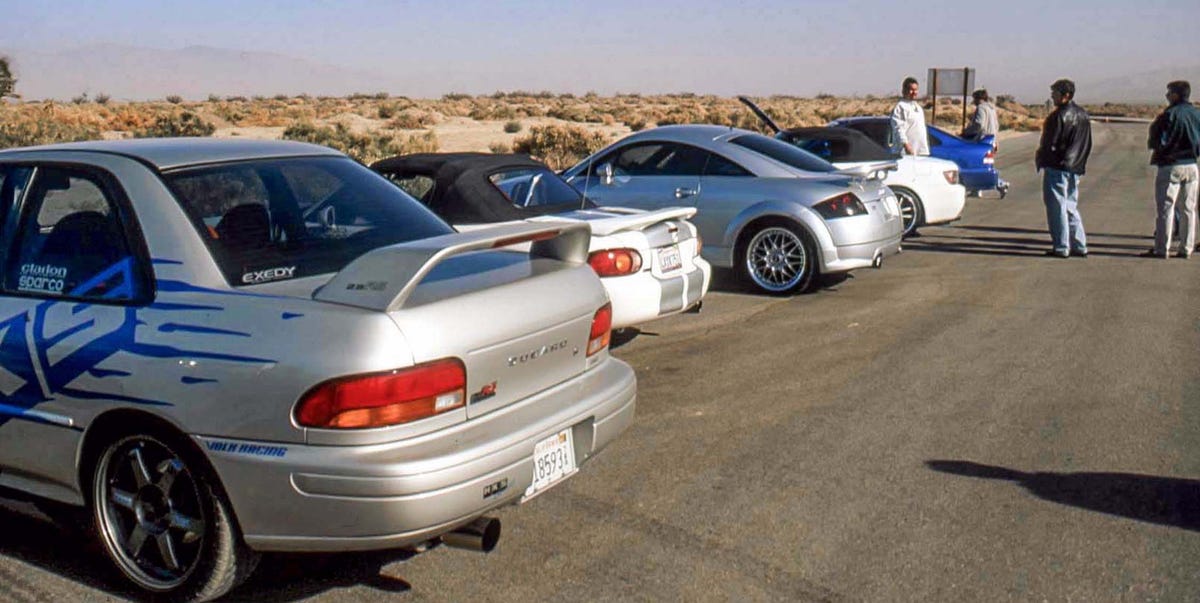
The HKS Impreza 2.5RS Turbo was the oddball — a flat-four in a field of inline-fours, turbocharged in an era when Honda guys worshipped natural aspiration like a religion. The Neuspeed TT Quattro brought German engineering and all-wheel drive to a fight dominated by Japanese iron. Its elegance was somewhat undermined by the obligatory bolt-on wing that couldn’t match the TT’s factory design language.
Then there was the ProSpec S2000, a car built on what was arguably Honda’s most brilliant platform of the era. The Vortech Civic Si added supercharging to Honda’s everyman sport compact. And the Racing Beat Miata brought Mazda’s lightweight philosophy to a test where everyone else was chasing horsepower.
Two of those six cars didn’t survive the test. Car and Driver’s cryptic teaser — “four survived” — doesn’t specify which ones broke or how spectacularly they failed, but that’s the nature of pushing aftermarket-modified cars to their limits on a test track a quarter century ago. Warranty coverage was not part of the conversation.
What strikes you looking at these photos now is how raw everything was. Engine bays are crowded but mechanical, filled with intake pipes you could trace with your finger and turbo plumbing you could understand with a shop manual. The interiors are stock or close to it. The tires are narrow by current standards.
These were machines built by enthusiasts who turned wrenches on weekends and read tuning magazines cover to cover because YouTube didn’t exist yet. The sport-compact tuner scene of 2000 thrived on accessibility. A kid with a Civic and a credit card could play the game.
The cars were cheap. The parts were cheaper. The knowledge was passed hand to hand at meets and through forums with dial-up load times.
Car and Driver republishing these images now isn’t just nostalgia mining, though there’s certainly an audience for it. The cars in this test — particularly the Integra Type R, the S2000, and the Impreza 2.5RS — have become bonafide collectibles. Clean examples command prices that would have seemed clinically insane when these photos were first shot.
A stock Integra Type R can fetch six figures today. A well-kept S2000 isn’t far behind. The tuner world that produced these six cars is mostly gone, replaced by ECU flashes and bolt-on kits that cost more than the original vehicles did new. The photos remain proof that once upon a time, four cylinders and a good idea were enough to make something genuinely dangerous.
Share this Story