
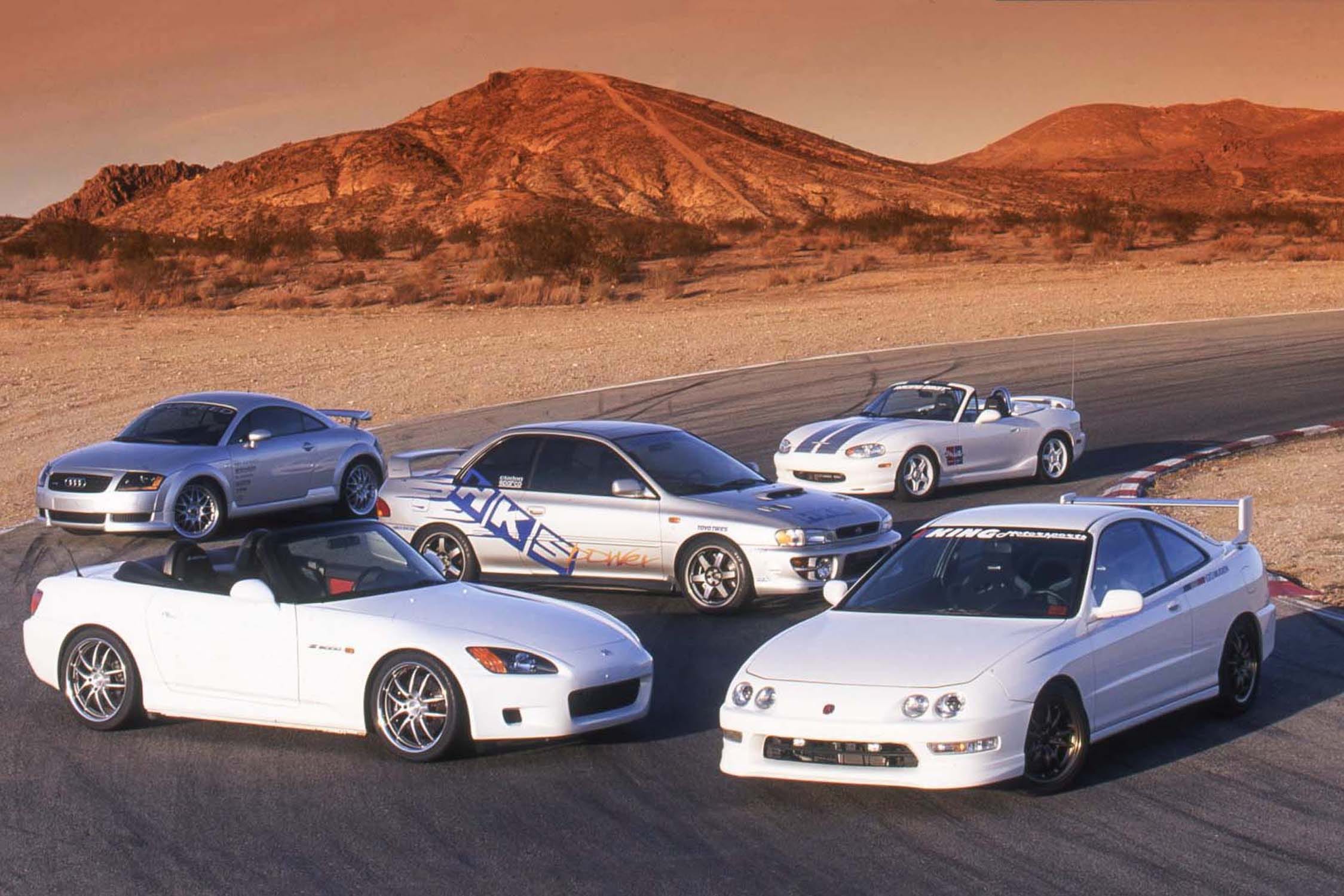


Four showed up to the finish line. That’s the number that matters from Car and Driver’s ambitious March 2000 tuner car test, a three-day desert odyssey that started with six cars, a Taco Bell lunch, and the kind of naive optimism only the late 1990s aftermarket scene could produce.
The original invite list had ten cars. Greddy couldn’t get its Honda Civic or Integra ready. Jackson Racing pulled a supercharged Prelude over fuel-map concerns.
DC Sports’ Honda S2000 got punted by a Formula Ford at Willow Springs. Borla’s turbocharged Ford Focus had a computer meltdown the morning of the event. Six remained, and then the desert started eating them.
Day two at Honda’s Mojave proving ground, a Vortech-supercharged Civic Si burned a piston during top-speed runs. Wide-open throttle for extended periods does that when fuel flow isn’t sorted. Day three, the HKS turbocharged Subaru Impreza 2.5RS refused to move.
The mass-air sensor had apparently died overnight in the cold. HKS blamed the stock Subaru part. Nobody was buying it entirely.
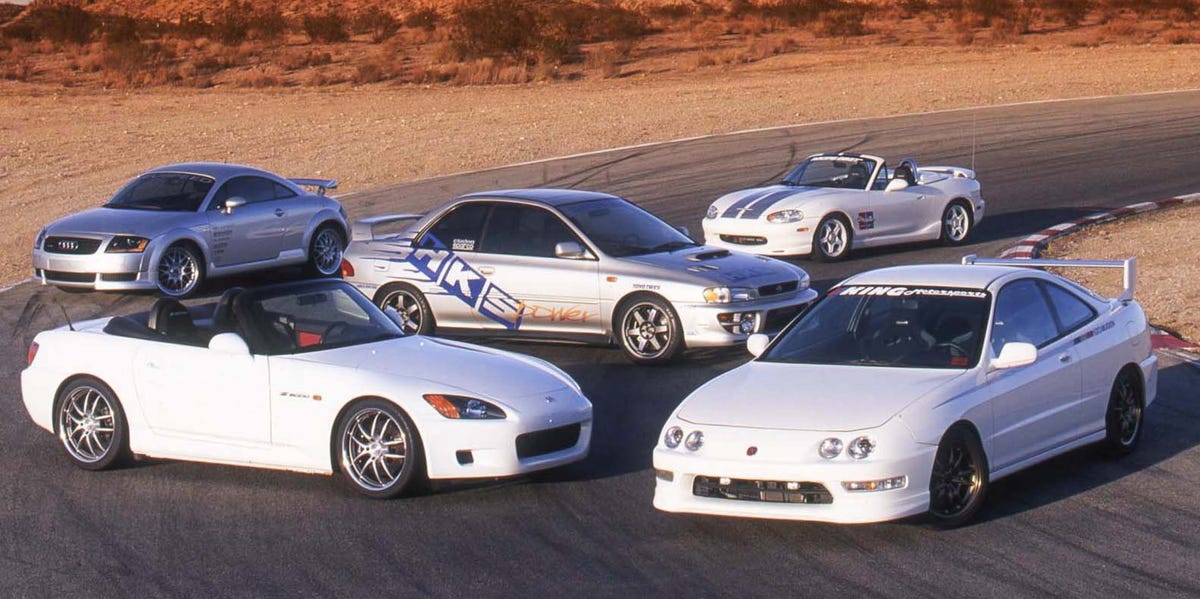
The survivors — a Racing Beat Mazda Miata, Neuspeed’s Audi TT Quattro, King Motorsports’ Mugen-built Acura Integra Type R, and T.C. Kline’s ProSpec Honda S2000 — completed laps at the Streets of Willow Springs and drove themselves home. That alone qualified as victory.
Reading this test a quarter-century later, what jumps off the page isn’t the horsepower figures or the lap times. It’s the fragility. These weren’t garage hacks built by amateurs.
HKS, Vortech, King Motorsports — these were serious outfits with reputations and catalog products. And still, a $39,261 turbocharged Impreza couldn’t last three days, and a supercharged Civic couldn’t survive a top-speed pull.
The King Motorsports Integra Type R was the star. Scott Zellner’s recipe — Mugen valve springs, a 9,000-rpm engine computer, stiffer motor mounts, a Mugen limited-slip differential, and a complete suspension overhaul — produced 220 horsepower and a 5.8-second run to 60 mph. The total build cost $19,213 on top of the stock car.
For that money, Zellner delivered what Car and Driver called “one of the best engine notes this side of a Ferrari.” The car worked. It didn’t break. It was fast and balanced, and that combination was rarer than it should have been.
The HKS Impreza, when it ran, hinted at what Subaru would eventually deliver to North America with the factory WRX. Its T-25 turbo setup pushed the 2.5-liter flat-four to 195 horsepower and 135 mph on the oval. The chassis felt planted through mountain roads with gentle understeer and barely a chirp from the tires.
All-wheel drive covered up sins. But the car’s third-day no-show left a “DNF” stamped across every performance column in the data sheet — a damning visual in a magazine test.
The broader picture in 2000 was a generation of drivers born in the mid-1980s who had never seen a carburetor and didn’t care about V-8s. They grew up in Camrys and Accords. They wanted their Civics and Integras to go faster, and a booming aftermarket was happy to oblige.
SEMA that year was overrun with tiny cars wearing carbon fiber, absurd exhaust tips, and turbo kits promising the moon. The promise was real. The execution was uneven.
Extracting serious power from small engines without the engineering resources of a factory meant living on the edge of reliability. Void the warranty, bolt on a turbo, cross your fingers. Sometimes you get a stunning track weapon like Zellner’s Integra, and sometimes you rent a U-Haul.
That tension — between youthful enthusiasm and mechanical reality — defined the tuner era. The parts catalogs made it look easy. The Mojave Desert proved it wasn’t.

Share this Story