
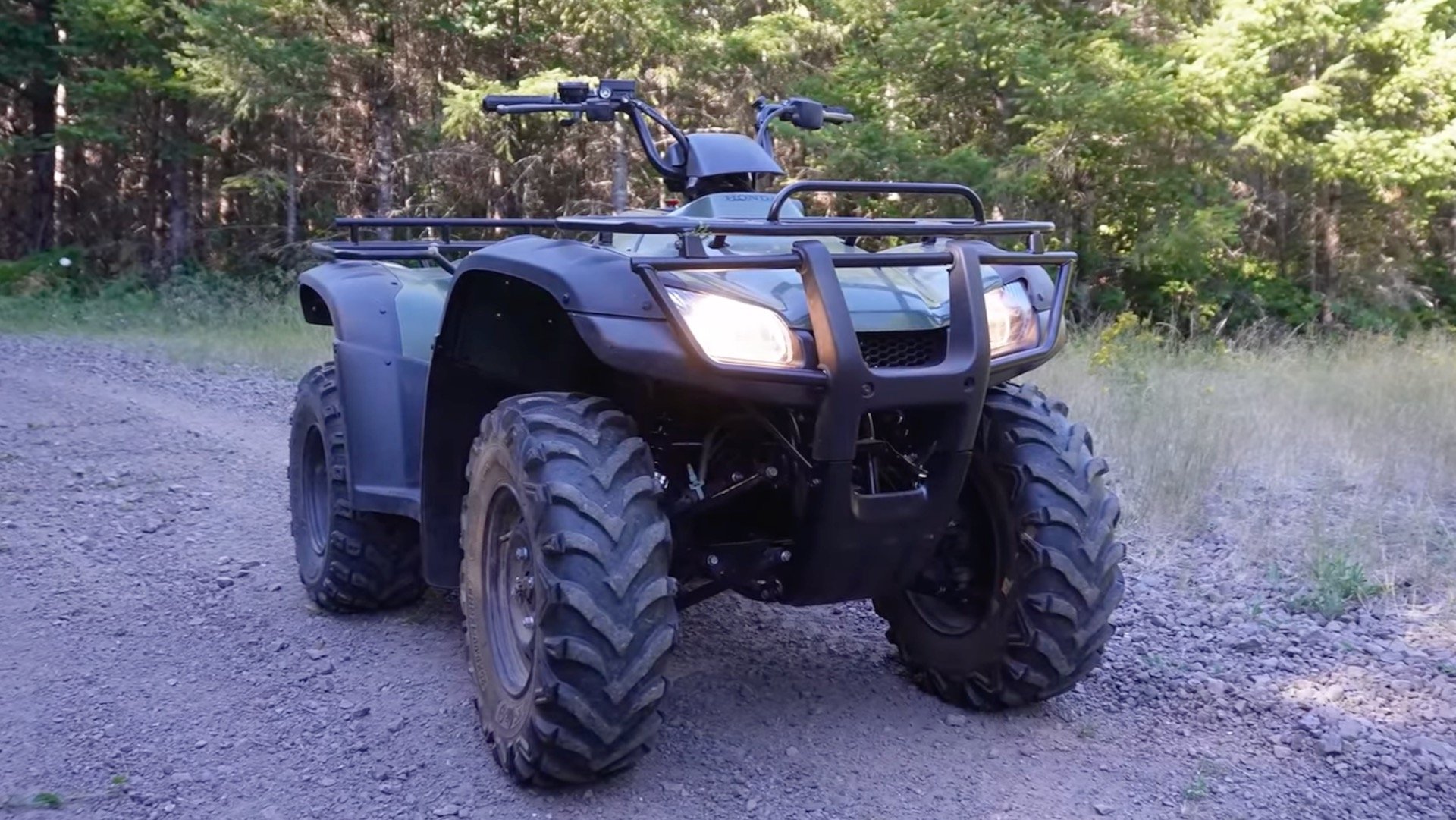


A YouTuber named RMS Builds just finished converting a 2006 Honda Rancher to battery power, and the results challenge every excuse the major manufacturers keep making about why electric ATVs aren’t ready yet.
This wasn’t the builder’s first rodeo. A previous conversion of a 2004 Yamaha RC450 worked well enough to justify a second attempt, but it also revealed a problem. Even without an exhaust pipe, the Yamaha’s chain drive created enough noise to undermine the whole point of going electric. So the Honda Rancher was chosen specifically for its shaft drive, which promised to deliver the silence an electric powertrain should provide.
The swap is more straightforward than you might expect. A 10-kilowatt motor, roughly 13.4 horsepower, slots into the space where Honda’s original gasoline engine sat. A 6.1-kilowatt-hour battery pack feeds it. The controller and electronics mount on a plate bolted to the top motor mount. No major frame surgery required.
The hard part was mating the electric motor’s output shaft to the universal joint that sends power to the rear differential. That took serious machining work, the kind of precision fabrication that separates a real build from a weekend hack job.
Here’s the number that jumps out: 487 pounds with batteries installed. That’s actually about 10 pounds lighter than the lightest stock gasoline Rancher. Weight parity in a DIY conversion is almost unheard of.
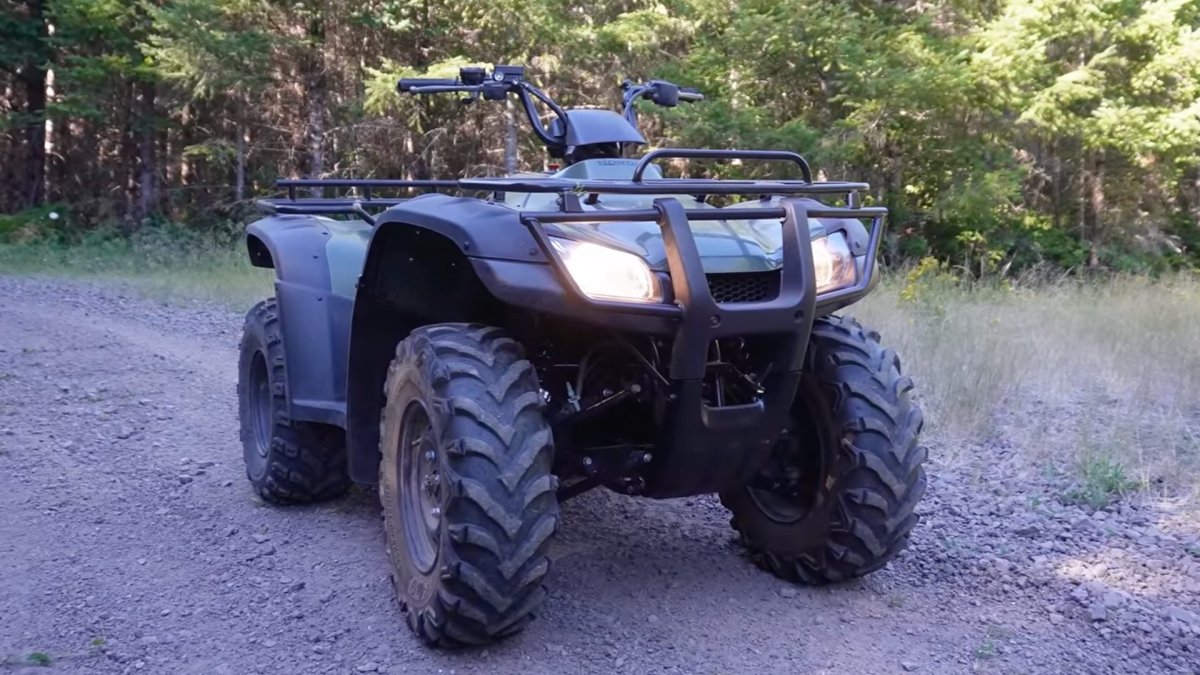
Range lands at an estimated 35 miles under normal riding conditions. For trail work or property maintenance, that’s a full day for most riders. It’s not going to replace a gas quad for all-day desert runs, but nobody claimed it would.
In a pair of drag races against a stock gas-powered Rancher, the electric version lost. RMS Builds doesn’t hide from that result, and it wasn’t the point anyway. The point was noise, or rather, the absence of it.
And on that front, the build delivers. There’s some motor whine, which is unavoidable with any electric drivetrain under load. But compared to its gasoline twin, the electric Rancher is dramatically quieter. Compared to the chain-driven Yamaha conversion, which produced irritating slap and rattle at speed, the shaft-drive Honda is in another league entirely.
Stop the quad and the contrast becomes absolute. No idling rumble. No vibration through the handlebars. Just whatever sounds the woods or fields were already making before you showed up.
The major ATV manufacturers have been slow to electrify their utility and recreational lineups. Polaris has its Ranger XP Kinetic side-by-side, and a few startups have taken shots at the market, but the selection remains thin. Meanwhile, a guy with a YouTube channel and a machine shop is building functional electric quads in his garage that weigh less than stock and run quietly enough to justify the effort.
Two videos cover the entire process, from fabrication to final assembly. The barrier to entry isn’t small. You need machining skills, electrical knowledge, and comfort working with high-voltage battery systems. But the fact that one person can pull this off with off-the-shelf components and a 20-year-old donor frame says something about where the technology already sits.
The question isn’t whether electric ATVs work. This build proves they do. The question is why the companies with billion-dollar R&D budgets are still letting hobbyists lead.



Share this Story