
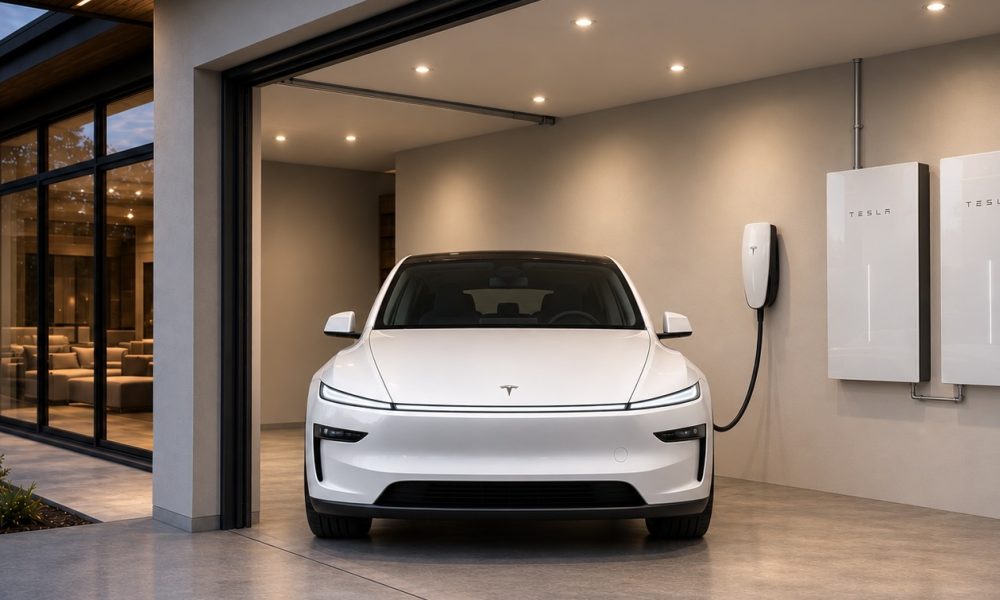


Every Model 3 and Model Y ordered in the United States or Puerto Rico on or after October 1, 2026, can now feed power back into a home during an outage. Tesla Energy confirmed Tuesday that Powershare Home Backup works on both cars when paired with a Powerwall 3, claiming the setup can extend home backup by over two days.
Until this week, that trick belonged exclusively to the Cybertruck, which only gained full Powerwall integration last month after repeated delays stretching back years. Tesla needed about four weeks to carry the same capability over to its two highest-volume vehicles.
The technical backbone is an inverter Tesla calls PCS2 Lite, though the company has not disclosed when that component entered production across different trims. Owners of older Model 3 and Model Y cars may or may not have the hardware. The only way to check is a buried menu on the touchscreen: Software, then Additional Vehicle Information, then look for “Powershare Support: Enabled.”
On the home side, the bar is lower. A house already equipped with a Powerwall 3 and either a Wall Connector 3 or Universal Wall Connector needs nothing else. A software update handles the rest.
When the grid goes dark, the car and the Powerwall negotiate roles and deliver up to 11.52 kW of continuous power. Tesla pegs the runtime at two-plus days for standard trims, assuming 30 kWh of daily household consumption and a car starting at 90 percent charge. The Cybertruck stretches that past three days thanks to its larger pack.
There are notable gaps. Powerwall 2 and Powerwall+ owners are told compatibility is “coming soon.” Model S and Model X are excluded entirely. And the Grid Support program that lets Cybertruck owners in Texas sell power back during demand peaks, earning bill credits, is not available on Model 3 or Model Y.
Ford and GM have offered vehicle-to-home backup for several years. Both require a separate inverter and dedicated backup hardware bolted to the wall. Tesla’s approach leans on equipment that Powerwall 3 customers already own, which makes the installation path shorter but locks out anyone who does not want to buy into Tesla’s energy ecosystem.
That lock-in is by design. At Tesla’s March 2023 Investor Day, Elon Musk said flatly, “I don’t think very many people are going to want to use bidirectional charging, unless you have a Powerwall.” Three years later, the company shipped the feature for its volume cars with exactly that condition attached.
Lead engineer Wes Morrill explained why the Cybertruck rollout took so long. When two devices capable of forming a home grid need to decide which one leads during an outage, the software handshake across multiple hardware generations is genuinely hard. Once Tesla solved that puzzle for the truck, extending it to Model 3 and Model Y was a matter of weeks, not months.
The update arrived bundled in software release 2026.38.3, the same package that delivered Tesla’s annual Halloween Mode. That pairing tells you something about where bidirectional charging sits on the priority list now. It is a feature drop, not a product launch.
Tesla also recently introduced a Powerwall Lease in Texas, offering two units for roughly $35 a month after credits when paired with a Tesla Electric plan. Stacking that lease with Powershare-capable cars creates a tidy closed loop. Tesla sells the car, the battery, the wall charger, the electricity plan, and now the software that ties them all together.
Whether competitors can match the integration without demanding a single-brand ecosystem is the question Ford and GM have been trying to answer for years. They still require extra boxes on the wall.



Share this Story