
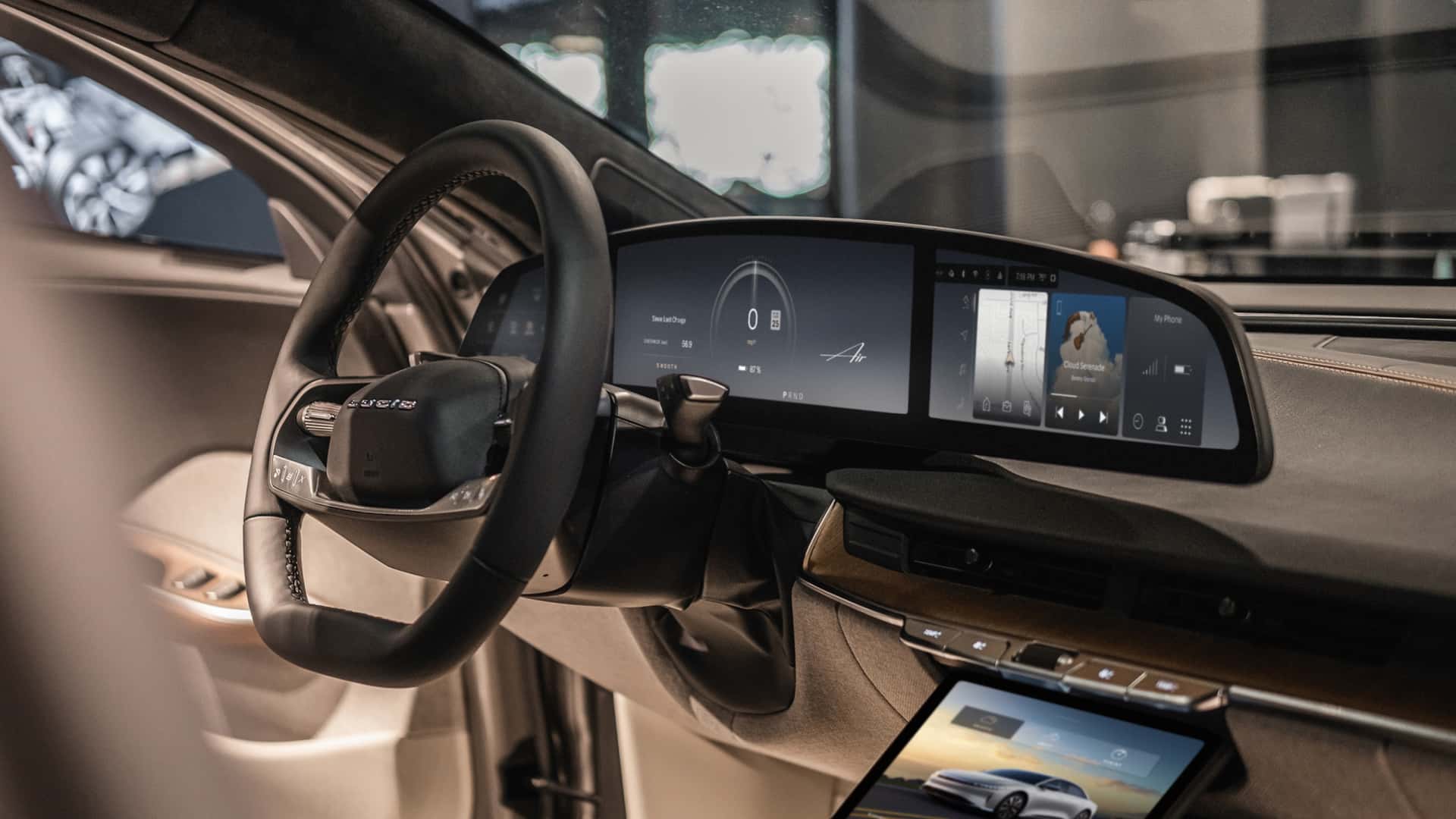


Lucid rolled out a redesigned user interface for the Air sedan on Tuesday, calling it faster, more intuitive, and more in line with the system that debuted in the Gravity SUV. There’s a catch. If your Air was built before 2025, you might need a $950 hardware upgrade to run it.
The update, called UX 3.0, arrives automatically over the air for 2025 and newer models. For 2022, 2023, and some 2024 cars, the existing infotainment processor simply can’t handle it. Lucid switched to a second-generation chip partway through the 2024 model year, leaving earlier builds on the wrong side of the hardware divide.
The $950 price covers the new processor and installation in the U.S. Pricing for other markets hasn’t been announced.
Charging customers to unlock a software update by swapping out a computer is not unheard of in the EV world, but it stings more when the brand positions itself as a luxury alternative to Tesla. The Air starts north of $69,000. Telling owners of three-year-old cars that the latest interface requires a paid retrofit feels like a move borrowed from a different price bracket.
The update itself brings real improvements. A redesigned home screen uses swipeable cards for frequently accessed features. The upper “Cockpit” display and the lower vertical “Pilot Panel” are finally decoupled, meaning drivers can run navigation on one screen and media on the other.
That was a glaring omission from earlier software versions, a basic multitasking capability that competitors offered from day one.
Route planning gets an overhaul too, with the ability to filter by charging network, set arrival range targets, and specify adapter compatibility. Apple CarPlay and Android Auto now render larger on the Air’s curved display and should, Lucid says, be more reliable. A new quick-controls gesture lets drivers swipe down from the top of the Pilot Panel to reach popular settings without digging through menus.
All of it sounds like what UX 2.0 should have been. Lucid has always punched above its weight on powertrain engineering. The Air’s range and efficiency numbers remain class-leading, but the software experience has lagged behind the hardware promise, and the Gravity’s arrival exposed just how dated the Air’s interface had become.
The $950 upgrade is a reasonable price for a processor swap if you compare it to what dealers charge for far less meaningful work. But the optics matter. Lucid is a small company fighting for every customer, every renewal, every positive word-of-mouth recommendation.
Early adopters took a leap on a startup. Asking them to pay again just to keep their infotainment current sends a complicated message about how Lucid values loyalty.
There is precedent. Tesla has occasionally gated software features behind hardware upgrades, and legacy automakers have started charging subscriptions for functions that used to come standard. The industry is clearly moving toward a model where the car you buy is not the car you keep, at least not in terms of capability, unless you keep paying.
Lucid says the 2.11.0 software update is rolling out now for eligible vehicles. For everyone else, the service centers are waiting.


Share this Story