
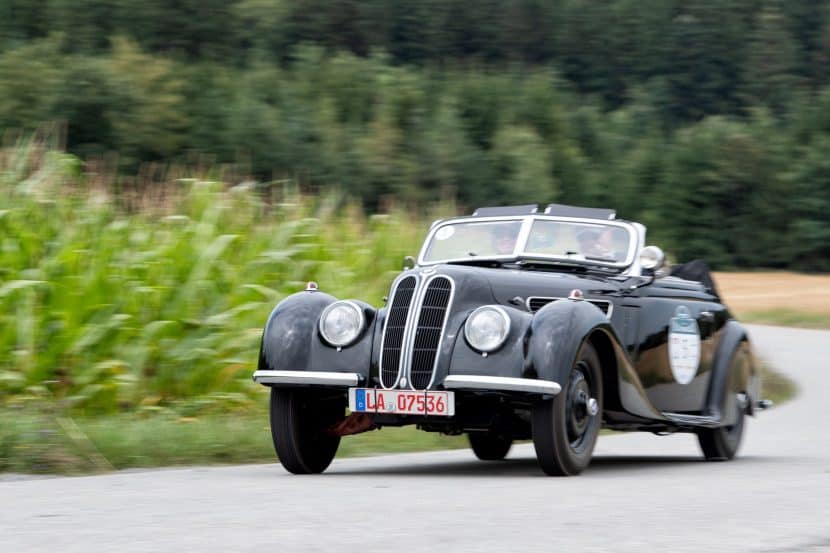


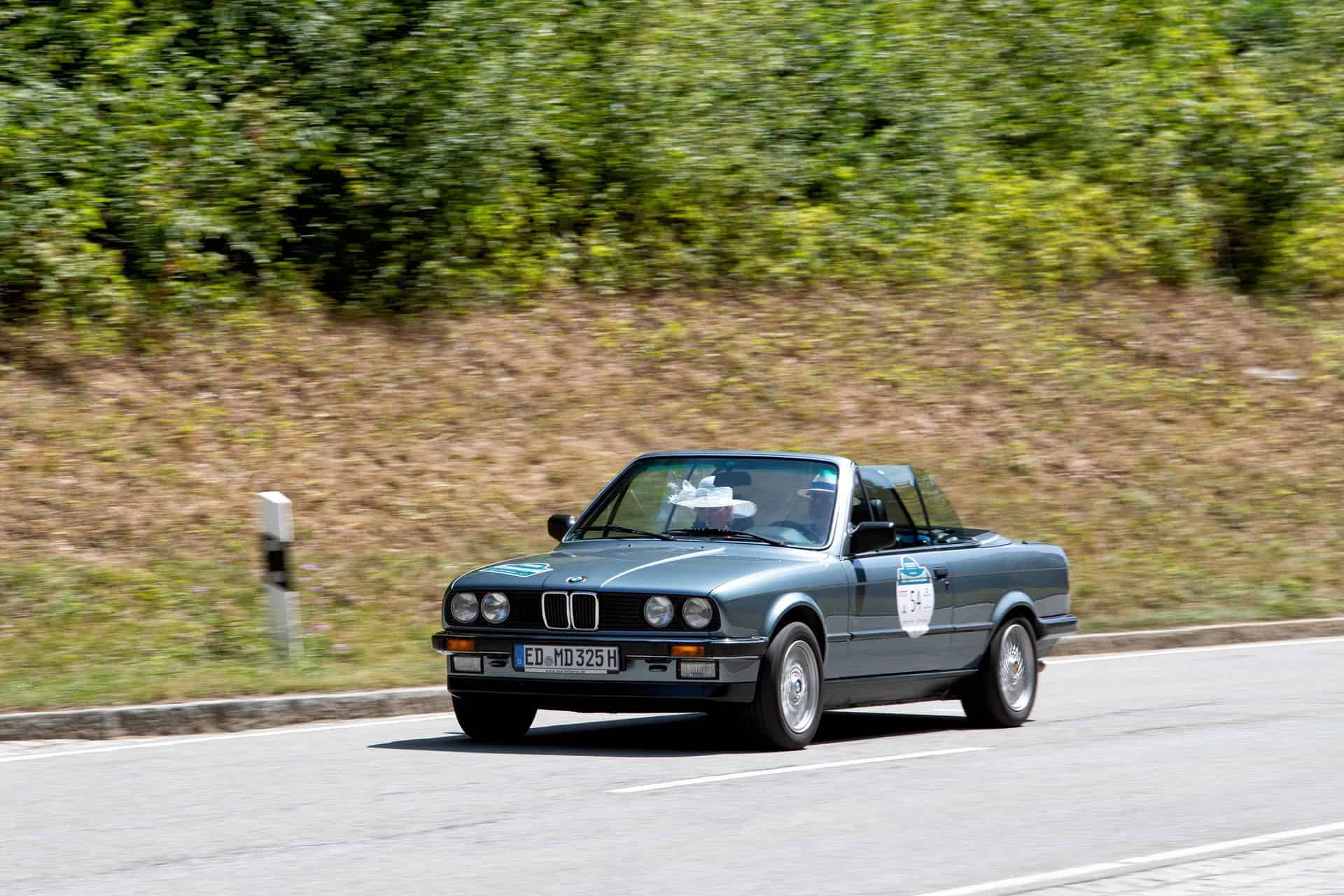
A 1935 BMW 315/1 and a 1985 E30 325i Cabriolet have almost nothing in common except a badge and a willingness to be driven hard on Bavarian back roads. Both showed up at the 35th Falkenhausen Classics on July 25-26, bookending a nine-car BMW contingent that stretched across five decades of the marque’s history.
Fifty-five classic cars entered the two-day regularity rally through Lower Bavaria, that rolling patchwork of castles and farmland between Munich and the Bavarian Forest. The BMW lineup read like a museum catalog nobody would actually build: a 1937 327 Cabriolet, a pair of 502 Cabriolets, a 503, a 2600 Luxus V8 still carrying its “Baroque Angel” nickname, a BMW-Glas V8 3000, and an E9-generation 2800 CS coupe.
The oldest car in the entire field was a 1933 Aston Martin Le Mans Short Chassis. Harald and Elke Springer’s 315/1 trailed it by just two years.
Regularity rallies flip the usual motorsport logic. Nobody is chasing lap times. Crews receive a roadbook with fixed times for each section, and penalties stack up for arriving either early or late at checkpoints.
Precision and navigation matter more than horsepower. A co-driver who can hold pace through a 90-minute stage is worth more than 50 extra horses under the hood.
The weekend opened Saturday with a one-hour prologue from Neufahrn Castle, essentially a warm-up loop through the countryside. After a break, the first regularity stage ran about two hours and 15 minutes in warm sunshine, finishing at Mengkofen Castle with an evening reception.
Sunday carried the weight. A short 30-minute stage launched from the Adlkofen Automobile Museum, home of organizing club Scuderia Isar e.V., and ended in Landshut’s historic center. A Concours d’Elegance there gave spectators close access to the cars and their crews.
The third stage ran 90 minutes through Frontenhausen, passing the roundabout made locally famous by the Eberhofer crime film series, before a brief rain shower caught the field on its way to Tunzenberg Castle. The final stage, roughly two and a half hours long, wound toward Peuerbach Castle for the prize-giving ceremony.
Events like Falkenhausen don’t generate the headlines that concours at Pebble Beach or Villa d’Este attract. They’re regional, deliberately unhurried, and built around the simple act of driving old cars on public roads with some competitive structure layered on top. No trailer queens. No roped-off display lawns. These cars get road grime on their fenders.
What makes the BMW roster interesting is how it traces a company that nearly went bankrupt in the late 1950s. The 502 and 503 were beautiful, expensive machines that almost killed the brand financially. The Baroque Angel was a prestige play BMW could barely afford.
The BMW-Glas V8 3000 exists only because BMW absorbed Hans Glas GmbH in 1966 and briefly continued the smaller firm’s coupe with its own V8 dropped in. The 2800 CS coupe represents the moment BMW finally found its commercial footing. And the E30 325i Cabriolet? That’s the car BMW built when the money was flowing and the brand could afford to have fun.
Nine cars, one rally, and a compressed history lesson that no corporate heritage department could stage this well. The 36th running is already on the calendar.

Share this Story