
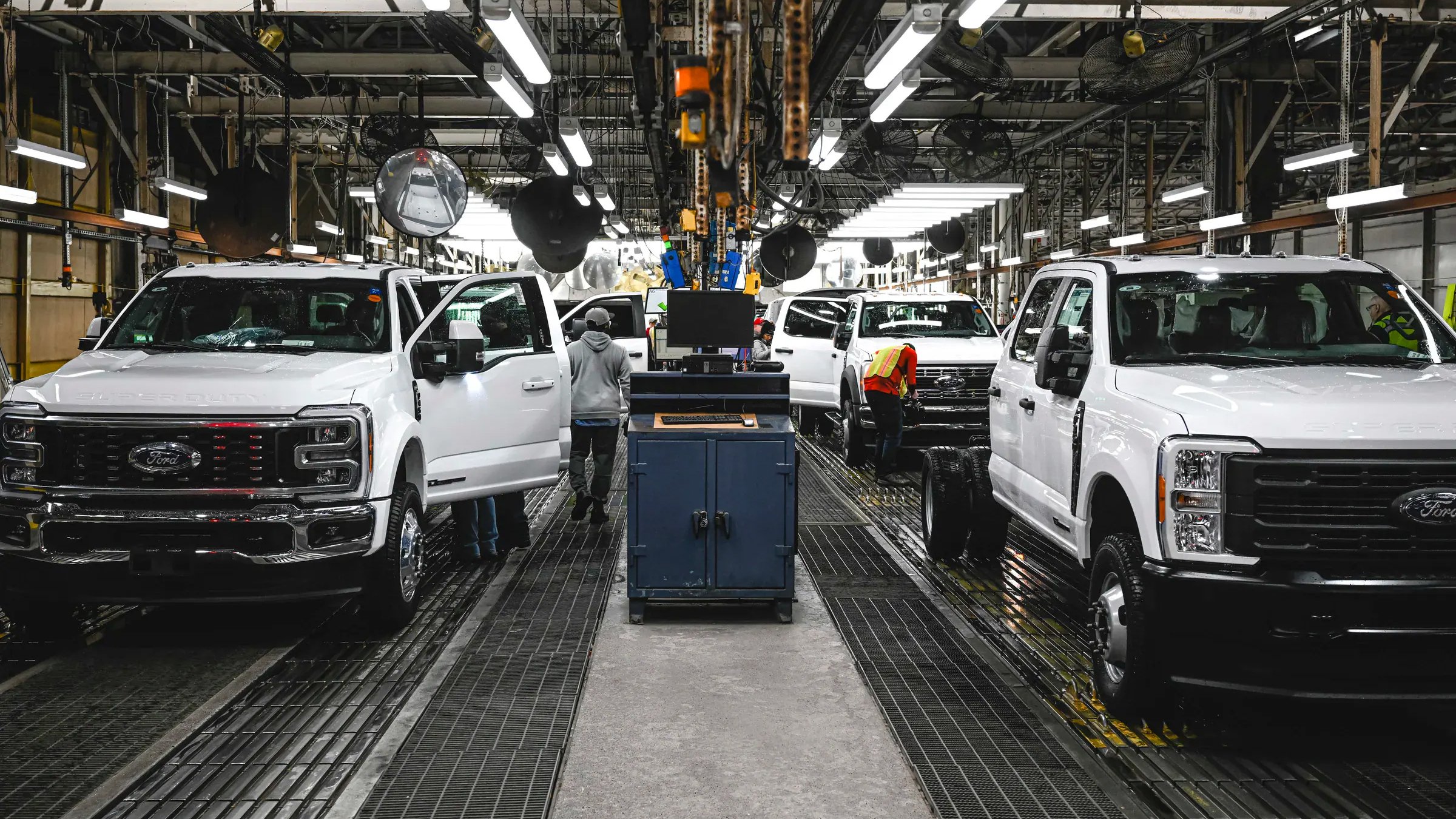


Ford is throwing three Super Duty prototypes at the Pentagon, competing directly with General Motors for a U.S. Army tactical truck contract worth 600 units. The rivalry between Detroit’s two largest truck makers just found a new battlefield, literally.
The contract itself is modest by military procurement standards. Six hundred trucks won’t move the needle on either company’s bottom line. But defense work carries weight that transcends unit volume. It validates engineering, opens doors to future orders, and plants a flag in a market where reputation compounds over decades.
Ford’s decision to base its prototypes on the Super Duty platform is telling. Rather than engineer a purpose-built military vehicle from scratch, the company is betting that a hardened version of its commercial workhorse can meet the Army’s requirements. That approach keeps development costs low and leverages a supply chain Ford already controls.
GM’s competing entry hasn’t been detailed publicly, but the company has deep roots in military vehicle production stretching back to World War II. Its subsidiary GM Defense delivered the Infantry Squad Vehicle to the Army in 2020, a contract that gave it a foothold Ford is now trying to challenge.
The timing of this competition lands amid a broader reshuffling across the global auto industry. Porsche announced plans to eliminate 9,000 jobs by 2035, roughly one in five employees, as Volkswagen Group’s restructuring bleeds across every brand in its portfolio. Mercedes-Benz managed to post improved second-quarter profits despite a 30 percent year-over-year sales collapse in China, a split result that pushed its stock up nearly 6 percent on Tuesday.
Stellantis offloaded its Free2move car-sharing operation to a German private equity firm, shedding a side business active in 14 cities across the U.S. and Europe. European automakers are trimming. American automakers are fighting over government contracts.
BYD launched the Racco in Japan, an electric kei car priced at roughly $12,213 after subsidies. That number should unsettle every automaker trying to sell small EVs at two or three times the cost. Japan’s kei car segment is fiercely local, dominated by Suzuki and Daihatsu, and BYD’s willingness to price this aggressively suggests it views the segment as a beachhead rather than a profit center.
BMW is reportedly developing a convertible version of the i4 electric coupe with a folding fabric roof, targeting a 2028 launch. The only real competitor would be the Maserati GranCabrio Folgore, which starts well above $150,000. An open-top i4 at a lower price point would essentially have the mainstream EV convertible market to itself.
Land Rover confirmed it is pulling the Discovery Sport from several European markets, another quiet retreat from a nameplate that never quite found its footing against German competition.
Back in Detroit, the Army truck contract may be small, but the symbolism runs deep. Ford and GM have defined American manufacturing for over a century, and their willingness to scrap over 600 military trucks says something about how seriously both companies take even marginal territory. The Pentagon’s decision, whenever it comes, will carry echoes well beyond the motor pool.

Share this Story