
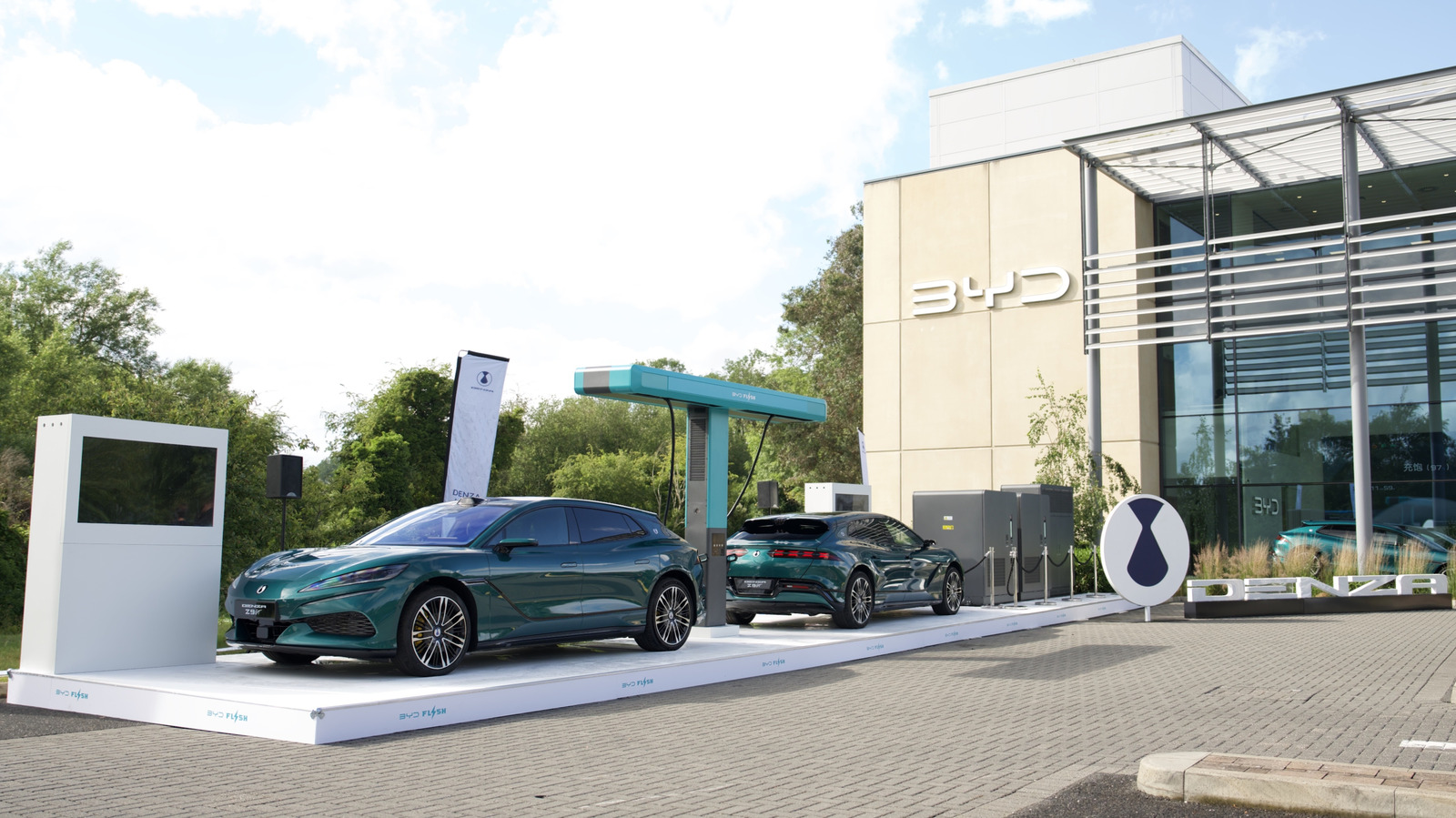


A Toronto job posting on LinkedIn gave it away. BYD North America is hiring a Flash Charging Business Development Manager, and the role is explicitly tied to building out the Chinese automaker’s ultra-fast charging network across Canada. Not the U.S. Canada.
The timing is no accident.
Earlier this year, Ottawa opened the door to 49,000 Chinese-built EVs annually at a tariff of just 6.1 percent, a fraction of the 100 percent duty the U.S. slaps on the same vehicles. That policy decision is now pulling an entire ecosystem northward. BYD isn’t just planning to sell cars in Canada. It’s planning to own the refueling experience, too.
Flash Charging, as BYD brands it, claims peak speeds of 1,500 kW. That’s more than four times faster than the best public DC fast chargers currently available in North America, which top out around 350 kW. BYD says a five-minute session pushes a compatible vehicle from 10 to 70 percent, recovering roughly 250 miles of range.
For context, a Tesla Model 3 on a Supercharger needs about 15 minutes to add 170 miles.
The architecture is different from anything deployed here. Each Flash Charging station uses a pair of massive battery-storage units as intermediaries between the grid and the vehicle. The car doesn’t pull directly from the electrical grid at those insane rates. It pulls from the buffer batteries, which recharge themselves more slowly between sessions.
BYD says this sidesteps local grid capacity constraints entirely. In China, the company has already installed 4,239 Flash Charging stations as of early March and aims to hit 20,000 by year’s end. European and U.K. media recently got hands-on demonstrations as part of a broader global rollout push.
The obvious question for Canada is cold weather. BYD addressed it with an internal test: a Denza Z9 GT equipped with its second-generation Blade battery, frozen to minus 22 degrees Fahrenheit, charged from 20 to 97 percent in 12 minutes. At room temperature, the same charge takes nine minutes. Not parity, but not catastrophic degradation either.
BYD isn’t alone in eyeing the Canadian market. Manufacturer-plated Chinese vehicles have been spotted around the Toronto area, Geely has been posting Canadian jobs, and Chery has officially announced plans to sell vehicles in the country by late 2026. But BYD is the only one simultaneously building charging infrastructure, a play that mirrors Tesla’s early Supercharger strategy: lock customers into your ecosystem before competitors even arrive.
This is BYD testing what a North American footprint looks like without touching American soil. Canada becomes the proving ground: a wealthy, English-speaking market with brutal winters, high EV adoption targets, and a government willing to crack the door open just enough to let Chinese automakers through.
The strategic implications ripple southward. If BYD demonstrates that 1,500 kW charging works reliably in Saskatchewan in January, the pressure on American charging networks, already struggling with reliability issues at a quarter of those speeds, becomes enormous. And the pressure on Washington to justify keeping Chinese EVs and their infrastructure permanently locked out gets harder to maintain with a functioning showcase six hours north of Detroit.
One LinkedIn job posting in Toronto. That’s all it took to signal that the global charging race just landed in North America’s backyard.

Share this Story