
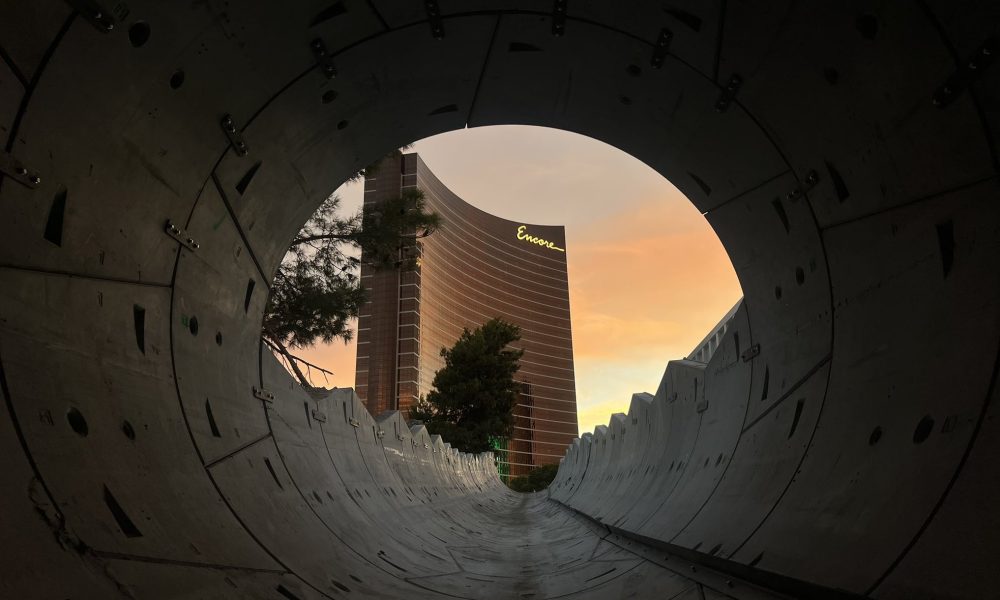


Clark County commissioners just approved 19 more stations for Elon Musk’s Vegas Loop, pushing the Boring Company’s entitled total to 123. The underground transit network currently has about 11 stations open to the public. That ratio tells you everything about where this project actually stands.
The Boring Company thanked the county on X and then floated a line that deserves to be read twice: “Because Loop is point-to-point with no intermediate stops, in the limit, one could have a Loop station in every driveway.” The company that has built roughly a dozen functioning stops is already talking about putting one in your garage.
The approval history traces an escalation pattern that has become the project’s defining feature. In 2023, commissioners signed off on 18 additional stations as part of a plan targeting 69 stops across 65 miles. By late that year, the number had climbed to 93 planned stations.
Last year the design called for 104 across 68 miles. Now it is 123. The blueprints keep growing faster than the tunnels behind them.
What riders can actually use remains modest. The system has carried more than 4 million passengers since it started running in 2021, a decent number built mostly on ferrying convention-goers between halls and nearby Strip hotels. Recent additions at Fontainebleau and Sahara have extended the corridor, but the tunnel connection to Harry Reid International Airport, which would give the Loop its first real transportation purpose beyond resort shuttles, has already slipped past its original first quarter deadline.
There is also a Westgate to Paradise Road segment that Las Vegas Convention and Visitors Authority CEO Steve Hill has said he hopes will be running in time for November’s Formula 1 race. Hope is doing heavy lifting in that sentence. Construction timelines on this project have slipped before.
Boring Company’s Prufrock tunneling machines did set an internal record in March, completing a 2.28 mile tunnel near Westgate. That is real progress, and it suggests the company’s digging capability is improving. But regulatory approval and construction are two very different animals.
Each new station still requires fire safety sign-offs, integration with existing infrastructure, and coordination with the resorts and properties that host the stops. None of that moves as fast as a county commission vote.
The county keeps saying yes because the arrangement costs Clark County nothing. Boring Company funds the construction privately, and the stations bring foot traffic to casinos and hotels that want it. For commissioners, every vote is free infrastructure on paper.
The risk sits entirely with Musk’s company, which has to turn those approvals into concrete, steel, and functioning tunnels before the political goodwill runs thin. That driveway comment is pure Boring Company messaging strategy. Treat every approval as a floor, then immediately start talking about a ceiling that does not exist yet.
It keeps the ambition out in front of the execution, which works as long as execution eventually catches up. Right now, 123 stations are entitled. Roughly 11 are open.
The airport link is late. The F1 deadline is approaching fast. And the company is already pitching a future where Loop stations are as common as mailboxes.
The tunneling machines are in the ground. The question is whether they can dig fast enough to keep the gap between promises and pavement from becoming the project’s permanent story.



Share this Story