
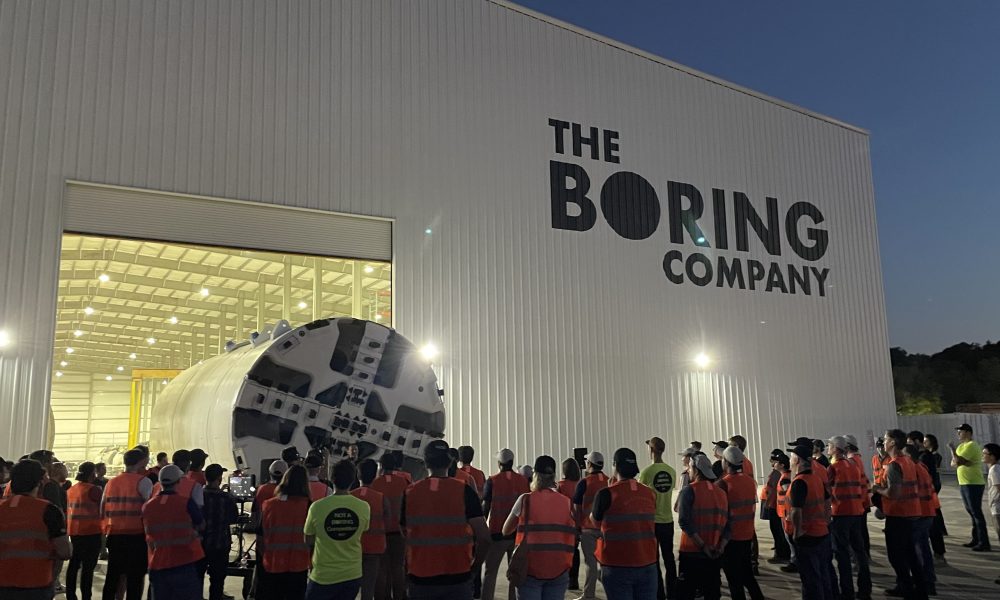


The Boring Company just rolled out Liner Truck 3, an autonomous vehicle built from Tesla Model 3 battery packs and drive units, designed to haul 22,000 pounds of precast concrete tunnel segments without a single human being underground.
The vehicle was unveiled on the company’s official X account and represents the production-ready version of a concept tested earlier at the Bastrop, Texas research tunnels. A factory tour released last month showed an employee piloting a fully loaded prototype with a PlayStation controller. Liner Truck 3 looks like the cleaned-up, daily-use evolution of that experiment.
It operates under what The Boring Company calls its Zero-People-In-Tunnel protocol, piloted remotely from a Global Operations Control Center in Texas. The job it performs is repetitive and brutal: shuttling concrete segments from surface staging areas to wherever a Prufrock boring machine is actively cutting. If those segments don’t arrive fast enough, the boring machine idles. That bottleneck is the entire reason Liner Truck 3 exists.
The timing is not accidental. The Boring Company has multiple Prufrock machines either active or arriving in Nashville, where Music City Loop construction has been accelerating since February. The Vegas Loop network continues adding tunnel mileage on a near-monthly basis. Both projects demand a logistics chain that can keep pace with machines designed to dig faster than anything the tunneling industry has historically produced.
A driverless truck running Tesla drivetrain components is The Boring Company’s answer to that supply chain pressure.
What makes this vehicle worth watching goes beyond one company’s tunneling operations. Tesla Model 3 drive units already move passengers through the Vegas Loop. Now those same components are hauling concrete underground. Musk’s companies have been quietly building an internal parts ecosystem where passenger car hardware gets repurposed for industrial applications, and Liner Truck 3 is the latest example of that strategy in action.
The component reuse logic has a certain elegance. Tesla produces Model 3 battery packs and drive units at scale, which drives costs down. The Boring Company gets proven, mass-manufactured powertrain hardware without developing its own from scratch.
Both companies benefit from shared engineering DNA, and the arrangement avoids the kind of low-volume, custom-built equipment costs that plague traditional tunneling operations.
Whether this approach scales beyond tunnel logistics vehicles is an open question. Musk’s companies now span electric vehicles, tunneling, space launch, humanoid robotics, and AI chip manufacturing. The Terafab project in Grimes County, Texas, a joint Tesla-SpaceX-xAI venture targeting over a terawatt of AI compute, just locked in its site with a $10 million payment to the county.
SpaceX confirmed it will build its own natural gas power plants for the facility rather than pulling from the Texas grid. Every one of these ventures has equipment needs, and every one sits under an owner who has shown a clear preference for vertical integration.
Liner Truck 3 is a concrete hauler. It does one thing. But the philosophy it represents, pulling proven components off one production line and dropping them into entirely different machines for entirely different industries, is the thread connecting a growing number of Musk’s operational decisions.
The PlayStation controller was the demo. The 22,000-pound payload running autonomously through a Nashville tunnel is the product. The question now is what gets built next from the same parts bin.
Share this Story