
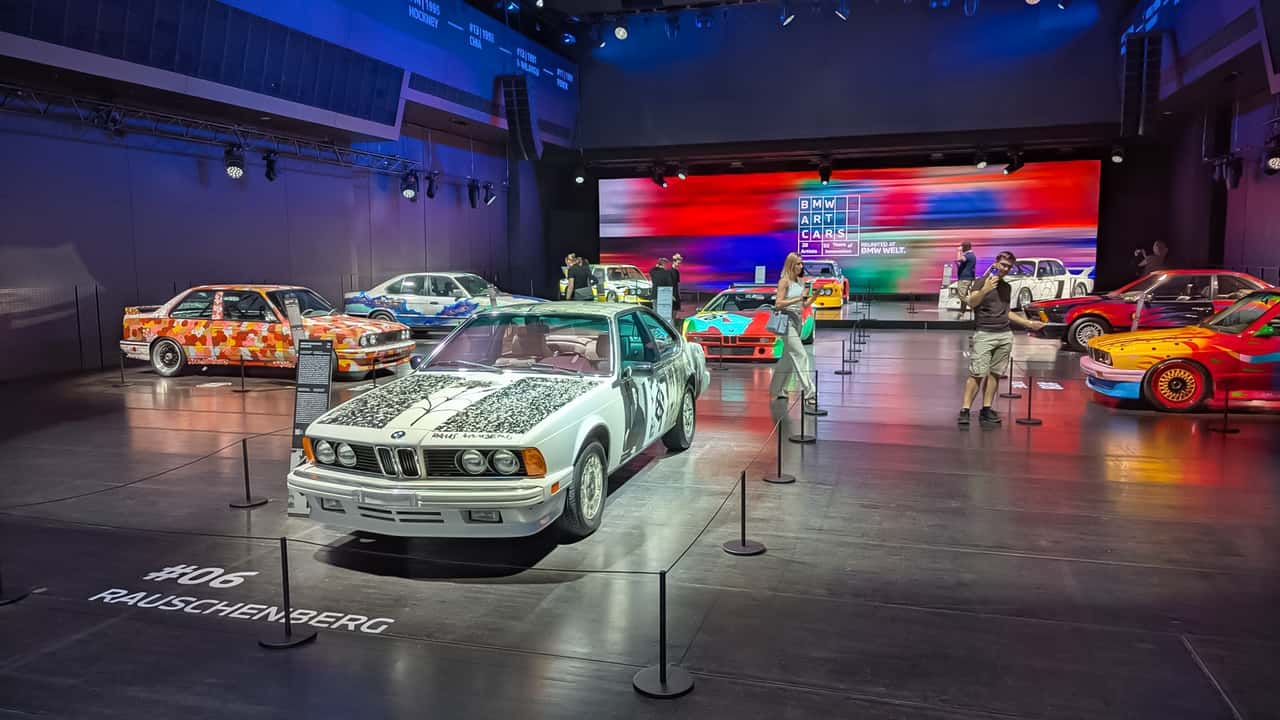


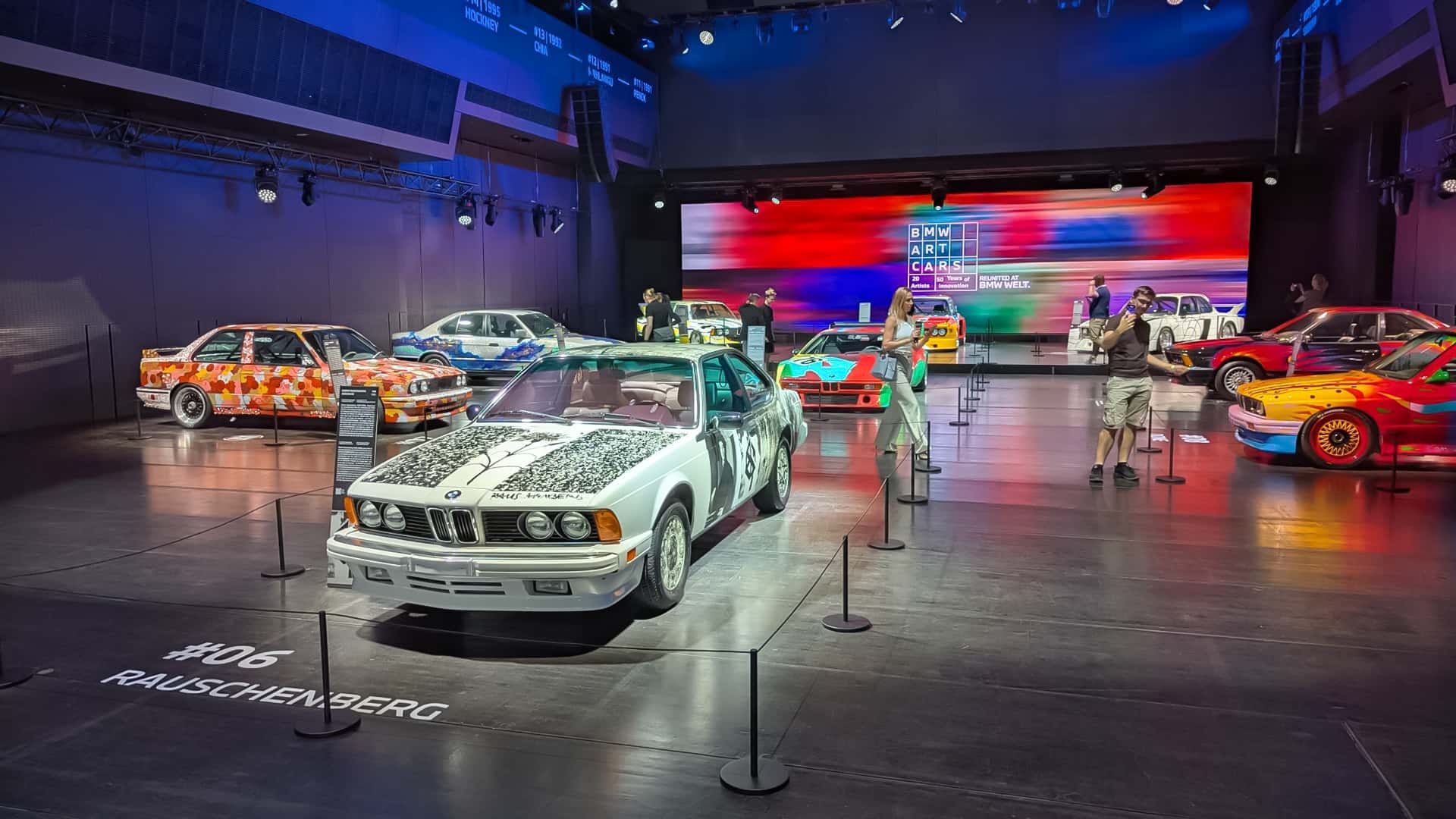
It took half a century, but every single BMW Art Car is finally in one room. All 20 of them, from Alexander Calder’s 1975 Le Mans racer to Julie Mehretu’s 2024 M Hybrid V8, lined up together at BMW Welt in Munich for the first time in the collection’s history.
The exhibition, running July 29 through August 31, 2026, marks the end of a world tour that hit more than 30 countries. Admission is free. The cars are arranged in reverse chronological order, walking visitors backward through five decades of collisions between fine art and sheet metal.
The whole thing started because a French race driver happened to also be an art auctioneer. Hervé Poulain convinced BMW motorsport boss Jochen Neerpasch to let Alexander Calder paint a 3.0 CSL for the 1975 24 Hours of Le Mans. Nobody planned a series. Nobody envisioned a 50-year legacy.
It was a one-off stunt that refused to stay one-off. Frank Stella followed in 1976 with another CSL. Roy Lichtenstein did a 320i Turbo in 1977.
Then Andy Warhol got his hands on an M1 in 1979, and the program became something else entirely. That car alone is probably worth more than most dealerships.
The roster reads like a MoMA catalog crossed with a racing paddock. Ernst Fuchs, Robert Rauschenberg, David Hockney, Jeff Koons. Each one took a production or racing BMW and turned it into something that sits uncomfortably between sculpture and machine.
Some were built to race. Most were built to provoke. Olafur Eliasson’s 2007 entry might be the strangest of the bunch.
He took BMW’s hydrogen-powered H2R prototype, stripped the body panels, replaced them with a skeletal metal frame coated in frozen water, and lit the whole thing from inside. It weighs about two tons and sits on the East Plaza like some kind of automotive ice fossil. Whether you buy BMW’s “poetic meditation on sustainability” framing or not, the thing stops you cold.
The more recent entries have pushed into digital territory. Cao Fei’s 2017 contribution was a digital concept based on the M6 GT3. Mehretu’s 2024 car, the M Hybrid V8 race machine, brought the collection back to physical paint on a physical car, which feels like a deliberate choice in an era drowning in screens.
BMW Welt has layered digital experiences on top of the physical exhibition. A Treasure Hunt app rewards visitors who scan five artworks with a free drink. Another app called Artlas offers audio guides in 25 languages and an AI-powered chat.
The opening night featured a panel discussion on the cultural weight of the automobile, plus a merchandise push that included scale models, a book, and pieces from Cao Fei’s capsule collection.
What makes this gathering worth paying attention to is the sheer improbability of it. These cars are scattered across museums, private vaults, and BMW’s own archives around the world. Getting all 20 into one building required the kind of logistical effort that usually accompanies diplomatic summits, not art shows.
Neerpasch once called this the world’s most significant collection of automotive art. That claim is hard to argue with when you see the full lineup. Calder, Warhol, Hockney, Koons, Mehretu — these aren’t decorative paint jobs.
They are finished works by artists whose canvases hang in the world’s most serious institutions. The exhibition closes August 31. After that, the 20 cars scatter again, back to their separate corners of the globe, with no word on when BMW will attempt to reunite them a second time.
Share this Story