
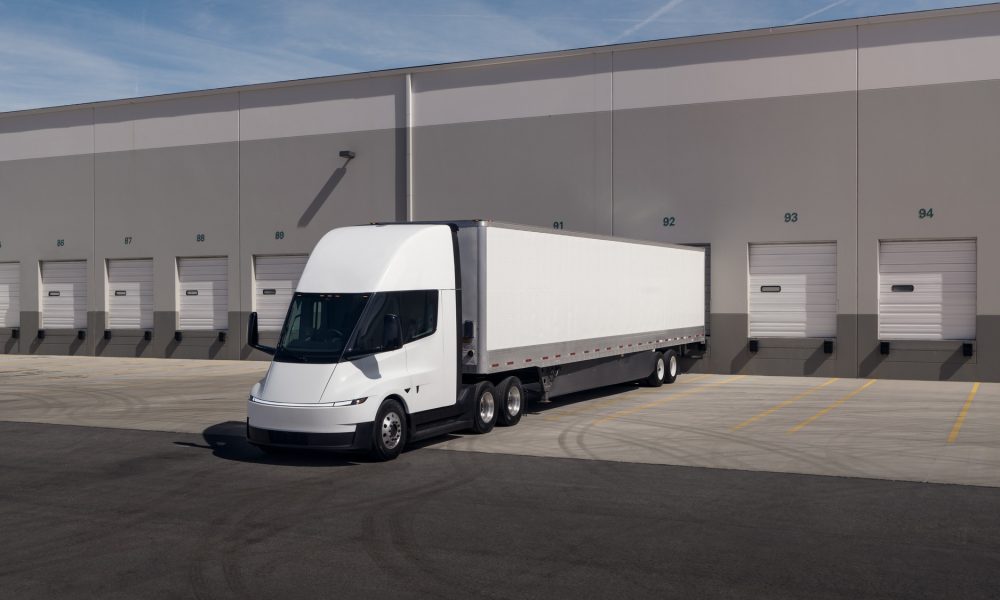


The largest electric truck order in American history landed on Tesla’s doorstep two days before the company even cut the ribbon on its new factory. ZET SCALE, a freshly formed alliance of shippers and carriers, committed to 2,500 Class 8 electric trucks with Tesla as the primary manufacturer. That single deal could nearly double the number of heavy-duty electric trucks on U.S. roads.
Tonight Tesla inaugurates its 1.7-million-square-foot Semi production plant in Sparks, Nevada, and drone footage from the site already tells the story. A row of new Semi units sat outside the factory wearing the liveries of PepsiCo, DHL, U.S. Foods, Einride, WattEV, and several lesser-known names. Some of those logos belong to confirmed buyers, while others like LTS, OK Produce, and HMD have never been publicly tied to firm orders, suggesting Tesla plans to expand its customer list on stage tonight.
The ZET SCALE deal is structured to lower the barrier for carriers who have been reluctant to go electric. ZET Financial is issuing the purchase order for all 2,500 trucks and placing them with fleets through fair market value leases. The trucks will roll out across 10 freight hubs spanning Los Angeles, Houston, Dallas, Chicago, Atlanta, Seattle, and the Newark-New York corridor.
Microsoft and PepsiCo are among the founding shippers pooling freight demand, which let every bidder price lower than it would for a single fleet. Tesla won the top slot through a competitive RFP scored on price, range, charging capability, and production capacity. Kenworth, RIDE, and Volvo were selected as secondary options.
No public breakdown exists showing how many of the 2,500 trucks will actually be Semis, but Tesla’s position as primary manufacturer means it will take the largest share. The order dwarfs everything that came before it. Einride’s 500-unit commitment in August had been the record, and WattEV’s 370-truck California deal in May held the state title. Both now look like warm-up acts.
The Tesla Semi is designed for lower cost per mile operations than diesel,” said Dan Priestley, director of the Semi program. ZET SCALE has already signaled the initial 2,500 is just the opening round, with a longer-term target of 10,000 trucks or more.
The factory itself sits next to Gigafactory Nevada’s 4680 cell lines and is designed for an eventual capacity of 50,000 trucks per year. Priestley has said Tesla expects to build “many thousands” of Semis in 2026, with outside estimates ranging from 5,000 to 15,000 deliveries depending on how smoothly the production ramp unfolds.
Tesla first showed the Semi in 2017 and promised production by 2019. Pilot builds didn’t reach PepsiCo until late 2022. That seven-year gap between promise and volume production is the kind of delay that would have killed most programs, but the order book kept growing while skeptics kept writing obituaries.
PepsiCo now runs dozens of Semis on daily regional routes. Einride’s CEO expects all 500 of his trucks delivered by the end of 2027. Tonight’s handover event, livestreamed on X starting at 6 p.m. Pacific, is designed to signal that Tesla’s truck operation has moved from prototype curiosity to industrial scale.
The real test starts now. Filling a 2,500-truck order while ramping a brand-new factory while managing an S-curve production climb is a different sport than parking a dozen trucks outside a PepsiCo warehouse. Tesla has the orders. Whether it has the execution remains the only question that actually matters, and the answer will be counted one truck at a time.

Share this Story