
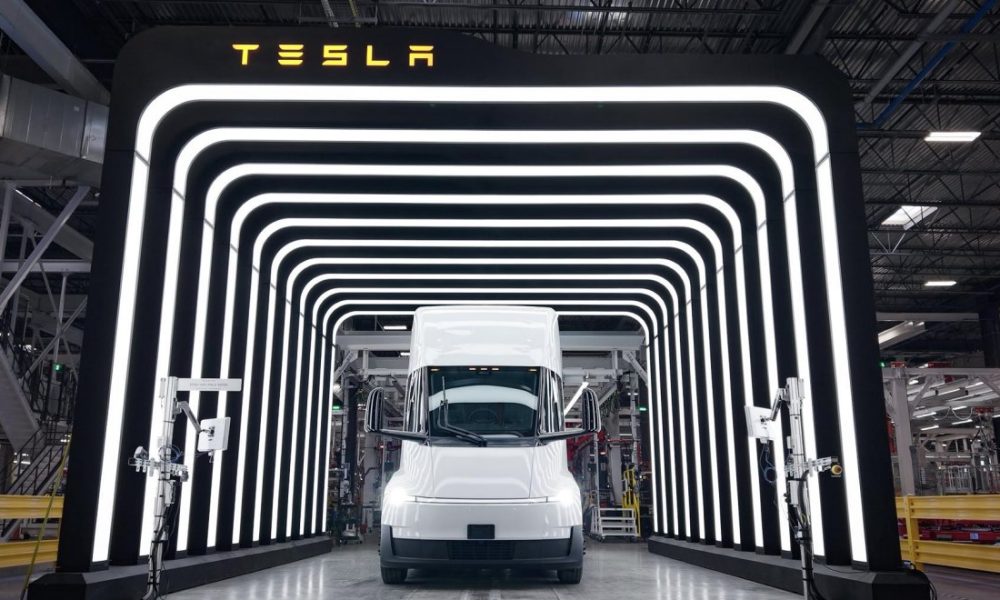


Tesla will officially inaugurate its Nevada Semi factory on September 24, a full five months after the first trucks rolled off the high-volume production line. The company’s Semi account posted the announcement on X with little more than a graphic reading “Semi Rollout” and a date. No guest list, no agenda, no details.
That alone makes this unusual. Tesla has historically treated the first vehicle off a new line as the celebratory moment. Gigafactory Berlin, Gigafactory Texas, even the original Fremont ramp all had their pageantry timed to the first units hitting the floor. The Semi plant in Sparks, Nevada, started building trucks on April 29 and has been quietly ramping ever since, with no fanfare.
So why throw a party now?
The 1.7 million square foot factory was built as part of a $3.6 billion expansion Tesla announced in early 2023. It sits adjacent to the battery cell lines feeding the Semi’s structural pack, a deliberate co-location meant to eliminate the supply chain chokepoint that kept this truck in limbo for years. The plant is designed for 50,000 trucks annually at full capacity, though Semi program director Dan Priestley has only said production “is now ramping,” carefully avoiding any claim of scale.
Nine years have passed since Elon Musk first unveiled the Semi in 2017. The original delivery target was 2019. What followed instead was a slow trickle of hand-built pilot units sent to PepsiCo, years of delays, and a painfully gradual buildout of the Nevada facility. The gap between promise and product has been wide enough to drive a fleet of conventional diesel rigs through.
The September 24 date does not exist in isolation. Tesla confirmed the Semi is heading to Europe, with a full unveiling at the IAA Transportation trade show in Hannover, Germany, running September 15 through 20. That gives Tesla roughly ten days in September to stage two events on two continents, both designed to push one message: the Semi is no longer a prototype shuffling between California distribution centers. It is a production truck with international ambitions.
Hannover is where European truck buyers go to shop. Daimler, Volvo, MAN, and Scania will all be there with their own electric and hydrogen offerings. Tesla showing up with the Semi means it is ready to compete for orders in a market that has been skeptical about whether the truck would ever actually materialize in volume.
The inauguration in Nevada starts to make more sense as a calculated staging event. Tesla gets a domestic spectacle to pair with the European debut, and it gets to set the narrative around ramp numbers and delivery timelines at a moment when the audience is paying attention to the truck for the first time in years.
Whether the factory is anywhere near its 50,000 unit annual target remains an open question. Priestley’s language has been careful. Ramping” is not “ramped.” Tesla has not disclosed production figures for the Semi, and the company’s track record with ramp timelines across every vehicle program suggests caution is warranted.
Still, two events in ten days across two continents is not something you schedule for a truck that is not moving. The real test comes after the confetti settles, when fleet operators start asking for delivery dates and Tesla has to answer with something more concrete than a graphic on X.

Share this Story