
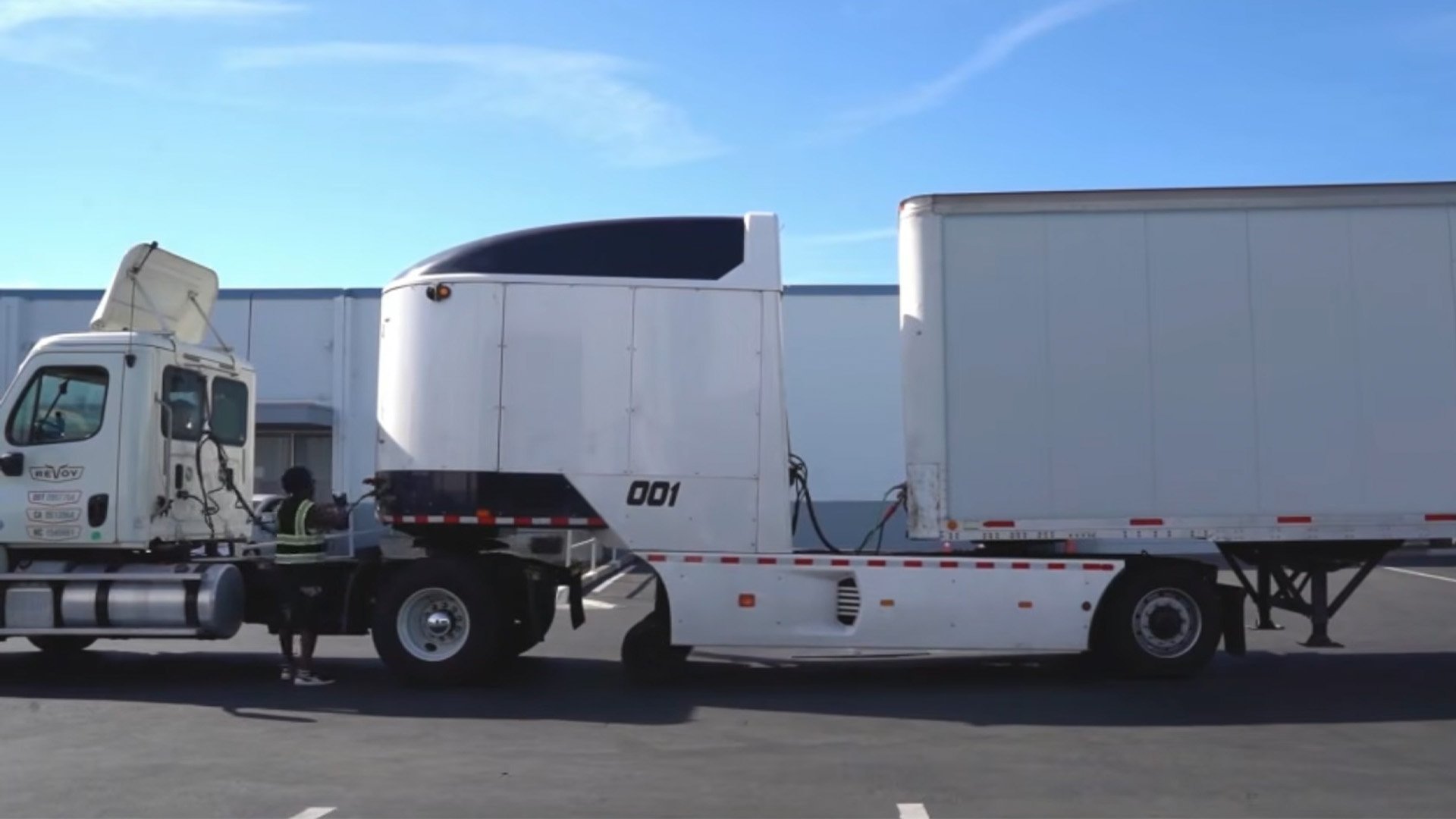


A California startup called Revoy just closed a $27 million funding round for what might be the strangest idea in commercial trucking electrification: a battery-and-motor module that clips between a tractor and its trailer like an oversized fanny pack, temporarily converting any diesel rig into a hybrid.
Founded in 2020, Revoy designed an automated unit that syncs with a truck’s diesel engine, adding electric assist and regenerative braking. The company claims its current hardware can deliver 200 miles of electric boost for a fully loaded 80,000-pound truck, cutting carbon emissions by up to 85 percent. Operating costs, CEO Peter Reinhardt told Bloomberg, should be comparable to running a conventional diesel rig.
The concept targets a real problem. Battery-electric semis require enormous packs to deliver meaningful range under load, and the economics still don’t pencil out for most fleets. Revoy’s pitch is simpler: don’t replace the truck, just bolt something onto it.
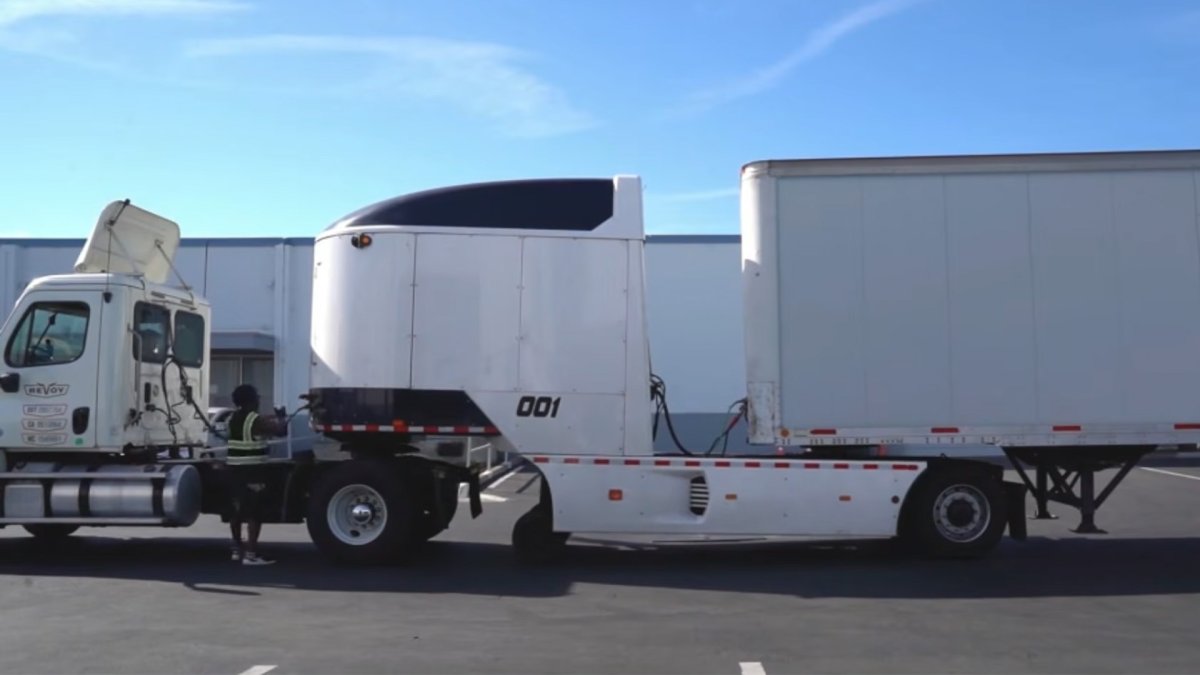
But simplicity ends there. The battery module is too large to recharge fully through regenerative braking alone, so Revoy envisions a network of swap hubs where drivers exchange depleted units for fresh ones. That means building proprietary infrastructure from scratch, the exact bottleneck that has plagued every battery-electric trucking venture to date.
Swapping stations, trained technicians, logistics coordination for module inventory. None of that is cheap or easy.
Revoy received NHTSA approval for public road use in 2023 and launched a pilot program with Ryder in 2024. Commercial operations are slated to begin later this year on a 200-mile route near Portland, Oregon, using modules assembled from Chinese components and a specially trained driver corps.
Chinese components. In this political climate. The $27 million round represents more than half of the $41 million Revoy has raised to date, and the company says it plans to develop a cheaper version with a smaller battery but comparable range. Developing a domestically sourced alternative, assuming that’s even on the roadmap, would burn through that war chest fast.
The timing also works against Revoy in its most critical market. California is rolling out a rebate program for all-electric commercial trucks that could tilt the economics decisively toward full battery-electric semis. That could undercut the hybrid value proposition before Revoy can scale.
There is an elegance to the idea of extending the useful life of existing diesel trucks rather than scrapping them. Fleets have hundreds of billions of dollars tied up in rolling stock, and any path to lower emissions that doesn’t require replacing the entire vehicle has obvious appeal. Revoy is betting on pragmatism over purity.
Whether pragmatism can survive the need for dedicated swap infrastructure, potential tariff exposure on Chinese parts, and a shifting regulatory landscape that increasingly favors zero-emission vehicles is another question entirely. Pilot programs are one thing. Building a national network of battery swap hubs while competing against an industry that’s slowly but steadily going fully electric is a fundamentally different challenge.
Revoy’s next version, lighter and cheaper, is supposed to answer some of these concerns. But the company hasn’t said when it will arrive or what it will cost. The Portland route launches later this year, and that will be the first real test of whether a battery backpack for semi trucks is a bridge to something bigger or a detour nobody asked for.


Share this Story