
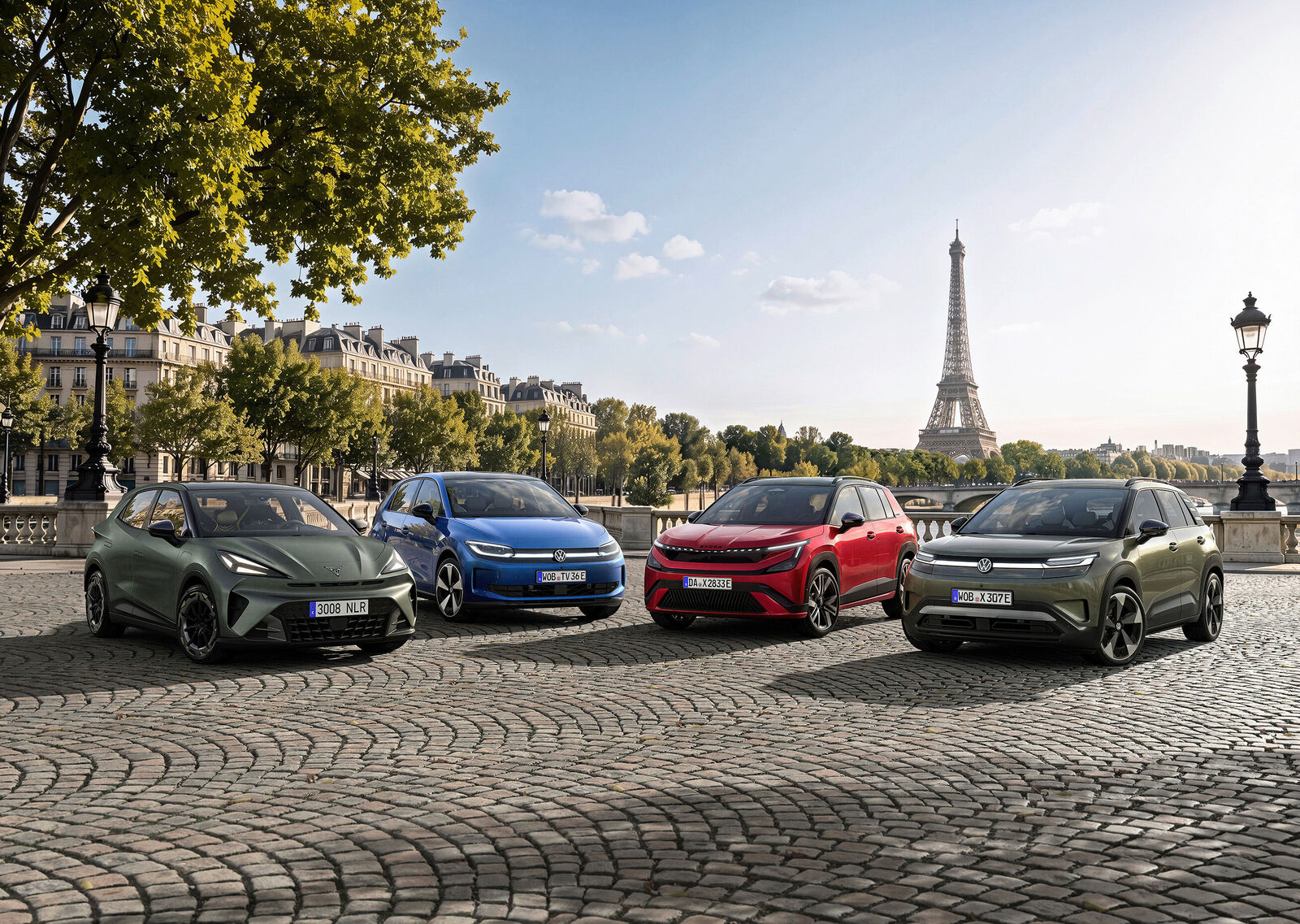


Almost 150,000 people have put down orders for cars that don’t exist yet. Not a single delivery has been made. The vehicles in question are four small electric hatchbacks and crossovers from the Volkswagen Group, and the automaker is treating this pre-delivery demand as validation of a strategy that has consumed billions of euros and bet the future of two Spanish factories on affordable EVs.
The full lineup appeared together for the first time at the Paris Motor Show this week. The CUPRA Raval, Volkswagen ID. Polo, Škoda Epiq, and Volkswagen ID. Cross share more than 80 percent of their components, all ride on the updated MEB+ platform, and all are built in Spain. Two hatchbacks come out of Martorell, and two small SUVs roll off the line in Pamplona.
This is the Electric Urban Car Family, and the name tells you everything about what Volkswagen is trying to do: make EVs cheap enough for the masses.
Thomas Schäfer, who runs both the VW brand and the Group’s volume division, called the project proof that the company can “successfully bring together competitiveness, industrial strength and affordable electric mobility from Europe for Europe.” That’s a mouthful, but the underlying math is simple. Shared batteries, shared drivetrains, shared front-wheel-drive architecture, shared supplier contracts — four distinct faces on what is fundamentally one car.
The investment behind this play is enormous. SEAT and CUPRA alone have sunk three billion euros into the transition from combustion to electric. The broader “Future Fast Forward” initiative, which includes PowerCo’s battery cell plant in Sagunto and a 300-million-euro battery assembly facility in Martorell, totals ten billion euros across all partners. Spain is becoming VW Group’s small-EV heartland, a deliberate counterweight to the Chinese factories churning out competitors at similar price points.
Whether 150,000 pre-orders translates into 150,000 paying customers is the question nobody at the Paris Motor Show was eager to answer. Order-to-delivery conversion rates vary wildly, and the European EV market has proven fickle. Buyers who click “reserve” in a moment of enthusiasm sometimes cool off by the time the car arrives.
Still, the segment these four cars target is massive and underserved. Europe’s best-selling vehicles remain small cars, and until now, electric options in that space have been either too expensive or too compromised. The Renault 5 E-Tech and Citroën ë-C3 are nibbling at this problem from different angles, but VW’s approach — flooding the zone with four variants across three brands — is a blunt-force response.
A year ago at IAA Mobility, these vehicles were shown in heavy camouflage, more promise than product. Now they’re production-spec machines with price tags designed to pull first-time EV buyers off the fence.
The real test starts when deliveries begin and warranty claims start rolling in. Building one platform is efficient. Building it well enough to satisfy CUPRA buyers who want sportiness, Škoda buyers who want value, and VW buyers who want the badge they trust is a different challenge entirely.
Volkswagen has wagered ten billion euros that four cars can share a skeleton and still feel like individuals. The orders suggest Europe wants to believe it.
Share this Story