
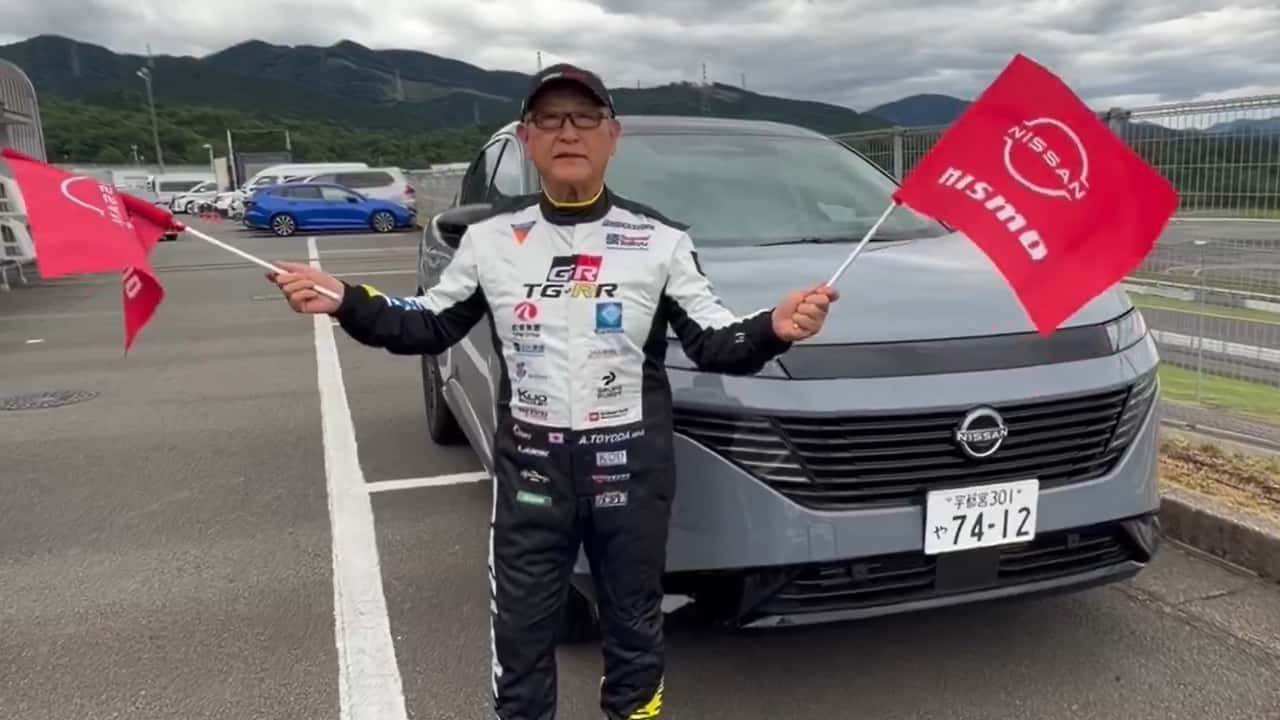


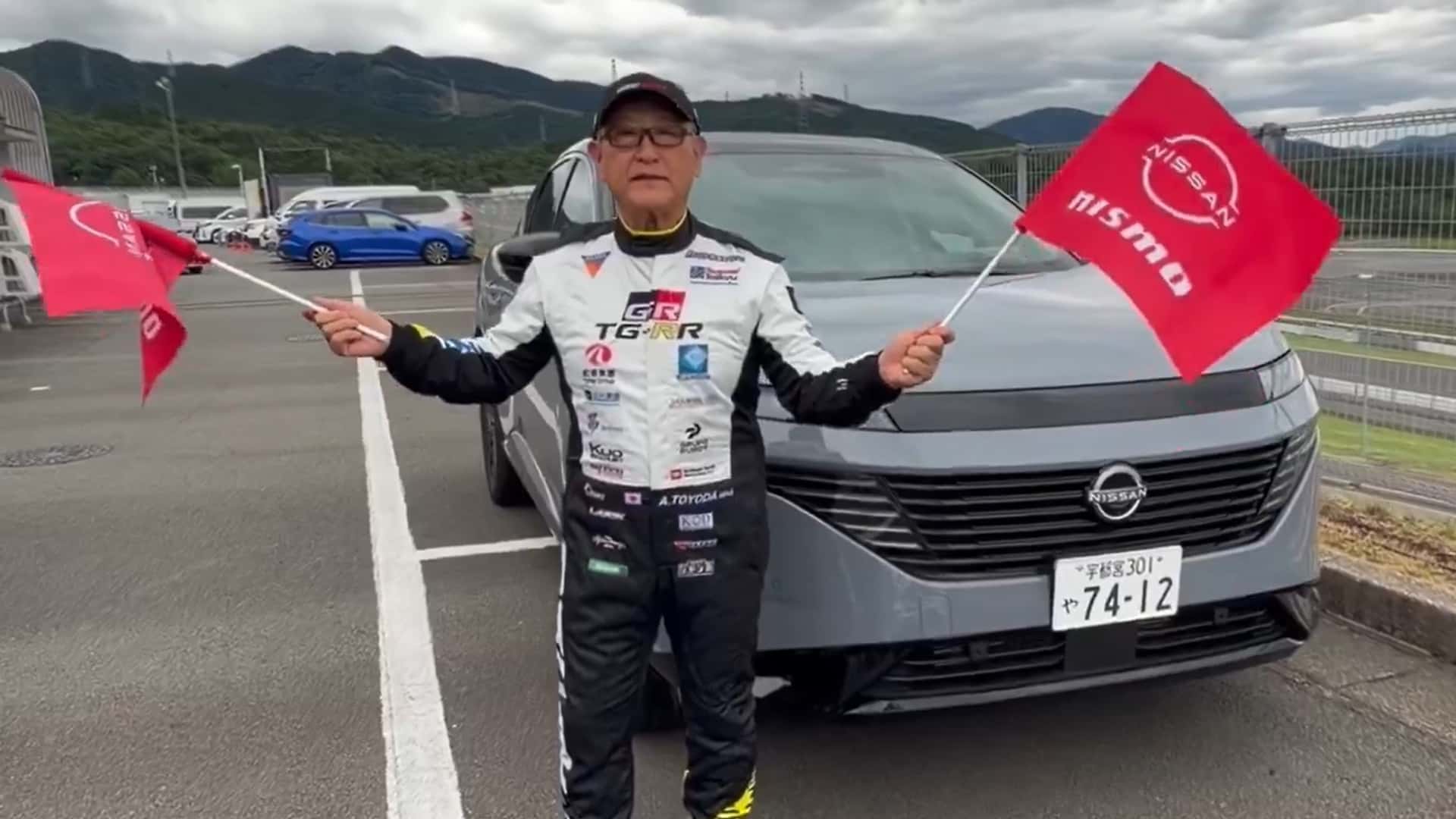
Akio Toyoda stood at Fuji Speedway last weekend, waving two Nissan flags with a Murano parked behind him, grinning like a man who knows exactly what he’s doing. Toyota Japan’s official X account posted the video. It went viral almost immediately.
This is an American-made car that we brought over to Japan,” Toyoda said, translated from Japanese. “I really hope our Japanese customers will use it, too. It’s the Nissan Murano!”
A chairman of the world’s largest automaker cheerfully promoting a direct competitor’s product on his own company’s social media channel. Try to imagine Mary Barra waving a Ford flag. Or Carlos Tavares — back when he had a job — plugging a Hyundai. It doesn’t happen. Except Toyoda has been doing this kind of thing for years, and the reason this time is more strategic than it appears.
The Murano plug ties directly to a new U.S.-Japan trade agreement that eliminates local crash-testing requirements for American-built vehicles entering Japan. Under the deal, cars manufactured in the United States will be deemed compliant with Japanese safety standards. Toyota is shipping its American-made Camry, Highlander, and Tundra east across the Pacific. Nissan plans to send Tennessee-built Muranos starting in early 2027.
Toyoda isn’t being charitable. He’s defending the framework that benefits Toyota most. Every time he publicly champions the arrangement — even using a rival’s product as the prop — he builds political goodwill for the trade pipeline his own company needs wide open. The Camry is the real play. The Murano is the costume.
There’s a practical wrinkle Toyoda conveniently glossed over. Nissan will export left-hand-drive Muranos to a country where traffic flows on the left side of the road. That’s a real ask for Japanese buyers accustomed to right-hand-drive vehicles.
Whether meaningful Murano volume materializes is an open question. But Toyoda doesn’t need Nissan to sell a single Murano to win here. He needs the trade channel to stay open and politically palatable in both Tokyo and Washington.
This isn’t the first time Toyoda has played the magnanimous competitor card. At the 2024 Tokyo Auto Show, he rolled his personal Suzuki Jimny onto Toyota’s own stand. He co-hosted a joint motorsport festival with Hyundai in South Korea.
He championed a three-way partnership with Mazda and Subaru on carbon-neutral combustion fuels. Every gesture reads as goodwill. Every gesture also happens to reinforce Toyota’s position at the center of the Japanese auto industry’s orbit.
The man turned 70 recently and still moves through the industry like a player-coach — showing up at endurance races, mugging for cameras, saying things other executives would never risk. He built Gazoo Racing from an internal passion project into a standalone performance brand. He has publicly argued that a full EV transition “isn’t the answer” and backed it up with billions in hybrid development that now looks prescient as competitors scramble to recalibrate their electrification timelines.
Waving a competitor’s flag is easy when you’re sitting on top. Toyota sold more than 11 million vehicles globally last year. Nissan is fighting for survival, having narrowly avoided a merger with Honda that collapsed earlier this year. The power imbalance makes Toyoda’s gesture generous and cost-free at the same time.
What makes this moment stick isn’t the flags. It’s the calculation underneath the smile. Toyoda understands something most automotive executives still haven’t figured out: the industry’s next decade won’t be won by the company that destroys its rivals. It’ll be won by the one that shapes the rules everyone else plays by. And right now, nobody is writing more of those rules than the guy cheerfully waving somebody else’s banner at Fuji Speedway.
Share this Story